

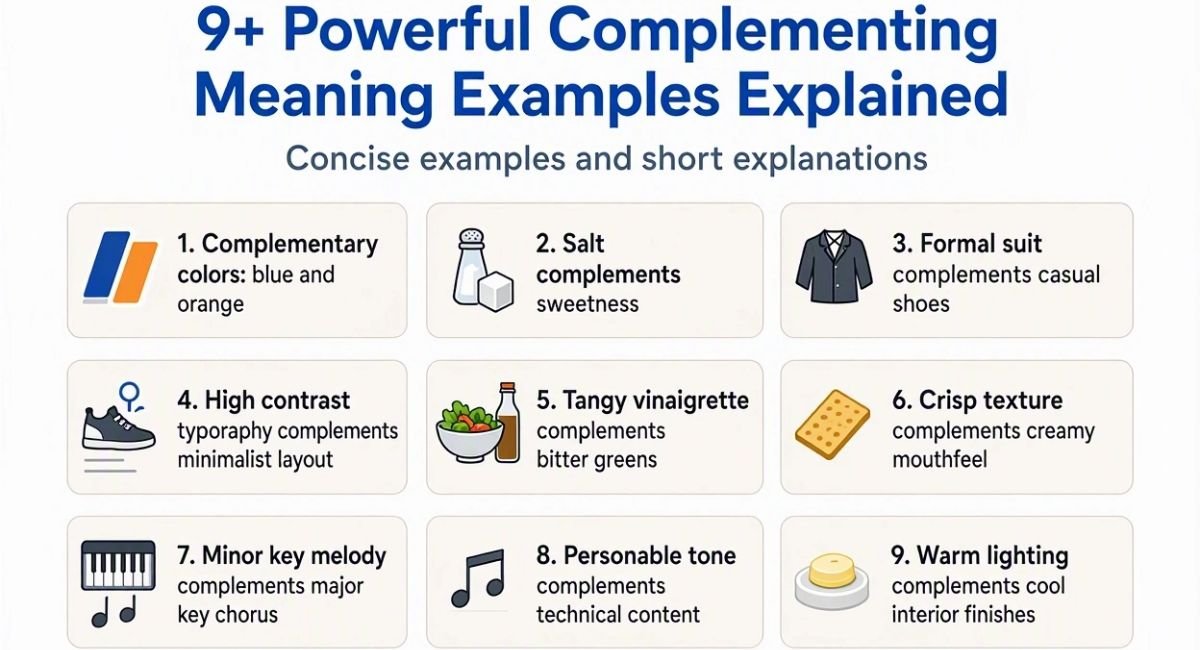
Understanding complementing meaning can help you use English more accurately in conversations, academic writing, emails, and everyday situations. The word complementing meaning describes the act of adding something that improves, completes, or works well with something else. For example, a blue tie may complement a gray suit, while fresh herbs can complement the flavor of a meal.
However, many English learners confuse complementing meaning with complimenting. These words sound almost identical, but their meanings are different. One describes how things work together, while the other refers to praising someone or something.
In this guide, you will discover the meaning of complementing, practical examples, useful synonyms, common grammar patterns, and simple tricks for remembering the difference between these confusing words.
What Is the Meaning of Complementing?
- Complementing meaning refers to adding something that improves, completes, balances, or enhances another thing. It often describes two or more elements that work well together.
- The word complementing meaningis the present participle or gerund form of the verb complement. Depending on the sentence, it can describe an ongoing action or function as a noun.
- When one thing complements another, both elements contribute to a better overall result. They do not necessarily have to be identical. In fact, their differences can make them more effective together.
- For example, a bright scarf can complement a simple outfit. The scarf adds color and visual interest, making the entire appearance more appealing.
- Similarly, a clear explanation can complement a detailed diagram. The explanation provides context, while the diagram makes complicated information easier to understand.
- In professional settings, complementary skills can help team members work together successfully. One person may be excellent at research, while another may excel at presenting the findings.
- In cooking, a sauce can complement a dish by balancing its flavors. In music, a soft piano melody can complement a singer’s voice.
- Therefore, the central idea behind complementing meaning is enhancement through combination. Something complements another element when it contributes to a more complete, balanced, or effective whole.
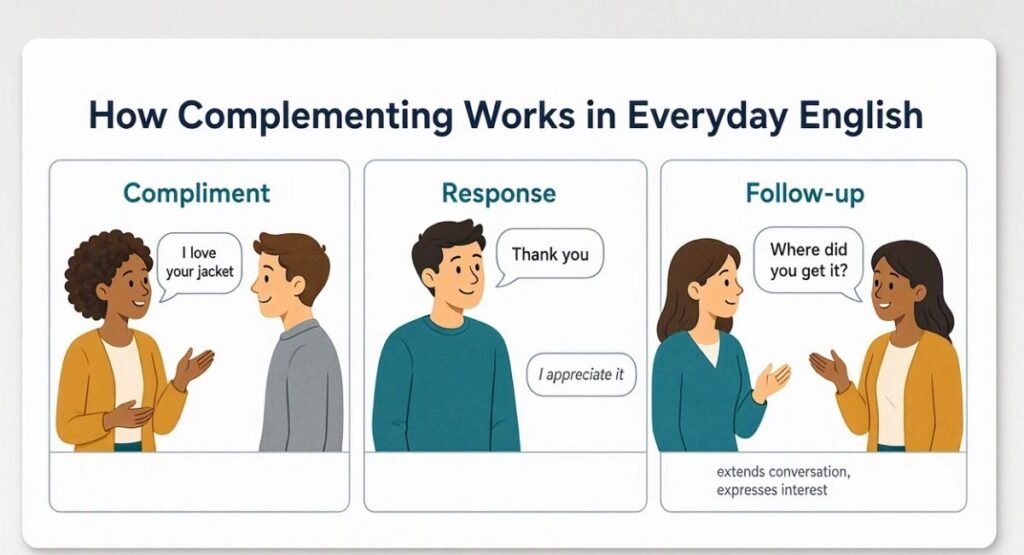
How Complementing Works in Everyday English
- English speakers use complementing meaning in many situations, including fashion, food, relationships, education, business, design, and communication.
- The exact meaning depends on the words surrounding it. However, the basic idea remains the same: one thing adds value to another.
Complementing in Fashion and Appearance
- A person might say, “Your shoes are complementing meaning your outfit beautifully.” This means the shoes work well with the clothing and improve its overall appearance.
- A patterned scarf may complement a plain coat by introducing texture and color. Likewise, neutral shoes can complement a brightly colored dress without distracting from it.
- In interior design, wooden furniture may complement a room’s warm color scheme. The materials and colors create a consistent visual effect.
Complementing in Food and Cooking
- Lemon juice can complement grilled fish by adding freshness and balancing rich flavors.
- Fresh basil may complement tomato sauce because the herb enhances the sauce’s aroma and taste.
- Similarly, a mild side dish can complement a spicy main course by providing contrast and balance.
Complementing in Education
- A practical activity can complement a theoretical lesson by helping students apply what they have learned.
- For example, classroom discussions complement textbook reading because students can explore ideas and ask questions.
- Educational videos may also complement written materials, especially when learners benefit from seeing a process demonstrated.
Complementing in Business
- Marketing and customer service can complement each other. Effective marketing attracts customers, while helpful service encourages satisfaction and loyalty.
- In addition, employees with different strengths can complement one another’s abilities. A creative designer and a detail-oriented editor may produce better results together.
- These examples show that complementing meaning is not limited to physical objects. It also describes how ideas, skills, activities, and people contribute to a shared outcome.

Nine Powerful Examples of Complementing Meaning
- The following examples explain how complementing works in different contexts. Each sentence includes a short explanation to make the meaning easier to remember.
Example 1: Clothing
- Sentence: Her silver necklace is complementing meaning her black evening dress.
- Meaning: The necklace adds elegance and works well with the dress.
- Why it works: The necklace and dress create a more attractive overall appearance when combined.
Example 2: Food
- Sentence: The lemon dressing is complementing meaningthe fresh vegetable salad.
- Meaning: The dressing improves the salad’s flavor.
- Why it works: Its acidity adds brightness and balances the other ingredients.
Example 3: Interior Design
- Sentence: The wooden shelves are complementing meaning the room’s neutral colors.
- Meaning: The shelves fit well with the room’s existing design.
- Why it works: The wood introduces warmth without clashing with the color scheme.
Example 4: Education
- Sentence: The teacher is complementing the lesson with practical exercises.
- Meaning: The exercises add value to the lesson.
- Why it works: Students can practice the ideas they learned during instruction.
Example 5: Business
- Sentence: The company’s online store is complementing meaning its physical retail locations.
- Meaning: The online store supports the company’s existing sales channels.
- Why it works: Customers can shop through different channels that serve different needs.
Example 6: Music
- Sentence: The violin is complementing meaning the singer’s gentle voice.
- Meaning: The violin enhances the musical performance.
- Why it works: The instrument adds melody and emotion without overpowering the singer.
Example 7: Technology
- Sentence: The new application is complementing meaning the company’s existing software.
- Meaning: The application adds useful functions to the current system.
- Why it works: The two tools serve related purposes and improve the overall workflow.
Example 8: Personal Skills
- Sentence: Her communication skills are complementing meaning his technical knowledge.
- Meaning: Their abilities work well together.
- Why it works: One person can explain ideas effectively while the other provides technical expertise.
Example 9: Writing
- Sentence: The photographs are complementing the article’s detailed explanations.
- Meaning: The images support and improve the written content.
- Why it works: Readers can understand the subject through both words and visuals.
Complementing vs. Complimenting: The Crucial Difference
- One of the most common English spelling mistakes involves complementing meaning and complimenting. Their similar pronunciation makes them easy to confuse, but their meanings are distinct.
- Complementing means improving, completing, or working well with something else.
- Complimenting means praising someone or expressing admiration for a quality, achievement, appearance, or action.
- For instance, “The curtains are complementing meaning the sofa” describes how two things work together. However, “She is complimenting the sofa’s design” means she is expressing praise for its appearance.
- The easiest way to distinguish them is to focus on the intended message. If something enhances another thing, choose complementing. If someone offers praise, choose complimenting.
Quick Comparison Table
| Word | Meaning | Example |
| Complement | To improve or complete something | This sauce complements the meal. |
| Complementing | Improving or working well with something | The colors are complementing each other. |
| Compliment | To praise someone or something | I gave her a compliment. |
| Complimenting | Expressing praise | He is complimenting her presentation. |
Easy Memory Tricks
- Complement = Complete: Both words contain the letters comple. Think of completing something or making it more effective.
- Compliment = Praise: Remember that a compliment is a kind remark about someone or something.
- Complementary colors: These are colors that work together according to a color relationship. In everyday descriptions, complementary colors can create an appealing contrast.
- Complimentary remarks: These are positive comments that express appreciation or admiration.
- Check the sentence: Ask whether the action involves improvement or praise. That simple question usually identifies the correct spelling.
Complementing as a Verb: Grammar and Sentence Structure
- Complementing comes from the verb complement. It can describe an action happening now, an activity in general, or a quality that helps another element work better.
- Correct usage depends on the sentence structure. Understanding a few common patterns makes the word easier to use confidently.
Pattern 1: Subject + Is/Are + Complementing + Object
- This structure describes an action that is happening now or around the present time.
- Example: “The new curtains are complementing the furniture.”
- Example: “Her experience is complementing meaning the team’s existing knowledge.”
- Example: “The background music is complementing meaning the presentation.”
Pattern 2: Complementing + Object as a Gerund
- A gerund is an -ing verb form that functions as a noun. In this pattern, complementing meaning describes an activity or process.
- Example: “Complementing the main dish with fresh vegetables improves the meal.”
- Example: “complementing meaning research with practical evidence can strengthen an argument.”
- Example: “Complementing classroom lessons with real-world examples helps students understand concepts.”
Pattern 3: Complementing Each Other
- This phrase describes two or more elements that work well together. It often appears when discussing colors, personalities, skills, or ideas.
- Example: “The two colors are complementing each other.”
- Example: “Their different personalities are complementing meaning each other.”
- Example: “The company’s design and engineering teams are complementing meaning each other.”
Pattern 4: Complementing Something With Something Else
- This pattern explains what is being enhanced and what is being added.
- Example: “The chef is complementing meaning the soup with fresh herbs.”
- Example: “The teacher is complementing the reading assignment with a short video.”
- Example: “The writer is complementing meaning the report with supporting statistics.”
Common Grammar Tip
- Although complementing is grammatically correct, English speakers do not always need the continuous form.
- Instead of saying, “The blue curtains are complementing meaning the white walls,” you can say, “The blue curtains complement the white walls.”
- The simple present often sounds more natural when describing a general relationship or a lasting feature.
- Use is complementing or are complementing meaning when emphasizing an ongoing action or a temporary situation.
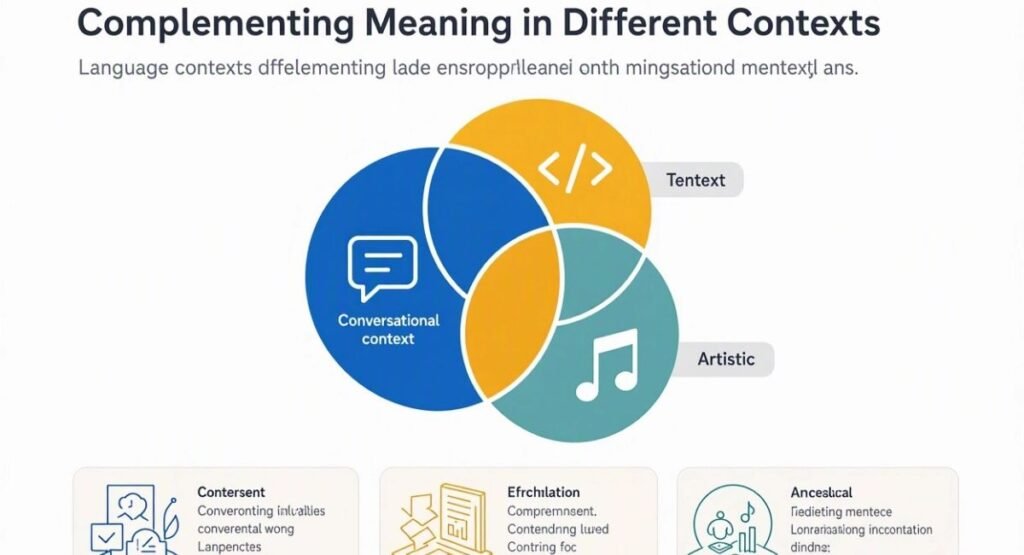
Complementing Meaning in Different Contexts
- A word can develop slightly different shades of meaning depending on the subject. Nevertheless, complementing consistently describes a helpful relationship between elements.
In Fashion and Personal Style
- Complementing clothing items create a coordinated appearance through color, shape, texture, or proportion.
- A brown belt may complement brown shoes, while a contrasting jacket can complement a simple outfit by adding visual interest.
- However, complementary items do not have to match perfectly. Sometimes, a thoughtful contrast produces a more interesting result.
In Art and Graphic Design
- Designers use complementary elements to create balance, emphasis, and visual harmony.
- A bold headline may complement a clean layout, while illustrations can complement written information.
- In color theory, complementary colors occupy opposite positions on a traditional color wheel. Their contrast can make a design appear more vivid.
- Designers should still consider accessibility, readability, and the intended audience. A visually striking combination may not always provide enough contrast for readable text.
In Relationships
- People may describe two personalities as complementing meaning each other when their strengths and differences support a healthy partnership.
- One person might enjoy planning, while the other brings spontaneity. Together, they may approach situations from different but useful perspectives.
- However, complementing meaning personalities does not mean that partners must be opposites. Shared values, communication, and mutual respect remain important.
In Science and Research
- Complementing evidence strengthens an explanation when different findings support the same conclusion.
- For example, laboratory results may complement observations from field research.
- Similarly, qualitative interviews can complement quantitative statistics by explaining the experiences behind numerical patterns.
- Researchers should still evaluate the reliability of each source. Evidence does not become accurate simply because it fits another finding.
In Technology
- Different technologies can complement each other when they perform connected functions.
- For example, a calendar application may complement a project management platform by helping users coordinate schedules and deadlines.
- A security system may complement data backups by addressing a different aspect of digital protection.
- The relationship works best when the tools integrate effectively and do not introduce unnecessary complexity.
Complementing vs. Completing: Are They the Same?
- Complementing and completing are related in some situations, but they are not interchangeable in every sentence.
- Completing means finishing something or bringing it to its required endpoint.
- complementing meaning means enhancing something, contributing to it, or making it work better with another element.
- For example, “She is completing the assignment” means she is finishing the work. However, “She is complementing the assignment with additional research” means she is adding information that improves it.
When to Use Completing
- Use completing when a task reaches its finish.
- Example: “He is completing the final chapter.”
- Example: “They are completing the application form.”
- Example: “The construction team is completing the building.”
When to Use Complementing
- Use complementing when an additional element enhances or supports another.
- Example: “The photographs are complementing meaning the chapter.”
- Example: “The new software is complementing the existing system.”
- Example: “The fresh herbs are complementing meaning the dish.”
A Simple Test
- If the sentence means finishing, use completing.
- If the sentence means enhancing or working well with, use complementing.
- If the sentence means praising, use complimenting.
- These three meanings cover many common situations in which English learners struggle to select the right word.
Useful Synonyms for Complementing
- Synonyms can help you express the idea more precisely. However, each alternative has a slightly different meaning, so choose the word that fits your context.
Enhancing
- Meaning: Improving the quality, value, or effect of something.
- Example: “The lighting is enhancing the room’s appearance.”
- Use this word when the main idea is making something better.
Improving
- Meaning: Making something better than it was before.
- Example: “The additional examples are improving the lesson.”
- This is a broad, straightforward alternative for everyday English.
Supporting
- Meaning: Helping something succeed, remain effective, or become stronger.
- Example: “The research is supporting the main argument.”
- Use supporting when the emphasis is on assistance rather than appearance or balance.
Balancing
- Meaning: Creating a suitable relationship between different elements.
- Example: “The acidity is balancing the sweetness of the dessert.”
- This word works especially well in cooking, design, and discussions of opposing qualities.
Matching
- Meaning: Having qualities that fit or correspond with something else.
- Example: “The shoes are matching the color of the handbag.”
- Matching often describes similarity, whereas complementing meaning can involve useful differences.
Enriching
- Meaning: Adding depth, interest, or value.
- Example: “The historical examples are enriching the discussion.”
- Use this alternative when additional information or experiences make something more meaningful.
Completing
- Meaning: Supplying what is missing or bringing something to a finished state.
- Example: “The final paragraph is completing the report.”
- Remember that completing may suggest finishing, while complementing meaning usually emphasizes enhancement.
Harmonizing
- Meaning: Bringing elements into agreement or creating a pleasing relationship.
- Example: “The colors are harmonizing with the room’s furniture.”
- This word is especially useful for music, design, and coordinated arrangements.
Strengthening
- Meaning: Making something more effective, convincing, or resilient.
- Example: “The additional evidence is strengthening the conclusion.”
- Use it when the added element increases effectiveness or credibility.
Working Well With
- Meaning: Functioning effectively alongside another element.
- Example: “Her leadership style is working well with the team’s creative approach.”
- This natural phrase can be easier for beginners than a formal synonym.
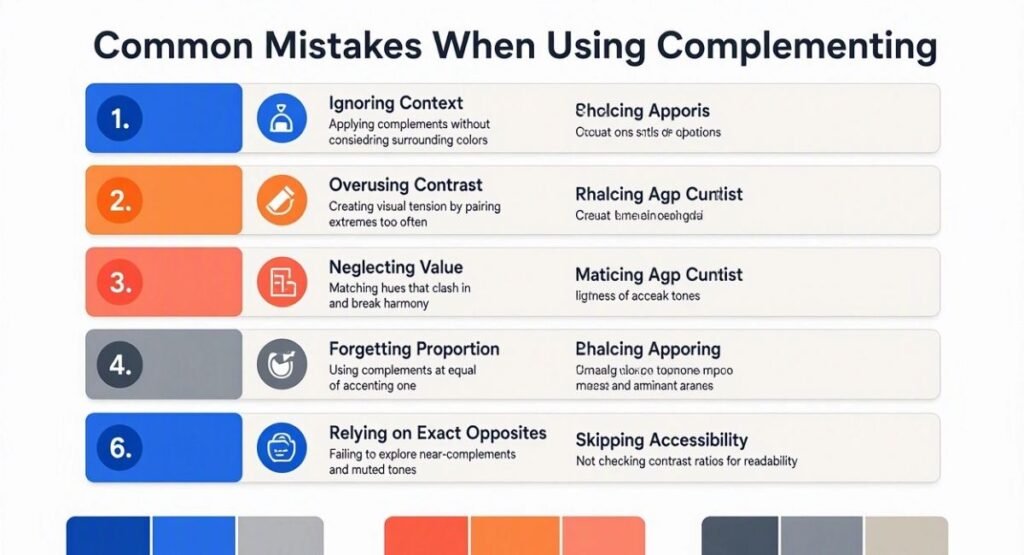
Common Mistakes When Using Complementing
- English learners often confuse similar words or use grammatical patterns that sound unnatural. The following mistakes are worth avoiding.
Mistake 1: Using Complementing When You Mean Complimenting
- Incorrect: “I am complementing your excellent work.”
- Correct, if you mean praise: “I am complimenting you on your excellent work.”
- Explanation: Complimenting expresses admiration. complementing meaning means contributing to or enhancing something.
Mistake 2: Assuming Complementing Means Matching Exactly
- Incorrect assumption: “These shoes do not match the dress, so they cannot complement it.”
- Better understanding: Shoes can complement a dress through contrast, texture, or style, even when their colors differ.
- Explanation: complementing meaning involves a useful or pleasing relationship, not necessarily an identical appearance.
Mistake 3: Using an Unnatural Continuous Form
- Less natural for a permanent fact: “Water is complementing meaning the body’s basic needs.”
- More natural: “Water complements the body’s basic needs.”
- Explanation: The simple present is often better for general truths and established relationships.
Mistake 4: Confusing Complementing With Completing
- Incorrect for the intended meaning: “The colorful border is completing the wall’s design,” if the writer specifically means it enhances the design.
- More precise: “The colorful border is complementing the wall’s design.”
- Explanation: Choose completing for finishing and complementing meaning for enhancement.
Mistake 5: Forgetting the Object
- Unclear: “The new colors are complementing.”
- Clearer: “The new colors are complementing meaning the furniture.”
- Explanation: The verb often takes an object that identifies what is being enhanced. However, context may make the object unnecessary in some constructions.
Mistake 6: Assuming Complementary Always Means Identical
- Incorrect assumption: “Complementary skills must be the same.”
- Better understanding: Complementary skills often differ but work effectively together.
- Explanation: A researcher and a presenter can have different strengths that support the same project.
Is Free Food Complimentary or Complementary?
- Free food is usually described as complimentary food. In this context, complimentary means provided free of charge.
- For example, a hotel may offer complimentary breakfast to its guests. An airline might provide complimentary snacks during a flight.
- Complementary food would mean food that goes well with another dish or contributes to a balanced combination.
- Consider these examples:
- “The hotel offers complimentary coffee in the lobby.” This means the coffee is free.
- “The salad provides a complementary flavor to the main course.” This means the salad works well with the meal.
- “The restaurant offers complimentary dessert with selected meals.” This means customers receive the dessert without an additional charge.
- “The chef selected complementary ingredients for the sauce.” This means the ingredients work well together.
- The distinction is important for menus, advertisements, travel information, and hospitality businesses. If you mean free of charge, use complimentary. If you mean enhancing another element, use complementary.
Is a Gift Complimentary or Complementary?
- A gift described as complimentary is generally offered free of charge, often as part of a service, purchase, or special promotion.
- For example, a shop may offer a complimentary gift to customers who spend a certain amount.
- A complementary gift, by contrast, would be a gift that works well with another gift or completes a collection.
- Consider the following examples:
- “The hotel provides a complimentary welcome gift.” The gift is included at no extra cost.
- “The matching notebook is a complementary gift to the pen set.” The notebook goes well with the pen set.
- “Customers receive a complimentary sample with every purchase.” The sample is free.
- “The second book is complementary to the first.” The second book adds to the first book’s subject or collection.
- In everyday commercial writing, complimentary gift is the usual phrase when emphasizing that customers do not have to pay for it.
Complementing Meaning in Professional Writing
- In professional communication, complementing can describe how different services, skills, documents, or strategies support each other.
- The word is particularly useful when explaining teamwork, product features, business operations, and organizational strengths.
In Business Emails
- Example: “Our customer support team is complementing the sales department’s efforts.”
- Meaning: The customer support team is helping the sales department achieve better results.
- Example: “The attached report complements the figures discussed in yesterday’s meeting.”
- Meaning: The report adds useful information to the figures already discussed.
In Reports
- Example: “The survey results complement the findings from our customer interviews.”
- Meaning: Both sources contribute useful information to the overall analysis.
- Example: “The proposed training program will complement the company’s existing development initiatives.”
- Meaning: The new program will support the current training activities.
In Presentations
- Example: “The charts complement the presentation by making the data easier to understand.”
- Meaning: The charts improve the audience’s understanding of the information.
- Example: “The speaker’s examples complement the theoretical discussion.”
- Meaning: The examples make the theory more practical and accessible.
In Marketing
- Example: “The new service complements our existing product range.”
- Meaning: The service adds value to the products the company already offers.
- Example: “The campaign’s visuals complement the brand’s established identity.”
- Meaning: The visual elements fit well with the brand’s overall presentation.

Complementing Meaning for English Learners
- English learners can understand complementing more easily by connecting it to familiar objects and situations.
- Instead of memorizing a complicated definition, imagine two things that become more useful or appealing when used together.
Beginner-Friendly Examples
- A lid complements a container by helping it close.
- A pillow complements a bed by adding comfort.
- A picture complements a wall by adding decoration.
- A handle complements a cup by making it easier to hold.
- A clear example complements an explanation by making the idea easier to understand.
Intermediate Examples
- A practical workshop complements a theoretical course.
- A strong introduction complements a well-organized essay.
- A flexible schedule complements a demanding workload.
- A thoughtful soundtrack complements a film’s emotional scenes.
- A detailed user guide complements a complicated software application.
Advanced Examples
- The qualitative findings complement the quantitative analysis by explaining patterns in the data.
- The company’s distribution network complements its manufacturing capabilities.
- The proposed legislation complements existing policies by addressing a related concern.
- The researcher’s observations complement the experimental results.
- The design’s restrained typography complements its bold visual imagery.
- These examples demonstrate that complementing works across many levels of English. As your vocabulary develops, you can use the word in both everyday and professional contexts.
How to Remember Complementing in Five Simple Steps
- Step 1: Focus on improvement. Ask whether one thing makes another more complete, balanced, attractive, or effective.
- Step 2: Think of the word complete. The spelling of complement contains a helpful reminder of completion and enhancement.
- Step 3: Separate praise from enhancement. If someone says something nice, use compliment. If something works well with another thing, use complement.
- Step 4: Read the entire sentence. The surrounding words often reveal the intended meaning more clearly than pronunciation alone.
- Step 5: Practice with everyday objects. Write sentences about clothing, meals, furniture, lessons, or technology. Familiar examples make the distinction easier to remember.
- For additional practice, create three sentences each day using complement, complementing, and complimenting. Compare their meanings and check whether each sentence expresses the idea you intended.
Quick Practice: Test Your Understanding
- Choose the correct word in each sentence. The answers appear below the questions.
Question 1
- The blue curtains are ______ the white walls.
- Options: complementing / complimenting
Question 2
- She is ______ her colleague on the successful presentation.
- Options: complementing / complimenting
Question 3
- The hotel provides ______ drinks to its guests.
- Options: complementary / complimentary
Question 4
- The photographs are ______ the written instructions.
- Options: complementing / complimenting
Question 5
- The final chapter ______ the information presented earlier.
- Options: complements / compliments
Answers and Explanations
- Answer 1: Complementing. The curtains work well with the walls.
- Answer 2: Complimenting. She is expressing praise for her colleague.
- Answer 3: Complimentary. The drinks are provided free of charge.
- Answer 4: Complementing. The photographs improve or support the instructions.
- Answer 5: Complements. The chapter adds useful information to the earlier material.
- Review the explanations whenever you make a mistake. Understanding why an answer is correct will help you apply the same rule in new situations.
Complementing and Complementary: Understanding the Word Family
- The word complement has several related forms. Learning these forms helps you recognize the word in different types of sentences.
Complement
- Part of speech: Noun or verb.
- As a noun, a complement is something that completes or enhances another thing.
- Example: “The final section is a useful complement to the report.”
- As a verb, complement means to enhance or work well with something.
- Example: “The illustrations complement the text.”
Complementing
- Part of speech: Present participle or gerund.
- It describes the act of enhancing, supporting, or working well with something.
- Example: “The illustrations are complementing the text.”
- Example: “Complementing the report with charts makes the findings clearer.”
Complementary
- Part of speech: Adjective.
- It describes things that work well together or provide related benefits.
- Example: “The two courses offer complementary skills.”
- Example: “The restaurant serves complementary side dishes with the main course.”
- Remember that complementary does not automatically mean free. The context determines whether the word describes a useful relationship or another specialized meaning.
Complemented
- Part of speech: Past tense or past participle of complement.
- Example: “The new curtains complemented the room’s furniture.”
- Example: “The presentation was complemented by detailed charts.”
- This form is useful when describing a relationship or enhancement that occurred in the past.
Complimentary
- Part of speech: Adjective.
- It can mean expressing praise or provided free of charge.
- Example: “She wrote a complimentary review.”
- Example: “Guests received complimentary breakfast.”
- The spelling resembles complementary, but the meaning is different. Checking the intended meaning prevents common errors.
FAQs
1. What does complementing meaning refer to?
Complementing meaning refers to the act of improving, completing, or enhancing something by adding an element that works well with it. For example, a scarf may complement an outfit, while a diagram may complement a written explanation. The central idea is that the elements contribute to a better overall result.
2. What does the word complement mean?
The word complement means something that completes, improves, or works well with another thing. It can function as a noun or a verb. For example, “The illustrations complement the article” means the illustrations support and improve the written content.
3. What does it mean to compliment someone?
To compliment someone means to express praise or admiration for that person’s appearance, ability, achievement, or behavior. For example, “I complimented my friend on her presentation.” The word compliment relates to praise, whereas complement relates to enhancement or completion.
4. Is free food complimentary or complementary?
Free food is usually called complimentary food. The word complimentary means provided without charge. For example, a hotel may offer complimentary breakfast. By contrast, complementary food describes food that works well with another dish or helps create a balanced meal.
5. Is a gift complimentary or complementary?
A gift offered free of charge is generally called a complimentary gift. A complementary gift is something that pairs well with another gift or adds to an existing collection. Therefore, the correct word depends on whether you mean free or well suited to something else.
6. What is the difference between complementing and complimenting?
Complementing means enhancing, supporting, or working well with something. Complimenting means expressing praise. For example, “The shoes are complementing the dress” describes how the items work together. “She is complimenting the dress” means she is praising its appearance.
7. What is another word for complementing?
Possible alternatives include enhancing, improving, supporting, balancing, enriching, and harmonizing. The best choice depends on the sentence. For example, enhancing emphasizes improvement, while balancing highlights the relationship between different elements.
8. How do you use complementing in a sentence?
Use complementing when describing something that enhances or works well with another element. For example, “The fresh flowers are complementing the room’s elegant design.” You can also use it as a gerund, as in “Complementing the lesson with examples helps students understand the topic.”
Conclusion
Understanding complementing meaning makes it easier to communicate clearly in everyday English, professional writing, education, and creative work. The word describes how one thing enhances, supports, or works well with another.
Remember the essential difference: complementing means enhancing or completing, while complimenting means expressing praise. Similarly, complimentary often means free of charge, whereas complementary describes things that work well together.
Use the examples, grammar patterns, synonyms, and practice questions in this guide to strengthen your vocabulary. With regular practice, you can choose the correct word confidently and avoid one of English’s most common spelling mistakes.
Meta Description: Discover complementing meaning with 9 clear examples, simple grammar rules, synonyms, and the difference between complementing and complimenting.

2 thoughts on “9+ Powerful Complementing Meaning Examples Explained”