

When searching for stigmatism vs astigmatism, many people want to know which spelling is correct and whether both words describe the same eye condition. The confusion is understandable because the terms sound similar, especially when spoken quickly. However, there is an important distinction between the commonly searched word stigmatism vs astigmatism and the recognized eye condition called astigmatism.
stigmatism vs astigmatism is a common refractive error that can cause blurred or distorted vision. It occurs when the cornea or the lens inside the eye has a shape that prevents light from focusing properly on the retina. By contrast, stigmatism is not the standard medical name for this vision condition.
Stigmatism vs Astigmatism: What Is the Correct Term?
- Astigmatism is the correct medical term for a common focusing problem that affects vision.
- Stigmatism is often used as a misspelling or shortened version of stigmatism vs astigmatism when people search for information about blurry eyesight.
- The prefix a- in stigmatism vs astigmatism is part of the established medical word. Removing it changes the spelling and does not produce the standard name for this eye condition.
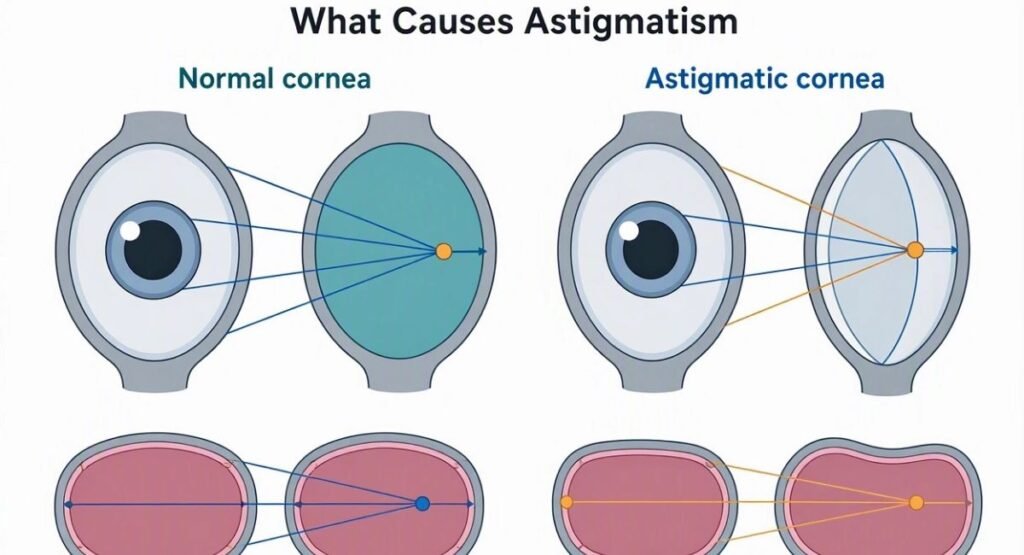
- stigmatism vs astigmatism occurs when the cornea or the eye’s internal lens has an uneven curvature. As a result, light does not focus into one sharp image on the retina.
- People with stigmatism vs astigmatism may notice blurred vision, eye strain, headaches, or difficulty seeing clearly at night. However, mild cases may cause no noticeable symptoms.
- The condition can affect children and adults. Some people have it from birth, while others develop it during childhood or later in life.
- If you typed stigmatism vs astigmatism into a search engine, you probably intended to learn about astigmatism. The medical information in this article therefore focuses on the recognized eye condition.
What Does Astigmatism Actually Mean?
- Astigmatism is a type of refractive error, meaning the eye does not focus incoming light correctly onto the retina.
- In an eye without significant astigmatism, the cornea has a relatively even curvature. With astigmatism, its curvature differs between directions, or the internal lens contributes to uneven focusing.
- Imagine looking through a surface that curves differently across its width and height. Light may focus at different points rather than forming one crisp image.
- Consequently, objects can appear blurry, stretched, shadowed, or distorted. The effect depends on the degree and pattern of astigmatism.
- Astigmatism can occur alongside nearsightedness (myopia) or farsightedness (hyperopia). These conditions affect how the eye focuses light, but they are not identical problems.
- A person may have mild stigmatism vs astigmatism and see comfortably without correction. Another person may need prescription lenses to read, drive, study, or work comfortably.
- The only reliable way to determine whether you have stigmatism vs astigmatism is through an appropriate eye examination. Symptoms alone cannot confirm the diagnosis.
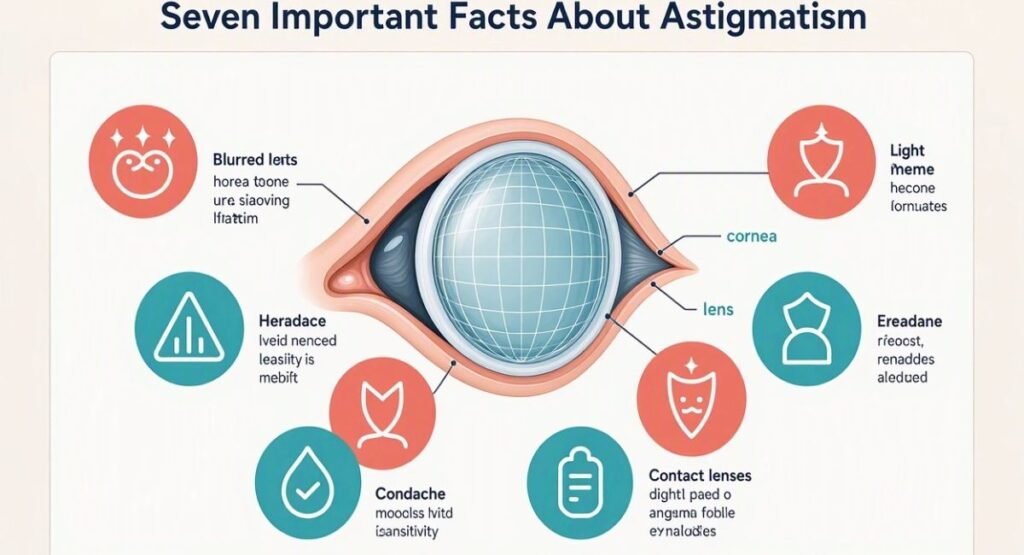
Seven Important Facts About Astigmatism
- Fact 1: It is common. Astigmatism affects people across different age groups and may occur alongside other refractive errors.
- Fact 2: It can affect near and distance vision. Some people notice problems reading, while others struggle to see road signs clearly.
- Fact 3: Both eyes do not have to be affected equally. One eye may have more stigmatism vs astigmatism than the other.
- Fact 4: It can be present from childhood. Some children are born with astigmatism, while others develop it as their eyes grow.
- Fact 5: Mild cases may go unnoticed. A person can have stigmatism vs astigmatism without experiencing obvious vision problems.
- Fact 6: Correction is available. Prescription glasses, suitable contact lenses, and selected surgical procedures can help improve vision.
- Fact 7: An eye examination matters. Blurred vision can have several causes, so a professional assessment is important before choosing treatment.
Common Symptoms That May Indicate Astigmatism
- Blurred vision: Objects may appear unclear at close distances, far distances, or both.
- Distorted images: Straight lines may appear less distinct, and letters may seem stretched or shadowed.
- Frequent squinting: You may squint while reading signs, looking at a screen, or trying to focus on distant objects.
- Headaches: Some people experience headaches after prolonged visual tasks, particularly when their eyes struggle to focus.
- Eye strain: Reading, studying, or using a computer may leave the eyes feeling tired or uncomfortable.
- Night vision difficulties: Bright lights may appear to have glare, halos, or streaks. These symptoms can have causes other than astigmatism, too.
- Difficulty reading: Words may look unclear, especially during extended reading sessions or when the prescription needs updating.
- Reduced visual comfort: You may find yourself changing your viewing distance or repeatedly adjusting your glasses to see clearly.
Not everyone experiences all these symptoms. In addition, similar problems can arise from other eye conditions, so a proper examination is necessary.
|What Causes Astigmatism?
- Natural eye shape: Differences in the curvature of the cornea or lens can prevent light from focusing evenly.
- Genetics: Astigmatism can run in families, although family history does not determine every person’s vision.
- Growth and development: The condition may be present at birth or become noticeable as the eyes develop.
- Eye injury: Certain injuries can change the shape or structure of the cornea and affect how light enters the eye.
- Previous eye surgery: Some procedures can change corneal curvature and may cause or alter astigmatism.
- Corneal conditions: Diseases such as keratoconus can change the shape of the cornea and affect vision.
- Other refractive errors: stigmatism vs astigmatism often occurs alongside nearsightedness or farsightedness, although these conditions have different optical characteristics.
Every case is different. Eye specialists can assess the likely cause and determine whether additional examination is needed.
How Astigmatism Affects Everyday Vision
- Reading: Text may look blurred or uncomfortable to focus on, especially when the prescription does not adequately correct the refractive error.
- Computer work: Long periods of screen use may reveal existing focusing difficulties or contribute to eye discomfort.
- Driving: Blurred distance vision or glare around headlights can make driving less comfortable, particularly at night.
- School activities: Children with uncorrected vision problems may struggle to see classroom displays or read printed material.
- Sports: Difficulty tracking fast-moving objects may affect comfort and performance during certain activities.
- Recognizing faces: People may find it harder to identify faces or details at a distance when their vision is unclear.
- Daily tasks: Activities such as cooking, sewing, reading labels, or using small tools may become more difficult if vision is not adequately corrected.
stigmatism vs astigmatism does not affect everyone in the same way. The degree of refractive error, other vision conditions, and the effectiveness of any correction all influence everyday experiences.
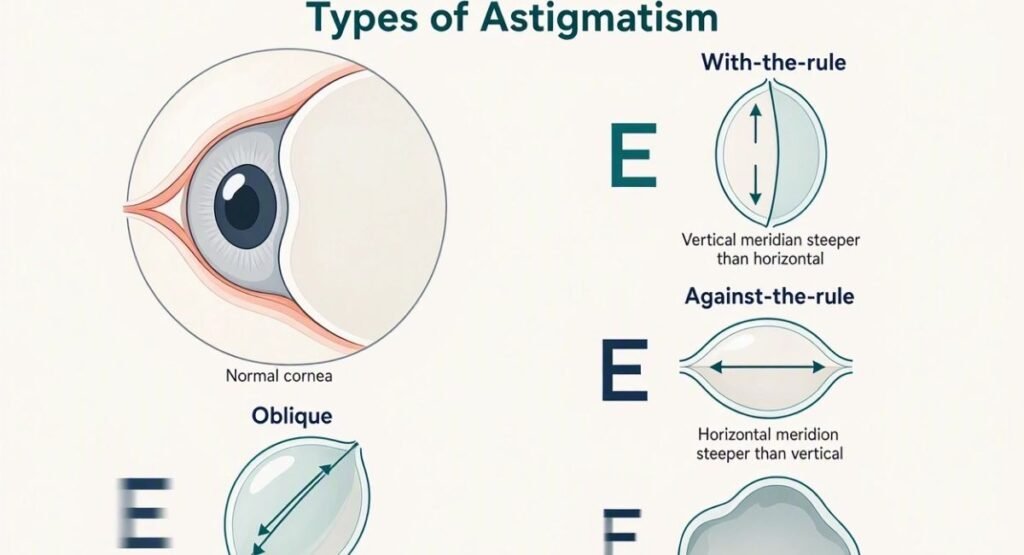
Types of Astigmatism Explained Simply
Eye specialists classify stigmatism vs astigmatism according to how it affects focusing and the shape of the cornea or lens. The following categories describe common clinical patterns.
Corneal Astigmatism
- Corneal stigmatism vs astigmatism occurs when the cornea has different curvatures in different directions.
- Because the cornea plays a major role in focusing light, differences in its shape can produce blurred or distorted images.
- An eye specialist may measure corneal curvature to understand this type of astigmatism.
Lenticular Astigmatism
- Lenticular stigmatism vs astigmatism occurs when the eye’s internal lens contributes to uneven focusing.
- The cornea may not be the only source of astigmatism; the lens can also affect how light reaches the retina.
- A comprehensive examination helps determine the factors contributing to a person’s prescription.
Myopic Astigmatism
- Myopic stigmatism vs astigmatism combines astigmatism with nearsightedness.
- Depending on the degree of refractive error, distant objects may appear blurry because of the combined focusing effects.
- Corrective lenses can be prescribed to address the relevant refractive components.
Hyperopic Astigmatism
- Hyperopic astigmatism combines stigmatism vs astigmatism with farsightedness.
- Some people may experience difficulty focusing comfortably, especially during close work.
- The appropriate prescription depends on the individual’s examination results and visual needs.
Mixed Astigmatism
- Mixed stigmatism vs astigmatism occurs when the principal focusing directions have different refractive errors, with one myopic and the other hyperopic.
- This is a more specific clinical classification rather than a separate disease.
- An eye-care professional can explain the type identified in your prescription.
Regular and Irregular Astigmatism
- Regular astigmatism: The principal curvatures follow a more consistent pattern and can often be corrected with standard cylindrical lenses.
- Irregular astigmatism: The curvature varies in a more complex way, so ordinary glasses may not fully correct the resulting visual distortion.
- Some people with irregular stigmatism vs astigmatism benefit from specialized contact lenses. The most appropriate option depends on the underlying cause and corneal condition.
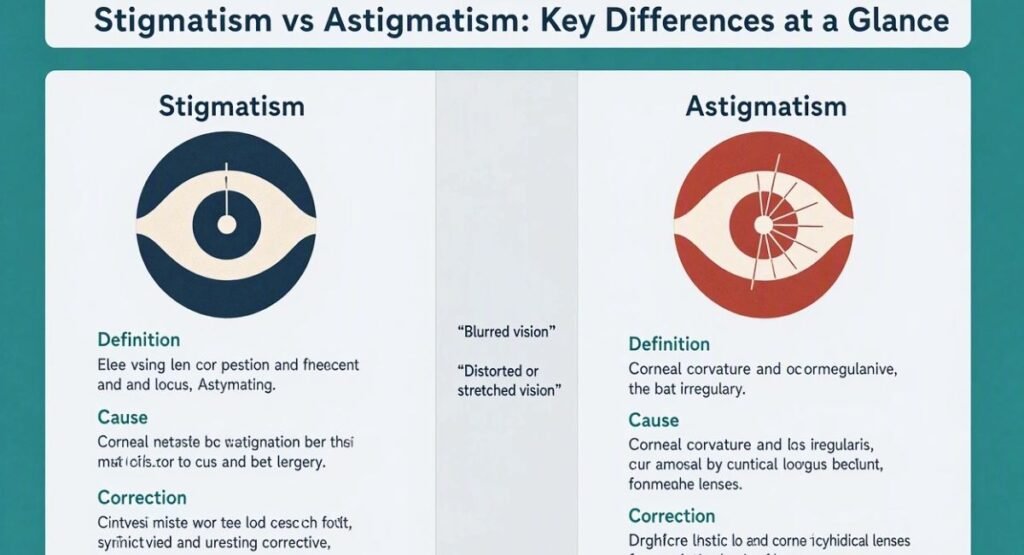
Stigmatism vs Astigmatism: Key Differences at a Glance
The following table summarizes the distinction between the commonly searched spelling and the recognized medical term.
| Feature | Stigmatism | Astigmatism |
| Standard eye-care term | No, not for this condition | Yes |
| Common usage online | Often a spelling mistake or mistaken shorthand | Established medical terminology |
| Refers to a recognized refractive error | Not as the standard name for this condition | Yes |
| Related to blurred vision | People often intend to ask about astigmatism | Can cause blurred or distorted vision |
| Used in eye prescriptions | Not the standard diagnostic term | Yes |
| Correct term for medical information | Use astigmatism | Use astigmatism |
Main takeaway: If you are discussing a vision problem caused by uneven focusing, stigmatism vs astigmatism is the appropriate term.- If you see stigmatism vs astigmatism in an informal article or search query, check whether the writer actually means astigmatism.
- Avoid treating the two spellings as interchangeable medical diagnoses. Accurate terminology helps readers find reliable eye-health information.
How Doctors Diagnose Astigmatism
- Visual acuity test: You read letters or symbols from a chart to assess how clearly you can see at a particular distance.
- Refraction test: The eye-care professional compares different lens strengths to determine which prescription improves your vision.
- Keratometry: An instrument measures the curvature of the cornea and helps identify differences in its shape.
- Corneal topography: When needed, a specialized device maps the corneal surface in greater detail.
- Comprehensive eye examination: The clinician evaluates your vision and checks for other eye problems that may affect your symptoms.
- Prescription assessment: The results help determine whether you need corrective lenses and what type of correction may suit your eyes.
Most routine tests are straightforward. Your clinician will explain any additional examination that may be necessary based on your symptoms or findings.
Treatment Options for Astigmatism
Treatment depends on the severity of the refractive error, your visual needs, and the overall health of your eyes. Mild astigmatism may not require correction if it does not affect vision.
Prescription Eyeglasses
- Corrective lenses: Glasses can compensate for uneven focusing and improve visual clarity.
- Cylindrical correction: stigmatism vs astigmatism prescriptions commonly include a cylinder value and an axis that describe the required correction.
- Everyday convenience: Glasses are noninvasive and can be suitable for reading, studying, driving, and other activities.
- Prescription updates: If your vision changes, an eye-care professional can check whether your current glasses remain appropriate.
Contact Lenses
- Toric contact lenses: These lenses are designed to correct stigmatism vs astigmatism and maintain the necessary orientation on the eye.
- Specialty lenses: Certain cases, particularly some forms of irregular astigmatism, may benefit from rigid gas-permeable or scleral lenses.
- Professional fitting: The right lens depends on your prescription, corneal shape, comfort, and eye health.
- Safe hygiene: Wash your hands, follow the recommended cleaning instructions, and avoid sleeping in contact lenses unless your eye-care professional specifically advises that your prescribed lenses are suitable for it.
Laser Eye Surgery
- LASIK: This procedure reshapes the cornea to correct selected refractive errors, including some cases of astigmatism.
- PRK: Photorefractive keratectomy is another laser procedure that can correct suitable refractive errors.
- Eligibility assessment: Not everyone is a suitable candidate. Corneal thickness, eye health, prescription stability, and other factors matter.
- Potential risks: Surgery can cause side effects or complications, so an ophthalmologist should discuss the benefits, limitations, and alternatives.
Orthokeratology
- Special contact lenses: Orthokeratology uses specially designed rigid lenses, generally worn overnight under professional supervision, to temporarily reshape the corneal surface.
- Temporary effect: The improvement in vision is not permanent, and the effect usually needs maintenance.
- Care requirements: These lenses require careful fitting, monitoring, and hygiene because contact lens wear carries a risk of eye infection.
- Professional advice: Suitability varies, so discuss the risks and expected benefits with an eye-care specialist.
Choosing the Right Option
- Ask an eye-care professional to explain your prescription and the degree of astigmatism.
- Consider your daily activities, comfort, budget, and willingness to maintain glasses or contact lenses.
- Discuss surgery only after a proper assessment of eligibility and potential risks.
- Arrange follow-up examinations if your vision changes or your current correction stops working well.
Can Astigmatism Be Prevented?
- stigmatism vs astigmatism often relates to the natural shape of the cornea or lens. In many cases, there is no established way to prevent it.
- Reading in dim light, watching television, and using digital screens are not established causes of astigmatism.
- Healthy visual habits can still improve comfort during daily activities, even though they do not eliminate the underlying refractive error.
- Take regular breaks during prolonged screen use if your eyes feel tired.
- Use appropriate lighting when reading or completing close work.
- Arrange routine eye examinations, especially for children and anyone experiencing changes in vision.
- Follow your eye-care professional’s instructions for glasses, contact lenses, and prescribed treatments.
These habits support eye comfort and help identify problems, but they should not be When Should You See an Eye-Care Professional?
- Arrange an eye examination if you experience persistent blurred vision, recurring headaches during visual tasks, or difficulty seeing clearly.
- Book an assessment if your glasses no longer provide clear vision or your current contact lenses become uncomfortable.
- Children should receive appropriate vision checks because they may not recognize or report blurry eyesight.
- Seek prompt medical attention for sudden vision loss, a sudden major change in vision, severe eye pain, or new flashes and numerous floaters.
- Sudden visual symptoms should not automatically be attributed to astigmatism. They may indicate a different problem that needs urgent assessment.
- If you are unsure whether your symptoms are serious, contact an eye-care professional or local urgent medical service for guidance.
Important: This article provides general educational information and does not replace a professional examination or individualized medical advice.
Common Myths About Astigmatism
- Myth: Astigmatism always causes severe blurry vision. Mild cases may produce few or no noticeable symptoms.
- Myth: stigmatism vs astigmatism only affects adults. Children can also have the condition, and early detection matters for visual development.
- Myth: Everyone with astigmatism needs surgery. Many people manage the condition with glasses or contact lenses, and some need no treatment.
- Myth: Astigmatism always affects both eyes equally. Its degree can differ between the two eyes.
- Myth: Eye exercises can reliably eliminate astigmatism. Exercises do not reshape the cornea or lens in a proven way that corrects this refractive error.
- Myth:stigmatism vs astigmatism means blindness is inevitable. stigmatism vs astigmatism is a common and often manageable vision condition. Its presence alone does not mean a person will become blind.
- Myth: A blurry image confirms astigmatism. Blurry vision has many possible causes, so an examination is needed for an accurate diagnosis.
Practical Tips for Living With Astigmatism
- Keep your prescription current: Attend eye examinations and update your lenses when recommended.
- Use correction consistently as advised: Wear your prescribed glasses or contact lenses according to your clinician’s instructions.
- Protect contact lens hygiene: Clean and store reusable lenses correctly, and never ignore pain or redness while wearing them.
- Improve screen comfort: Adjust brightness, reduce distracting glare, and take regular breaks during extended screen use.
- Plan for night driving: If lights appear unusually blurred or streaked, have your vision checked before relying on it for driving.
- Monitor changes: Note when symptoms occur, how long they last, and whether they affect one or both eyes.
- Support children’s vision: Arrange appropriate eye checks if a child squints, struggles to read the board, or frequently complains of headaches.
- Ask questions: Request a clear explanation of the cylinder and axis values on your prescription if you do not understand them.
These steps can help you manage everyday vision needs. However, they do not replace professional care or guarantee that symptoms will disappear.

SEO Quality Checklist Before Publishing
- Focus keyword: Include stigmatism vs astigmatism naturally in the title, introduction, a relevant heading, meta description, URL slug, and conclusion.
- Keyword balance: Use the exact phrase where it makes sense, then rely on natural variations such as astigmatism symptoms, astigmatism treatment, and correct spelling.
- Readability: Keep paragraphs manageable and use direct language, clear examples, and descriptive headings.
- Medical accuracy: Verify clinical statements against reputable eye-health sources before publication.
- Search intent: Answer both the spelling question and the likely medical question behind the search.
- Internal linking: Add links to relevant articles on your own website.
- External references: Include authoritative sources that directly support medical claims.
- Originality: Use your own explanations and examples instead of copying competitor wording or structure.
- Metadata: Confirm that the SEO title and meta description fit the limits recommended by your SEO plugin.
- Final review: Check spelling, grammar, mobile readability, links, and the rendered page in WordPress.
Rank Math’s exact score depends on your WordPress configuration and plugin version. A checklist can help with on-page optimization, but it cannot guarantee a particular ranking.
FAQs
What does having stigmatism mean?
People who say stigmatism when discussing eyesight usually mean astigmatism. Astigmatism is a refractive error that can cause blurred or distorted vision because the cornea or internal lens does not focus light evenly. An eye examination can confirm whether you have this condition.
Can stigmatism be corrected?
If you mean astigmatism, it can often be corrected with prescription glasses or contact lenses. Selected patients may also qualify for refractive surgery. The best option depends on the degree of astigmatism, eye health, prescription stability, and individual needs.
Do I need glasses if I have a stigmatism?
Not everyone with astigmatism needs glasses. Mild cases may not interfere with everyday vision, while more significant cases may benefit from prescription correction. An optometrist can determine whether glasses, contact lenses, or another option would help you see comfortably.
What are the three types of astigmatism?
A common classification describes myopic astigmatism, hyperopic astigmatism, and mixed astigmatism. These categories explain how astigmatism combines with different focusing errors. Eye specialists also classify it by corneal or lenticular origin and by whether the curvature is regular or irregular.
Is stigmatism a real eye condition?
Stigmatism is not the standard medical term for the common refractive error discussed in this article. The correct term is astigmatism. If you encounter the alternative spelling in a search result, look for a reliable medical source that uses the established terminology.
Can children develop astigmatism?
Yes. Astigmatism can be present at birth or develop during childhood. Some children may not realize that their vision is blurred, so routine vision screening and professional eye examinations are important when concerns arise.
Does astigmatism get worse over time?
Astigmatism can remain stable or change as a person grows and ages. Changes may also occur with certain eye conditions or after injury or surgery. Regular examinations help identify changes and determine whether a prescription needs updating.
Can astigmatism cause problems with night driving?
Yes, astigmatism can contribute to blurred vision or difficulty seeing clearly around lights at night. However, glare and halos can have other causes as well. If night driving becomes difficult, arrange an eye examination and avoid driving when you cannot see safely.
Conclusion
When comparing stigmatism vs astigmatism, the most important point is that astigmatism is the correct medical term for the common vision condition. The word stigmatism is often a misspelling used by people searching for information about blurry or distorted eyesight.
Astigmatism occurs when the eye’s cornea or internal lens affects how light focuses on the retina. Symptoms may include blurry vision, eye strain, headaches, and difficulty seeing clearly at night. Nevertheless, some people have mild astigmatism without noticeable symptoms.
Fortunately, suitable glasses, contact lenses, and selected surgical procedures can help manage the condition. If you notice changes in your vision, consult an eye-care professional for an accurate diagnosis and personalized guidance.
