


Choosing between took effect or took affect can be confusing because the words effect and affect look and sound similar. However, only one phrase is correct in standard English. The correct expression is took effect, which means that something started producing a result or became active.
You can use this phrase when discussing new laws, workplace policies, medical treatments, price changes, or software updates. For example, “The new policy took effect or took affect on Monday” means the policy became active that day.
By contrast, affect is usually a verb meaning to influence something. Understanding this simple difference will help you write more clearly and avoid common grammar mistakes in emails, essays, reports, and everyday conversations.
Took Effect or Took Affect? The Correct Answer Explained
- Took effect is the correct expression when something started working, became active, or began producing a result.
- Took affect is incorrect in standard English when you mean that a rule, change, treatment, or decision became active.
- Effect usually functions as a noun in this expression. It refers to a result, consequence, or change.
- Affect usually functions as a verb. It means to influence or change something.
- The phrase take effect changes according to tense. For example, use takes effect in the present, took effect in the past, and will take effect for the future.
Consider this example: “The new tax rules took effect in January.” The sentence explains when the rules became active. Writing “The new tax rules took affect in January” would be a grammatical mistake.
What Does “Took Effect” Actually Mean?
The expression took effect or took affect describes the moment something begins to operate or produce an intended or observable result. It often refers to a change that becomes active after a specific date, event, or waiting period.
- Laws and regulations: A new law began to apply.
- Workplace policies: A revised company rule became active.
- Medicine: A medication began producing a noticeable response.
- Technology: An update or setting became active.
- Financial changes: A new fee, rate, or price started applying.
- Personal decisions: A decision began influencing what happened next.
Real-Life Examples of “Took Effect”
- The new school rules took effect at the beginning of the semester.
- The discount took effect when the customer completed checkout.
- The medication took effect or took affect after the prescribed waiting period.
- The updated privacy policy took effect on October 1.
- The electricity price increase took effect last month.
- The software changes took effect after the system restarted.
Each example describes something becoming active or producing a result. That is why effect, rather than affect, belongs in the expression.

Why “Took Affect” Is Wrong: The Simple Grammar Rule
The phrase took affect does not work in standard English when you want to describe a rule, decision, or treatment becoming active. The confusion comes from the similar spelling and pronunciation of affect and effect.
- Effect as a noun: It names a result or consequence.
- Affect as a verb: It describes the action of influencing something.
- Take effect: This established expression means to become active or begin producing a result.
- Take affect: This is not the standard expression for that meaning.
Incorrect and Correct Examples
- Incorrect: The new policy took affect yesterday.
- Correct: The new policy took effect or took affect yesterday.
- Incorrect: The medicine took affect after an hour.
- Correct: The medicine took effect after an hour.
- Incorrect: The changes took affect immediately.
- Correct: The changes took effect immediately.
- Incorrect: The new rules took affect last week.
- Correct: The new rules took effect or took affect last week.
Remember that the correct phrase stays take effect, even when you change its tense. You do not replace effect with affect simply because the sentence refers to the past.
Effect vs. Affect: A Clear Comparison Table
| Feature | Effect | Affect |
| Usual grammatical role | Noun | Verb |
| Main meaning | A result or consequence | To influence or change |
| Correct phrase | Took effect | Affected something |
| Example | The rule took effect. | The rule affected employees. |
| Question to ask | What result occurred? | What did it influence? |
| Common use | Laws, policies, treatments, updates | Feelings, behavior, decisions, outcomes |
| This distinction is a reliable starting point for everyday writing. Although exceptions exist, the noun-and-verb rule works in most common situations. |
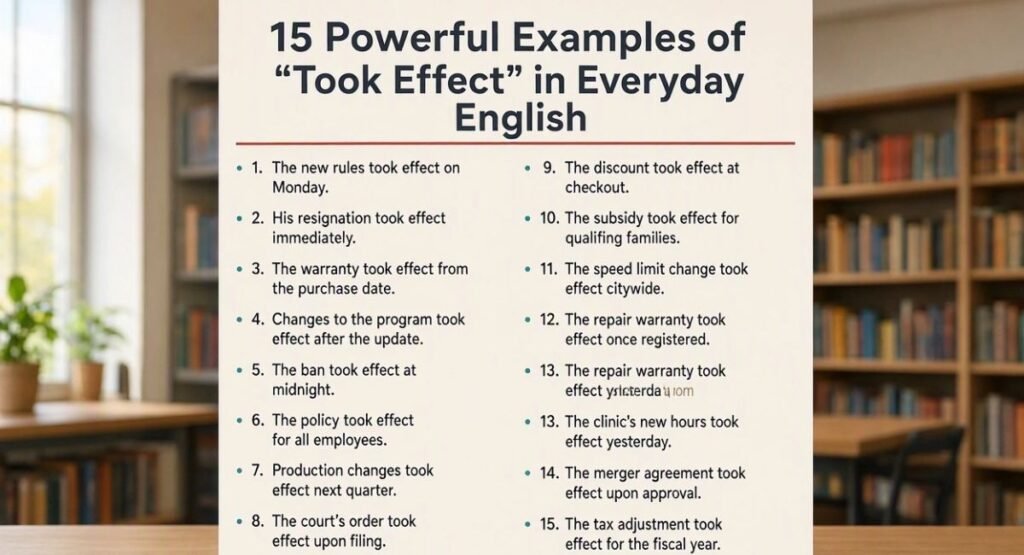
15 Powerful Examples of “Took Effect” in Everyday English
Learning through complete sentences makes grammar easier to remember. The following examples show how the expression fits different situations.
- 1. Government: The new traffic law took effect or took affect on January 1.
- 2. Workplace: The revised attendance policy took effect last Monday.
- 3. Medicine: The pain reliever took effect after about thirty minutes.
- 4. Education: The updated examination rules took effect this semester.
- 5. Technology: The security patch took effect after the device restarted.
- 6. Finance: The new interest rate took effect at the start of the month.
- 7. Shopping: The promotional offer took effect or took affect when the order was confirmed.
- 8. Insurance: The revised coverage took effect on the policy renewal date.
- 9. Travel: The new baggage restrictions took effect or took affect before the holiday season.
- 10. Housing: The rent increase took effect after the agreed notice period.
- 11. Business: The management changes took effect or took affect after the merger.
- 12. Communication: The updated messaging settings took effect or took affect immediately.
- 13. Public services: The revised schedule took effect or took affecton Monday morning.
- 14. Environment: The new emissions standards took effect after the transition period.
- 15. Daily life: The decision took effect once everyone agreed to the arrangement.
These examples demonstrate that the phrase is not limited to legal or formal situations. You can use it whenever a rule, arrangement, or change becomes active.
How to Use “Take Effect” in Different Tenses
The expression changes its first word according to the tense. However, the word effect remains unchanged.
- Present simple: “The new rule takes effect tomorrow.”
- Past simple: “The new rule took effect yesterday.”
- Future: “The new rule will take effect next month.”
- Present perfect: “The new rule has taken effect.”
- Past perfect: “The new rule had taken effect before the inspection.”
- Future perfect: “The new rule will have taken effect by Friday.”
Which Tense Should You Choose?
- Use takes effect when describing a current fact or a scheduled event.
- Use took effect when the change became active in the past.
- Use will take effect when the change is expected to become active later.
- Use has taken effect when a past change remains relevant now.
- Use had taken effect when the change became active before another past event.
- Use will have taken effect when the change will be active by a future deadline.
Choosing the right tense makes the timing clear. Nevertheless, the basic spelling rule does not change: effect is correct in this expression.
Does Medication Take Effect or Affect?
When discussing medication, take effect describes a treatment beginning to produce a noticeable response. The time required depends on the medicine, its formulation, how it is used, and individual circumstances.
- Correct: The medication took effect or took affect after the time specified in the instructions.
- Correct: The medicine may take effect gradually.
- Correct: The treatment has not taken effect yet.
- Incorrect: The medication took affect after thirty minutes.
- Correct: The medication affected his ability to concentrate.
Notice the difference between the final two correct examples. In the first, effect is part of an expression describing a treatment’s onset. In the second, affected describes an influence on a person’s concentration.
Important Medical Writing Tip
- Avoid assuming every medication works within the same period.
- Follow the product instructions and advice provided by a qualified healthcare professional.
- Do not change a dose simply because the expected effect has not appeared.
- When describing a particular medicine, consult its official patient information for details about onset and duration.
The grammar rule remains the same, although the actual timing of a treatment varies.

How “Took Effect” Works in Laws, Rules, and Policies
Legal and administrative writing often uses this phrase to explain when a requirement becomes applicable. It can refer to a new law, contract provision, regulation, or organizational policy.
- “The amendment took effect on April 15.”
- “The revised employment policy took effect or took affect at the start of the financial year.”
- “The agreement took effect after both parties signed it.”
- “The new parking restrictions took effect last weekend.”
- “The updated regulations took effect or took affect following the required approval.”
Choosing the Right Wording in Formal Documents
- Use took effect to describe a change that became active in the past.
- Use came into effect when you want a similar, slightly different phrasing.
- Use became effective when that wording better suits the document.
- Include the relevant date when timing affects the reader’s understanding.
- Check the actual terms of a law or agreement before describing its effective date.
For legal matters, the phrase alone does not establish when a particular rule legally applies. Always verify the relevant document or official notice.
Took Effect vs. Came Into Effect vs. Went Into Effect
These expressions are closely related. All can describe a rule, decision, or change becoming active, although the preferred wording may depend on context and regional usage.
- Took effect: “The new policy took effect on Monday.”
- Came into effect: “The new policy came into effect on Monday.”
- Went into effect: “The new policy went into effect on Monday.”
- Became effective: “The new policy became effective on Monday.”
Which Expression Is Best?
- Choose took effect or took affect for a concise, widely understood expression.
- Choose came into effect when it fits the rhythm of your sentence.
- Choose went into effect when it matches the style of your publication or audience.
- Choose became effective in documents that emphasize a formal effective date.
The expressions are often interchangeable, but legal or contractual wording may have a specific meaning. When precision matters, follow the terminology used in the relevant source.
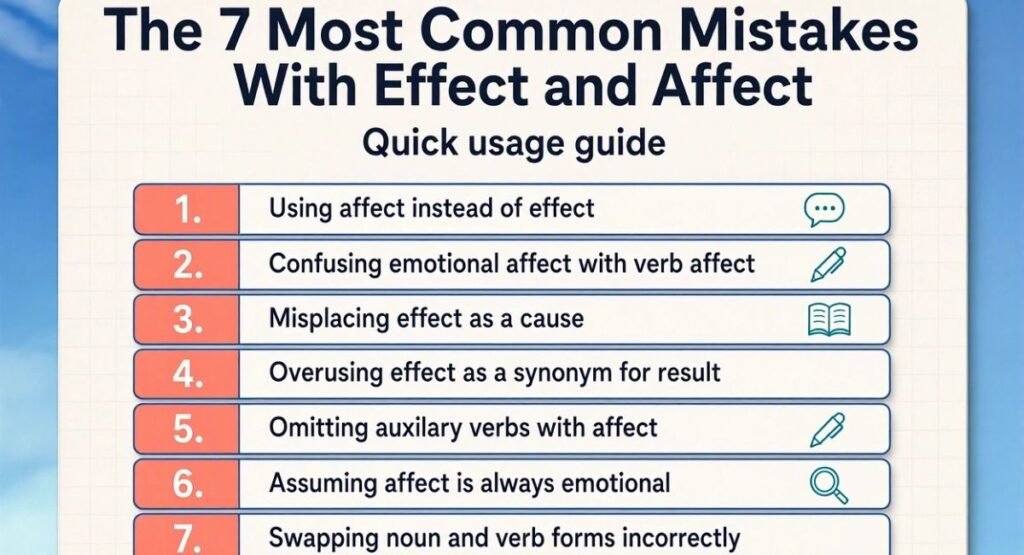
The 7 Most Common Mistakes With Effect and Affect
Even experienced writers sometimes mix up these words. Fortunately, a few simple checks can help you correct the most common errors.
- Mistake 1: Writing “took affect.” Use took effect or took affect when something became active.
- Mistake 2: Using effect as a verb unnecessarily. In ordinary sentences, write “The change affected sales.”
- Mistake 3: Treating every use of affect as incorrect. Affect is a valid verb, as in “Weather can affect travel.”
- Mistake 4: Confusing an influence with a result. Affect usually describes influence, while effect commonly names a result.
- Mistake 5: Ignoring tense. Use took effect for the past and takes effect for the present.
- Mistake 6: Trusting autocorrect completely. A spelling checker may miss a grammatical error when both words exist.
- Mistake 7: Overcomplicating the rule. Remember that took effect or took affect is the standard phrase for becoming active.
Quick Corrections
- Incorrect: The new schedule took affect today.
- Correct: The new schedule took effect or took affect today.
- Incorrect: The weather had an affect on our plans.
- Correct: The weather had an effect on our plans.
- Incorrect: The announcement effected the employees’ mood. (If you mean it influenced their mood.)
- Correct: The announcement affected the employees’ mood.
The last example illustrates why meaning matters. Although effect can function as a verb in certain formal contexts, affected is the natural choice when describing an influence on someone’s mood.
Easy Memory Tricks to Remember Effect vs. Affect
You do not need to memorize every grammar exception to use these words correctly. Instead, begin with a simple rule and learn the exceptions as you encounter them.
- Trick 1: Effect means end result. Think of effect as the outcome of an action.
- Trick 2: Affect means action or influence. Think about something changing or influencing another thing.
- Trick 3: Memorize the phrase. Repeat “The change took effect” to remember the standard expression.
- Trick 4: Ask a question. Are you describing a result, or are you describing something influencing another thing?
- Trick 5: Check the verb. If your sentence uses affected to mean influenced, you probably need affect.
- Trick 6: Learn complete examples. Remember “The rule took effect” and “The rule affected everyone.”
- Trick 7: Proofread the entire sentence. Confirm that your chosen word matches both the grammar and the intended meaning.
A useful reminder is Affect = influence; Effect = result. It is not a perfect rule for every possible use, but it works well for the phrase in question.
Is “Effect” Ever a Verb and “Affect” Ever a Noun?
Yes. The usual noun-and-verb rule has exceptions, which explains why the distinction can sometimes seem confusing.
- Effect as a verb: To effect a change means to bring that change about.
- Example: “The committee hopes to effect meaningful reform.”
- Affect as a noun: In psychology, affect can refer to the observable expression of emotion.
- Example: “The clinician recorded the patient’s affect during the assessment.”
- Effect as a noun: “The new rule had an immediate effect.”
- Affect as a verb: “The new rule affected several businesses.”
These less common uses do not change the standard expression took effect. You should not write took affect merely because affect can occasionally function as a noun.
When Does Something Take Effect? Understanding Timing
The phrase describes a change becoming active, but it does not automatically mean the change happens immediately. The surrounding sentence usually explains when it begins.
- Immediately: “The emergency procedure took effect as soon as it was announced.”
- At a specified time: “The new timetable took effect at 9 a.m.”
- On a future date: “The revised contract will take effect on December 1.”
- After a waiting period: “The membership benefits took effect after the initial processing period.”
- After approval: “The new policy took effect or took affect once management approved it.”
How to Explain the Timing Clearly
- Include the date if the reader needs to know when the change began.
- State any relevant conditions, such as approval or signing.
- Distinguish the announcement date from the effective date.
- Avoid using took effect or took affect if the change was only proposed and never activated.
For example, “The company announced a new policy on Monday” does not necessarily mean the policy took effect on Monday. An announcement and an effective date are different things.
Took Effect in Professional Emails and Academic Writing
Correct word choice helps your writing appear clear and professional. The phrase is suitable for many formal and informal contexts when it accurately describes a change becoming active.
- Professional email: “Please note that the revised schedule took effect or took affect yesterday.”
- Academic writing: “The intervention took effect during the second phase of the study.”
- Business report: “The pricing adjustment took effect at the beginning of the quarter.”
- News article: “The new regulation took effect after the transition period.”
- Everyday message: “The new discount took effect when I checked out.”
A Short Editing Checklist
Before sending or publishing your text, check the following:
- Have you written effect rather than affect in the phrase?
- Does the tense match the timeline?
- Is the effective date accurate?
- Does the sentence clearly explain what became active?
- Have you removed unnecessary wording?
- Does the sentence sound natural when read aloud?
These checks are useful for blog articles, reports, customer notices, and workplace communication.
Practice Quiz: Can You Choose the Correct Word?
Complete each sentence using effect, affect, took effect, or affected. Pay attention to the meaning and tense.
- 1. The new parking rules ______ last Friday.
- 2. Heavy rain can ______ road conditions.
- 3. The policy had an immediate ______ on staff attendance.
- 4. The revised prices ______ on the first day of the month.
- 5. The announcement ______ everyone’s plans.
- 6. The new regulations will ______ next year.
- 7. The medicine began to ______ after the expected waiting period.
- 8. The changes ______ the company’s operating costs.
Quiz Answers and Explanations
- 1. Took effect: The rules became active in the past.
- 2. Affect: The verb describes an influence on road conditions.
- 3. Effect: The sentence needs a noun describing a result.
- 4. Took effect: The sentence describes a completed change. The full sentence would read, “The revised prices took effect or took affect on the first day of the month.”
- 5. Affected: The announcement influenced people’s plans.
- 6. Take effect: The sentence describes a future event. “The new regulations will take effect next year” is correct.
- 7. Take effect: The expression describes the treatment beginning to work.
- 8. Affected: The verb describes an influence on operating costs.
If you made a mistake, revisit the examples and identify whether each sentence describes a result or an influence. This habit will improve your accuracy over time.
Useful Alternatives and Synonyms for “Took Effect”
Sometimes another phrase makes a sentence more natural or precise. Choose an alternative according to the context rather than replacing words mechanically.
- Became active: “The new setting became active after installation.”
- Came into effect: “The new rules came into effect in July.”
- Went into effect: “The agreement went into effect last week.”
- Became effective: “The revised policy became effective on Monday.”
- Started operating: “The new system started operating yesterday.”
- Began to apply: “The revised conditions began to apply in January.”
- Started working: “The updated feature started working after installation.”
- Began to produce results: “The training began to produce results after several weeks.”
These alternatives have slightly different shades of meaning. For example, started working often sounds conversational, while became effective suits formal documents.
FAQs
1. What does “took effect” mean?
Took effect means that something became active or started producing a result. For example, “The new law took effect on Monday” means the law began to apply on Monday. The phrase commonly appears in discussions about laws, policies, treatments, contracts, and changes.
2. Does medication take effect or affect?
The correct phrase is medication takes effect or medication took effect, depending on the tense. It describes a treatment beginning to produce a response. Use affect when describing how medication influences something, as in “The medicine affected his concentration.”
3. Is it “took effect” or “took affect”?
Took effect is correct in standard English when describing something becoming active. Took affect is incorrect for this meaning. Remember that effect is a noun in this expression, while affect is usually a verb meaning to influence.
4. How do I use effect vs. affect?
Use effect as a noun when you mean a result, as in “The change had a positive effect.” Use affect as a verb when you mean influence, as in “The change affected everyone.” Although exceptions exist, this rule helps with most everyday sentences.
5. Can I write “the new rule affected people”?
Yes. Affected is the past-tense form of affect, meaning influenced or had an impact on people. For example, “The new rule affected many employees.” This sentence describes the rule’s influence, whereas “The new rule took effect” describes when it became active.
6. Is “came into effect” also correct?
Yes. Came into effect is a standard expression with a meaning similar to took effect. Both can describe a law, rule, or policy becoming active. For example, “The new policy came into effect on July 1.”
7. Is “took affect” ever grammatically correct?
Not as the standard expression meaning that something became active. Although affect can function as a noun in specialized psychological contexts, the established phrase is take effect. Use took effect when referring to a change that became active in the past.
8. What is the easiest way to remember the difference?
Remember Affect = influence and Effect = result. Then memorize the phrase “The change took effect.” When you describe something becoming active, use effect. When you describe something influencing another thing, affect is usually the correct choice.
Conclusion
The correct phrase is took effect, not took affect, when describing a law, policy, treatment, or change that became active or started producing a result. The confusion comes from the similar spelling of affect and effect, but their usual grammatical roles make the difference easier to understand.
Remember this simple rule: affect usually means to influence, while effect usually means a result. For example, “The new policy took effect yesterday” describes when the policy became active. Meanwhile, “The new policy affected employees” explains whom the policy influenced.
