


The spelling of necessary can be confusing because many people accidentally add an extra letter when writing this common English word. The correct spelling is necessary, not neccessary. Although both versions may look similar, only one is accepted in standard English.
Fortunately, you do not need to memorize complicated spelling of necessary rules to get it right. A simple letter-counting trick, a few everyday examples, and regular practice can help you remember the correct spelling. Whether you are writing school assignments, professional emails, or everyday messages, this guide will help you use the word confidently.
You will also learn what necessary means, how to pronounce it, how it differs from related words, and which spelling of necessary mistakes to avoid. By the end, you will have practical techniques to improve your spelling of necessary and make your writing clearer.
The Correct Spelling of Necessary: One Simple Rule
The easiest way to understand the spelling of necessary is to look carefully at its letters. The word contains nine letters, including one C and two S’s.
- Correct: Necessary
- Incorrect: Neccessary
- Incorrect: Necesary
- Incorrect: Neccesary
- Incorrect: Necessery
The correct spelling of necessary is always necessary in standard British and American English. Therefore, you do not need to learn separate spellings for different English-speaking countries.
Remember this simple rule: one C and two S’s. If you can recall those letters, you can avoid the most common mistake.
5 Powerful Facts About the Word Necessary
Before exploring more examples, learn these five essential facts about the word.
- Fact 1: Correct spelling: Necessary is the only standard spelling of necessary of this word.
- Fact 2: Letter count: It contains nine letters.
- Fact 3: One C: The word has only one C, not two.
- Fact 4: Two S’s: It contains two consecutive S’s.
- Fact 5: Word type: Necessary is primarily an adjective that describes something needed or required.
These facts make the word easier to recognize when reading and writing. Moreover, they provide a quick reference whenever you are unsure about its spelling.
What Does Necessary Mean in Simple English?
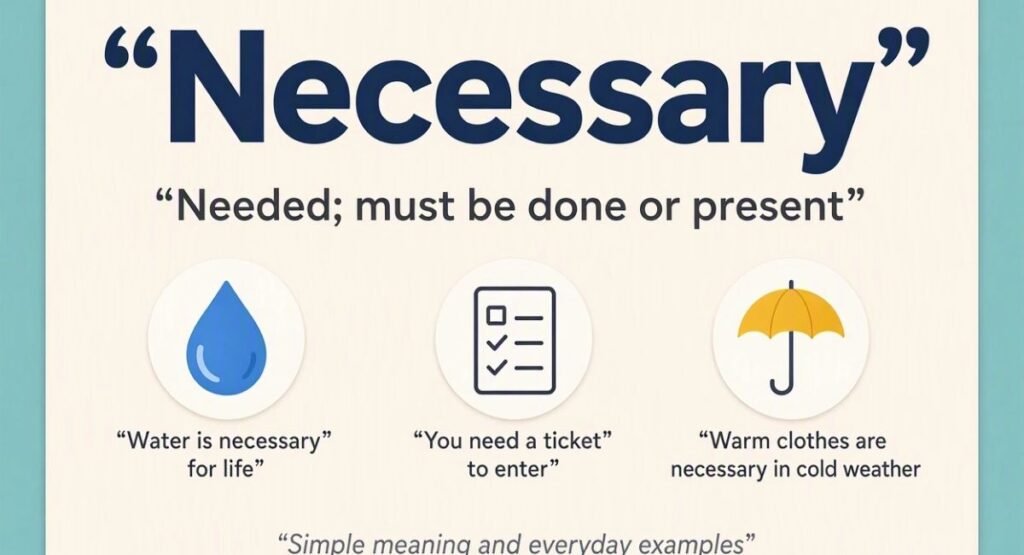
The word necessary means something that is needed, required, or essential for a particular purpose. It describes something that cannot easily be avoided or is important for achieving a specific result.
For example, food and water are necessary for human survival. Similarly, preparation is often necessary before an important examination.
Here are some simple meanings to remember:
- Needed: Something you must have or use.
- Required: Something that a rule, situation, or task demands.
- Essential: Something very important for a particular purpose.
- Unavoidable: Something that must happen under certain circumstances.
The exact meaning depends on the sentence. However, the central idea remains the same: something is needed or required.
7 Easy Memory Tricks for the Spelling of Necessary
Learning the spelling of necessary becomes easier when you connect the letters to a simple pattern. Instead of repeating the word without understanding it, use these seven practical techniques.
- Trick 1: Remember one C and two S’s. This is the most reliable shortcut. Think of the word as having one C followed by two S’s: ne-C-e-SS-ary.
- Trick 2: Divide the word into smaller parts. Practice writing “neces” and “sary” separately before combining them into necessary.
- Trick 3: Say the letters aloud. Repeat “one C, two S’s” whenever you write the word. This reinforces the correct letter pattern.
- Trick 4: Write it five times. Write necessary slowly, checking the C and both S’s after every attempt.
- Trick 5: Use a familiar sentence. Remember the sentence, “Practice is necessary for progress.” Recalling the sentence can help you remember the spelling.
- Trick 6: Compare the wrong and right versions. Write neccessary beside necessary and identify the extra C in the incorrect version.
- Trick 7: Test yourself later. Close your notes and spell the word from memory. Repeat the exercise the next day to strengthen recall.
These methods work best when you use them consistently. Therefore, choose two or three techniques that feel natural and practice them during your regular writing activities.
Necessary vs. Neccessary: 6 Important Differences
The spelling of necessary often causes confusion because the incorrect version looks almost identical to the correct one. However, a single extra letter makes the difference.
| Feature | Necessary | Neccessary |
| Spelling status | Correct | Incorrect |
| Number of C’s | One | Two |
| Number of S’s | Two | Two |
| Standard English | Accepted | Not accepted |
| Suitable for formal writing | Yes | No |
| Meaning | Needed or required | No standard meaning as a correctly spelled word |
Necessary is appropriate for essays, reports, emails, applications, and everyday communication.- Neccessary is a common spelling of necessary error. It should be corrected before publishing or submitting your work.
- Both versions may look similar at first glance. Nevertheless, the extra C makes neccessary incorrect.
The best way to avoid this mistake is to check the middle of the word carefully. Once you remember the one-C, two-S pattern, the correct spelling of necessary becomes easier to recognize.
10 Correct Examples of Necessary in Everyday Sentences
Reading examples helps you understand both spelling of necessary and meaning. The following sentences demonstrate how necessary appears in common situations.
- Example 1: Regular exercise is necessary for a healthy lifestyle.
- Example 2: It is necessary to carry identification when traveling.
- Example 3: A passport is necessary for many international trips.
- Example 4: Please bring all the necessary documents to the meeting.
- Example 5: Good communication is necessary for successful teamwork.
- Example 6: Water is necessary for plants to grow.
- Example 7: It may be necessary to change our plans because of the weather.
- Example 8: Careful research is necessary before making an important decision.
- Example 9: A strong introduction is necessary for a well-organized essay.
- Example 10: Please make the necessary changes before submitting your assignment.
Notice that necessary describes a requirement, condition, or important need in each sentence. As a result, these examples can help you remember the word while learning how to use it correctly.
5 Common Spelling Mistakes You Should Avoid
Many spelling of necessary mistakes happen because writers remember how a word sounds but forget its exact letter sequence. The spelling of necessary of necessary is particularly vulnerable to this problem.
- Mistake 1: Neccessary. This version contains an extra C. Always write necessary with one C and two S’s.
- Mistake 2: Necesary. This version has only one S. Remember that necessary contains two consecutive S’s.
- Mistake 3: Neccesary. This version has two C’s and only one S. Check both the C and S pattern.
- Mistake 4: Necessery. This version replaces the final A before R with an E. The correct ending is “ary.”
- Mistake 5: Necessarry. This version contains an extra R. Write the ending as “ary,” not “arry.”
To correct these errors, slow down when typing unfamiliar words. Additionally, use a spellchecker as a final review rather than relying entirely on it.
Necessary as an Adjective: 5 Useful Grammar Rules
Necessary is primarily an adjective. An adjective describes a noun or provides information about a condition, requirement, or quality.
- Rule 1: Place it before a noun. Example: We collected the necessary information.
- Rule 2: Use it after a linking verb. Example: A change is necessary.
- Rule 3: Use “necessary for” before a noun or noun phrase. Example: Sleep is necessary for good health.
- Rule 4: Use “necessary to” before a verb. Example: It is necessary to arrive early.
- Rule 5: Use it to describe requirements. Example: The manager approved the necessary repairs.
These patterns are useful in academic, professional, and everyday writing. However, the words that follow necessary depend on the sentence structure and intended meaning.
Necessary for vs. Necessary to
The expressions necessary for and necessary to are both correct, but they often introduce different types of information.
- Necessary for: Use this expression when identifying a person, activity, purpose, or result that needs something. Example: Planning is necessary for success.
- Necessary to: Use this expression when explaining an action that must be performed. Example: It is necessary to check your work.
- Necessary to a person or thing: This construction can also identify something essential to a particular subject. Example: Trust is necessary to a strong relationship.
Choosing the appropriate expression makes your writing more precise. Therefore, consider whether you are describing a requirement for something or an action someone must take.
Necessary vs. Necessity vs. Necessarily: 3 Key Differences
These three words are related, but they serve different grammatical purposes. Understanding the differences will help you spell and use each one correctly.
| Word | Part of speech | Meaning | Example |
| Necessary | Adjective | Needed or required | A permit is necessary. |
| Necessity | Noun | Something needed or the condition of being needed | Food is a necessity. |
| Necessarily | Adverb | In a way that is required or inevitable | Expensive does not necessarily mean better. |
Necessary: Use this word to describe something required or essential.- Necessity: Use this word when referring to a need, requirement, or essential item.
- Necessarily: Use this word when modifying a verb, adjective, or statement to express requirement or logical consequence.
The endings provide a helpful clue. Necessary ends in “ary,” necessity ends in “ity,” and necessarily ends in “arily.” Although they share a root, you should not substitute one for another without checking the sentence.
How to Spell Necessarily Without Confusion
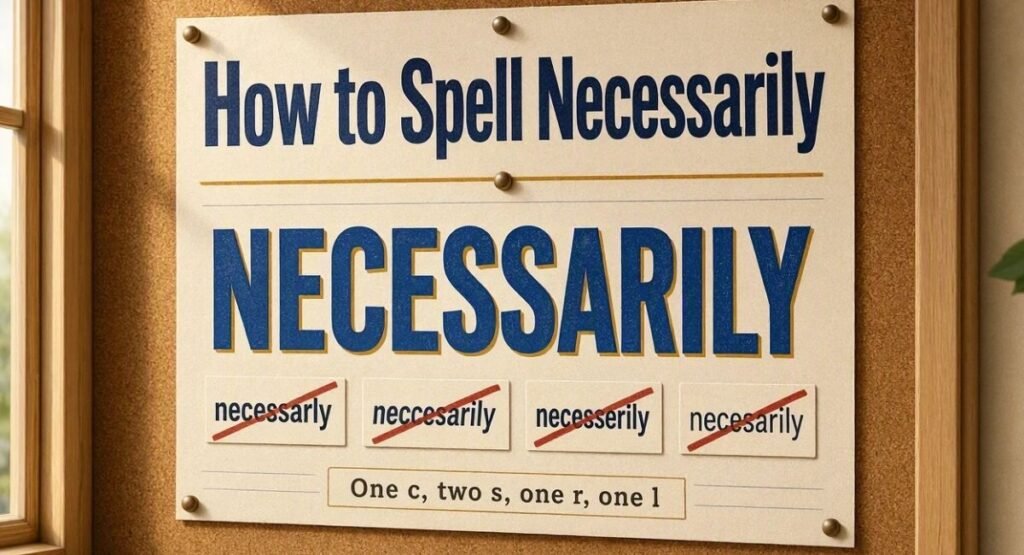
Necessarily is a common source of spelling of necessary errors because it is longer than necessary and changes the ending.
- Correct spelling: Necessarily
- Incorrect example: Neccessarily
- Incorrect example: Necesarily
- Related word: Necessary
- Memory tip: Start with necessary, then change its ending to form necessarily.
Use necessarily when the meaning involves something that follows as a requirement or logical result. - A higher price does not necessarily mean better quality.
- You do not necessarily need to buy a new computer.
- Being busy does not necessarily mean being productive.
Remember that necessary and necessarily are different forms. Therefore, check the complete word rather than assuming that the spelling of necessary of one automatically applies to the other.
Necessary vs. Unnecessary: 4 Simple Rules
Unnecessary is the opposite of necessary. It describes something that is not needed or required.
- Necessary: Regular practice is necessary to improve your writing.
- Unnecessary: Extra details are unnecessary in a short answer.
- Necessary: The team made the necessary adjustments.
- Unnecessary: We avoided unnecessary expenses.
The word unnecessary contains the prefix “un-,” which expresses the opposite meaning. It also retains the double S pattern associated with necessary. - spelling of necessary tip: Remember that unnecessary begins with “un” followed by “necessary.”
- Writing tip: Use unnecessary when you want to explain that something can be removed, avoided, or left out.
- Editing tip: Remove unnecessary words when they make a sentence longer without adding useful meaning.
This comparison is particularly helpful when editing essays, reports, and business documents. It allows you to improve both spelling of necessary and clarity.
8 Common Phrases That Use Necessary
Certain expressions appear frequently in English. Learning them helps you recognize the spelling of necessary in different contexts.
- If necessary: Take an umbrella if necessary.
- When necessary: Ask for assistance when necessary.
- As necessary: Update the information as necessary.
- Where necessary: Add explanations where necessary.
- It is necessary to: It is necessary to follow the instructions.
- Make the necessary changes: Please make the necessary changes before publication.
- All necessary information: Include all necessary information in your application.
- No longer necessary: The additional meeting is no longer necessary.
These phrases work in everyday conversation as well as formal communication. Moreover, memorizing complete expressions can help you recall the correct spelling of necessary more easily than studying isolated letters.
Necessary in School, Work, and Everyday Life
The word necessary fits many situations because people regularly describe requirements, priorities, and essential actions.
- School assignments: Proper research is necessary for a strong academic paper.
- Examinations: Regular revision is necessary before a major test.
- Professional emails: Please provide the necessary information by Friday.
- Business meetings: A clear agenda is necessary for an organized meeting.
- Travel: Travel documents are necessary for many international journeys.
- Health and fitness: Adequate sleep is necessary for normal daily functioning.
- Technology: An internet connection may be necessary to access online services.
- Household tasks: Basic tools are necessary for certain repairs.
- Personal development: Patience is necessary when learning a new skill.
- Teamwork: Mutual respect is necessary for effective collaboration.
These examples show that the word is useful across a wide range of topics. By practicing it in sentences relevant to your daily life, you can improve spelling of necessary retention and written communication.
Necessary vs. Essential vs. Important: Which Word Fits Best?
Necessary, essential, and important have similar meanings, but they are not always interchangeable.
| Word | Main meaning | Example |
| Necessary | Needed or required | A ticket is necessary for entry. |
| Essential | Absolutely fundamental or indispensable | Clean water is essential for survival. |
| Important | Having considerable value or significance | Education is important for personal development. |
Use necessary when a condition, rule, or task requires something.- Use essential when emphasizing that something is fundamental or indispensable.
- Use important when something matters, even if it is not strictly required.
For example, a notebook may be necessary for a particular classroom activity. Meanwhile, education can be important for a person’s future without being a requirement in every situation.
Choosing the right word depends on the level of necessity you want to communicate. As a result, understanding these differences makes your writing more accurate.
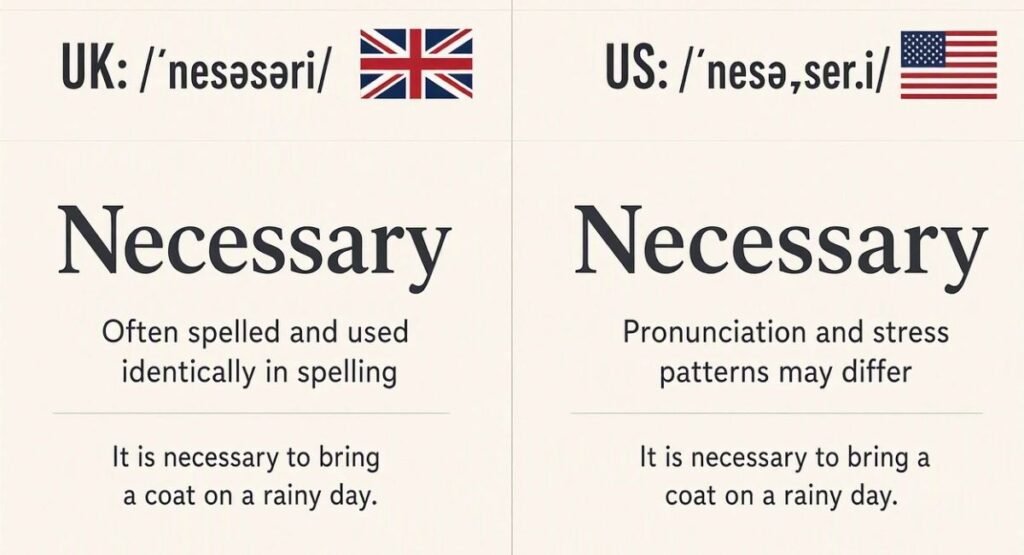
Necessary in British and American English
The spelling of necessary remains the same in standard British and American English. Unlike words such as “colour” and “color,” this word does not have a standard regional spelling of necessary variation.
- British English: Necessary
- American English: Necessary
- Canadian English: Necessary
- Australian English: Necessary
- International formal writing: Necessary
Although pronunciation and accent can vary between regions, the spelling of necessary remains unchanged. Therefore, you do not need to adjust the letters when writing for readers in the United Kingdom or United States.
For international communication, use necessary consistently. If you are following a particular publication’s style guide, check its overall spelling of necessary conventions, but do not change this word to neccessary.
Why Is Necessary So Easy to Misspell?
Even experienced writers sometimes misspell familiar words. Several factors can make necessary difficult to remember.
- Similar letter patterns: The repeated consonants can make the middle of the word confusing.
- Pronunciation: Everyday speech does not always make every written letter obvious.
- Typing quickly: Fast typing can introduce extra letters or leave letters out.
- Visual familiarity: Repeated exposure to an incorrect version can make it look familiar.
- Limited proofreading: Writers may overlook a small error when concentrating on meaning.
To reduce these mistakes, combine deliberate practice with proofreading. Read your writing slowly, focus on commonly misspelled words, and check uncertain spellings in a reliable dictionary.
A 5-Step Method to Check the Spelling of Necessary
When you are unsure about a word, a repeatable checking method can prevent errors.
- Step 1: Identify the word. Decide whether you intend to write necessary, necessity, or necessarily.
- Step 2: Check the C. Confirm that necessary contains only one C.
- Step 3: Count the S’s. Verify that the word contains two consecutive S’s.
- Step 4: Check the ending. Necessary ends with “ary,” not “ery” or “arry.”
- Step 5: Review the sentence. Make sure the word fits the meaning and grammar of the sentence.
For example, consider this sentence: “It is neccessary to submit the form.” The extra C becomes obvious when you apply the letter-counting rule. Correct it to “It is necessary to submit the form.”
This method is useful for proofreading essays, applications, reports, and important emails. Furthermore, it encourages you to check the word systematically instead of guessing.
10 Practice Questions to Test Your Spelling
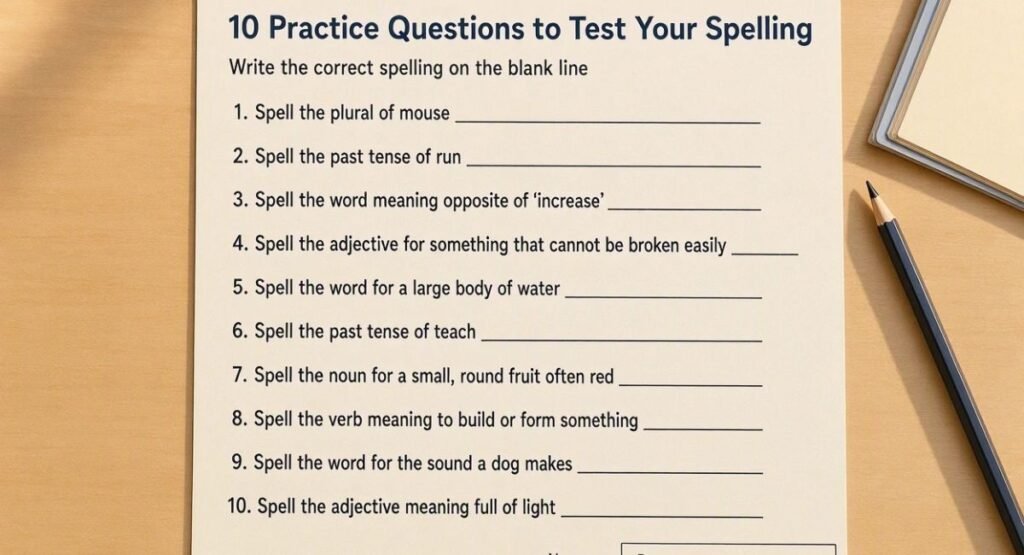
Practice helps turn spelling of necessary knowledge into a habit. Answer these questions without looking at the earlier sections, then check your answers below.
- Question 1: Which spelling of necessary is correct: necessary or neccessary?
- Question 2: How many C’s appear in necessary?
- Question 3: How many S’s appear in necessary?
- Question 4: Complete the word: N _ C E S S A R Y.
- Question 5: Choose the correct sentence: “Sleep is necessary for health” or “Sleep is neccessary for health.”
- Question 6: Which word is a noun: necessary or necessity?
- Question 7: Complete the sentence: “It is ______ to check your work.” Choose necessary or necessery.
- Question 8: What is the opposite of necessary?
- Question 9: Does the standard spelling change between British and American English?
- Question 10: Which is correct: necessarily or neccessarily?
Answers to the Spelling Quiz
- Answer 1: Necessary.
- Answer 2: One C.
- Answer 3: Two S’s.
- Answer 4: Necessary.
- Answer 5: “Sleep is necessary for health.”
- Answer 6: Necessity.
- Answer 7: Necessary.
- Answer 8: Unnecessary.
- Answer 9: No. Both use necessary.
- Answer 10: Necessarily.
If you answered all ten questions correctly, you understand the basic spelling of necessary pattern. If you missed any, review the one-C, two-S rule and try the quiz again.
5 Proven Ways to Improve Your English Spelling
Learning one word correctly can also help you develop better spelling of necessary habits overall. These five strategies can support long-term improvement.
- Read every day: Read books, articles, and reliable online resources to become familiar with correct spelling.
- Keep a personal word list: Record words you often misspell and review them regularly.
- Practice active recall: Cover the correct spelling and write the word from memory.
- Use a dictionary: Check uncertain words instead of relying on pronunciation alone.
- Proofread carefully: Review your writing before submitting, publishing, or sending it.
Consistency matters more than lengthy study sessions. Even five minutes of focused spelling practice each day can help reinforce familiar patterns.
FAQs
1. Which is correct, necessary or neccessary?
Necessary is the correct spelling. Neccessary is a common spelling mistake caused by adding an extra C. Remember that necessary contains one C and two S’s. Use the correct version in essays, emails, business documents, and everyday writing.
2. What’s a better word for “necessary”?
Several alternatives can replace necessary, depending on your sentence. Common choices include essential, required, needed, indispensable, and vital. For example, “Water is essential for life” communicates a similar idea to “Water is necessary for life.” Choose the alternative that best fits your intended meaning.
3. Is “necessary” spelled correctly?
Yes, necessary is spelled correctly when written N-E-C-E-S-S-A-R-Y. It contains nine letters, one C, and two consecutive S’s. The spelling is the same in standard British and American English. Avoid adding another C or changing the final A to an E.
4. What does “necessary” mean in simple words?
Necessary means needed or required. Something necessary is important for completing a task, meeting a requirement, or achieving a particular result. For example, studying is necessary to prepare for an examination. In simple terms, it describes something you need.
5. How do you remember the spelling of necessary?
Use the memory trick “one C and two S’s.” Write necessary several times while saying the rule aloud. You can also memorize a sentence such as “Practice is necessary for success.” Regular practice and self-testing make the correct spelling easier to remember.
6. Is necessary an adjective or a noun?
Necessary is primarily an adjective. It describes something that is needed or required, as in “The documents are necessary.” Its related noun is necessity, as in “Food is a necessity.” Using the correct form helps you maintain grammatical accuracy.
7. Is necessary spelled differently in British and American English?
No. Necessary has the same spelling in both British and American English. Although some English words have regional spelling variations, necessary does not. Therefore, you can use the same spelling in formal writing for readers in either country.
8. What is the difference between necessary and necessarily?
Necessary is an adjective meaning needed or required. Necessarily is an adverb used to express requirement or logical consequence. For example, “A password is necessary” describes a requirement, while “A password is not necessarily secure” explains that something does not automatically follow.
Conclusion
The spelling of necessary becomes much easier once you understand its letter pattern. The correct spelling is necessary, with one C and two consecutive S’s. The incorrect form neccessary contains an extra C and should not appear in standard English writing.
Remember the simple rule, practice using the word in everyday sentences, and check your work before submitting important documents. Additionally, learn related words such as necessity, necessarily, and unnecessary to strengthen your vocabulary and grammar.
With consistent practice, you can avoid this common spelling mistake and write with greater confidence. When you are unsure, consult a reliable dictionary and remember: one C, two S’s, and the correct spelling is necessary.
Meta Description: Learn the spelling of necessary with 15 easy tips, correct examples, common mistakes, memory tricks, and simple answers to popular spelling questions.

1 thought on “15 Easy Spelling of Necessary Tips to Remember It Forever”