

An extreme adjective is a powerful word that describes something at a very high or intense level. Instead of saying that a meal is very tasty, you can call it delicious. Similarly, rather than describing a room as very cold, you can say it is freezing. These words make everyday English more expressive, natural, and engaging.
Learning how to use an extreme adjective can significantly improve your vocabulary and communication skills. These adjectives help you express strong feelings, describe remarkable experiences, and communicate more precisely. However, they also follow certain grammar rules, especially when used with adverbs and comparative forms.
What Makes an Extreme Adjective So Powerful?
- An extreme adjective is an adjective that expresses a very high degree of a quality, condition, or feeling.
- It communicates an intensity that an ordinary adjective cannot fully express on its own.
- For example, hungry describes a desire to eat, while starving expresses an extremely strong feeling of hunger.
- Similarly, tired describes a need for rest, whereas exhausted suggests an almost complete lack of energy.
- These words are also called strong adjectives, intensifying adjectives, or non-gradable adjectives in some grammar contexts, although these terms do not always mean exactly the same thing.
- They allow speakers to communicate more vividly without relying on words such as very or really.
- In everyday conversations, they can make sentences shorter, clearer, and more expressive.
Examples:
- The water is freezing.
- The movie was fantastic.
- I am exhausted after the long journey.
- The view from the mountain was stunning.
- She was furious when she heard the news.
Each bold adjective expresses a strong degree of a particular quality. As a result, the reader or listener gets a clearer impression of the situation.

50+ Extreme Adjective Examples to Expand Your Vocabulary
- Learning adjectives in pairs makes it easier to understand their intensity.
- An ordinary adjective describes a quality, while its extreme alternative communicates a much stronger degree.
- The following examples show how these words work in everyday English.
| Regular adjective | Extreme adjective | Example sentence |
| Big | Enormous | They live in an enormous house. |
| Small | Tiny | A tiny bird sat on the branch. |
| Good | Excellent | She gave an excellent presentation. |
| Bad | Awful | We had an awful experience. |
| Beautiful | Gorgeous | The bride looked gorgeous. |
| Ugly | Hideous | The building looked hideous. |
| Cold | Freezing | It is freezing outside. |
| Hot | Boiling | The soup is boiling hot. |
| Tired | Exhausted | I feel exhausted after work. |
| Hungry | Starving | The children are starving. |
| Thirsty | Parched | We were parched after hiking. |
| Angry | Furious | He was furious about the delay. |
| Scared | Terrified | She was terrified of the storm. |
| Funny | Hilarious | His story was hilarious. |
| Interesting | Fascinating | The documentary was fascinating. |
| Surprised | Astonished | I was astonished by the result. |
| Happy | Ecstatic | They were ecstatic about the news. |
| Sad | Devastated | She was devastated by the loss. |
| Dirty | Filthy | His shoes were filthy. |
| Clean | Spotless | The kitchen was spotless. |
| Wet | Soaked | My clothes were soaked. |
| Dry | Bone-dry | The soil was bone-dry. |
| Clever | Brilliant | That was a brilliant idea. |
| Rich | Wealthy | He comes from a wealthy family. |
| Poor | Impoverished | The region was impoverished. |
| Loud | Deafening | The music was deafening. |
| Quiet | Silent | The room was silent. |
| Fast | Lightning-fast | The athlete was lightning-fast. |
| Slow | Sluggish | The computer became sluggish. |
| Difficult | Impossible | The task seemed impossible. |
| Easy | Effortless | She made the process look effortless. |
| Tasty | Delicious | The homemade cake was delicious. |
| Bad-smelling | Disgusting | The smell was disgusting. |
| Surprising | Incredible | The ending was incredible. |
| Exciting | Thrilling | The match was thrilling. |
| Important | Crucial | Timing is crucial. |
| Certain | Absolutely certain | I am absolutely certain. |
| Worried | Terrified | He was terrified about the outcome. |
| Painful | Excruciating | She experienced excruciating pain. |
| Crowded | Packed | The bus was packed. |
| Full | Stuffed | I am stuffed after dinner. |
| Empty | Vacant | The building was vacant. |
| Strong | Powerful | The storm was powerful. |
| Weak | Feeble | His voice sounded feeble. |
| Old | Ancient | They discovered an ancient temple. |
| New | Brand-new | He bought a brand-new car. |
| Surprised | Stunned | We were stunned by the announcement. |
| Angry | Enraged | The customer was enraged. |
| Pretty | Stunning | The landscape was stunning. |
| Bad | Terrible | The weather was terrible. |
| Good | Outstanding | Her performance was outstanding. |
| Cold | Freezing | The lake was freezing. |
| Funny | Side-splitting | The comedian told a side-splitting joke. |
| Hungry | Ravenous | I was ravenous after the game. |
| Tired | Worn-out | He felt worn-out after travelling. |
Note: Not every pair is a strict grammatical equivalent. Some words describe a related quality, while others have a more specific meaning. For example, impossible means something cannot be done, rather than simply being a stronger form of difficult. Use context to choose the most accurate adjective.
How Regular and Extreme Adjectives Differ
- Regular adjectives describe qualities that can exist at different levels. For example, something can be slightly cold, fairly cold, or very cold.
- Extreme adjectives generally express a high degree of a quality. For example, freezing already suggests an intense level of cold.
- Regular adjectives are usually gradable adjectives, which means they can naturally take degree words such as slightly, quite, very, and extremely.
- Extreme adjectives are often treated as non-gradable adjectives in traditional English grammar. They typically use intensifiers such as absolutely, completely, and utterly.
- However, actual English usage is flexible. Some extreme adjectives can be modified with very or really in informal speech, depending on the adjective, context, and speaker.
| Regular adjective | Extreme adjective | Natural intensifier |
| Cold | Freezing | Absolutely freezing |
| Tired | Exhausted | Completely exhausted |
| Angry | Furious | Absolutely furious |
| Beautiful | Gorgeous | Absolutely gorgeous |
| Funny | Hilarious | Absolutely hilarious |
| Dirty | Filthy | Absolutely filthy |
| Good | Fantastic | Absolutely fantastic |
| Scared | Terrified | Absolutely terrified |
Compare these sentences:
- The weather is very cold.
- The weather is freezing.
- The exam was very difficult.
- The exam was extremely difficult.
- The exam was impossible to complete within the time limit.
The examples demonstrate how adjective choice changes the strength and sometimes the meaning of a sentence.
7 Essential Grammar Rules for Using Extreme Adjectives
- Understanding the meaning of an adjective is only the first step. You should also know how to use it correctly in sentences.
- These seven practical rules will help you avoid common grammatical errors and sound more natural.
1. Choose Intensifiers That Match the Adjective
- Extreme adjectives often combine naturally with intensifiers such as absolutely, completely, utterly, and totally.
- For example, say absolutely amazing, completely exhausted, or utterly ridiculous.
- The best intensifier depends on the adjective. Some combinations are conventional, while others may sound unnatural.
- Avoid assuming that every intensifier works with every extreme adjective.
2. Avoid Automatically Adding “Very”
- Traditional grammar teaching usually advises against using very directly before extreme adjectives.
- Instead of very freezing, use absolutely freezing.
- Instead of very exhausted, use completely exhausted.
- Nevertheless, English speakers sometimes use very with certain strong adjectives, especially in casual conversation. Expressions such as very funny and very surprising are perfectly natural.
- Therefore, focus on conventional word combinations rather than applying a rigid rule to every adjective.
3. Use Comparatives Carefully
- Many extreme adjectives already express a high degree, so traditional grammar often discourages forms such as more freezing or more exhausted.
- However, comparisons are possible when the context supports them.
- For instance, more exhausted than yesterday is common and understandable.
- You can also say even more beautiful or more fascinating because these adjectives allow degrees in ordinary usage.
- Avoid treating all extreme adjectives as completely unchangeable.
4. Do Not Add “-est” to Every Extreme Adjective
- Traditional grammar advises learners to avoid forms such as freezingest or most exhausted when a more natural alternative exists.
- Instead, choose a suitable sentence structure.
- For example, use the coldest day of the year rather than the freezingest day.
- Still, expressions such as the most amazing experience are natural in modern English.
- The correct choice depends on the adjective and the meaning you want to convey.
5. Understand the Difference Between “Absolutely” and “Very”
- Very typically increases the degree of a gradable adjective.
- Absolutely often emphasizes the full or intense force of an extreme adjective.
- For example:
- The film was very interesting.
- The film was absolutely fascinating.
- I am very tired.
- I am completely exhausted.
- These combinations are useful patterns, not inflexible rules.
6. Consider the Situation and Tone
- Extreme adjectives are especially useful when you want to express a strong emotion, reaction, or impression.
- In formal writing, choose precise vocabulary rather than exaggerating every description.
- In informal conversation, stronger expressions can help you sound more enthusiastic or emotionally engaged.
- For example, The presentation was outstanding sounds more emphatic than The presentation was good.
7. Learn Adjective and Intensifier Combinations Together
- Memorizing individual adjectives is helpful, but learning natural word combinations is even more effective.
- Keep a vocabulary notebook with examples such as:
- Absolutely wonderful
- Utterly ridiculous
- Completely devastated
- Totally unacceptable
- Simply incredible
- Over time, these combinations will become easier to use without thinking about the grammar.
Which Adverbs Work Best With Extreme Adjectives?
- Adverbs of degree modify adjectives and communicate how strongly a quality is expressed.
- The choice of adverb depends on the adjective, the context, and the intended tone.
- The following table presents useful combinations for learners.
| Adverb | Example | Common purpose |
| Absolutely | Absolutely fantastic | Strong emphasis |
| Completely | Completely exhausted | Full intensity |
| Utterly | Utterly ridiculous | Strong judgment |
| Totally | Totally amazing | Informal emphasis |
| Entirely | Entirely different | Completeness |
| Really | Really hilarious | Conversational emphasis |
| Truly | Truly remarkable | Sincere emphasis |
| Simply | Simply incredible | Strong positive reaction |
| Quite | Quite extraordinary | Degree or emphasis, depending on dialect |
| Practically | Practically impossible | Near-complete degree |
Examples in context:
- The view was absolutely breathtaking.
- She felt completely devastated after the announcement.
- His explanation was utterly confusing.
- The concert was totally incredible.
- It was practically impossible to hear anything over the noise.
Although these combinations are useful, not every adverb fits every adjective. Reading and listening to natural English helps you learn which combinations sound appropriate.
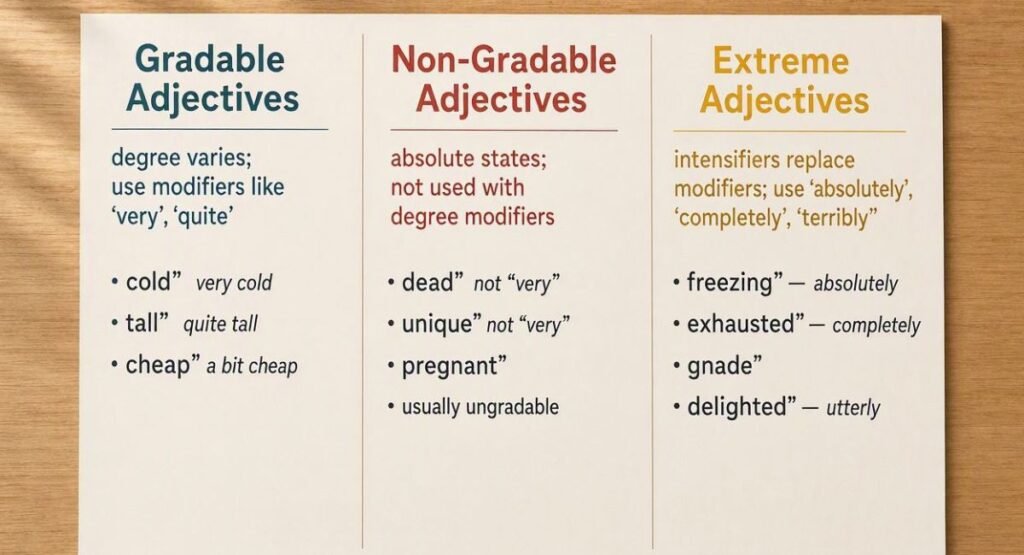
Gradable, Non-Gradable, and Extreme Adjectives Explained
- English adjectives can be grouped by how they express degree.
- Knowing these categories makes it easier to choose accurate words and modifiers.
- However, the categories can overlap, and some adjectives behave differently in different contexts.
Gradable Adjectives
- Gradable adjectives describe qualities that can vary in intensity.
- They can usually take modifiers such as a little, fairly, very, and extremely.
- Common examples include:
- Warm
- Cold
- Happy
- Tired
- Difficult
- Interesting
- Expensive
- Example: The room is quite warm.
- Example: This assignment is extremely difficult.
Extreme Adjectives
- Extreme adjectives express a high degree of a quality or feeling.
- They often replace a regular adjective combined with very.
- Examples include:
- Freezing
- Boiling
- Exhausted
- Terrified
- Delicious
- Hilarious
- Enormous
- Example: The room is freezing.
- Example: The children were exhausted after the trip.
Absolute Adjectives
- Absolute adjectives describe conditions that are traditionally considered complete or unable to exist in degrees.
- Common examples include:
- Dead
- Unique
- Impossible
- Perfect
- Empty
- Complete
- Example: The glass is empty.
- Example: Her solution was perfect.
- In real-world usage, speakers sometimes use these adjectives comparatively or figuratively, such as almost perfect or more unique. Formal writing may call for more precise alternatives.
| Category | Main idea | Examples | Typical modifier |
| Gradable | Quality varies by degree | Warm, happy, tired | Very, fairly |
| Extreme | High intensity | Freezing, ecstatic, exhausted | Absolutely, completely |
| Absolute | Complete or categorical state | Dead, impossible, unique | Completely, almost |
The distinction is useful for learning, but it is not a strict division that explains every adjective in every situation.
15 Common Extreme Adjectives and Their Everyday Uses
- The easiest way to remember strong adjectives is to connect them with situations you experience regularly.
- These examples show how an extreme adjective can make ordinary sentences more descriptive.
1. Freezing
- Meaning: Extremely cold.
- Example: It is freezing outside, so wear a warm jacket.
- Use it when describing very cold weather, water, or surroundings.
2. Boiling
- Meaning: Extremely hot, especially in informal descriptions.
- Example: The kitchen is boiling because the oven has been running all morning.
- It can also refer literally to a liquid reaching its boiling point.
3. Exhausted
- Meaning: Extremely tired.
- Example: I was exhausted after completing the project.
- It communicates a stronger level of tiredness than simply feeling sleepy.
4. Starving
- Meaning: Extremely hungry, often used informally.
- Example: We were starving after the long journey.
- It is often an exaggeration in casual conversation rather than a literal statement about starvation.
5. Terrified
- Meaning: Extremely frightened.
- Example: The child was terrified during the thunderstorm.
- Use it to communicate intense fear.
6. Furious
- Meaning: Extremely angry.
- Example: My manager was furious about the missed deadline.
- It conveys a much stronger reaction than annoyed.
7. Gorgeous
- Meaning: Extremely beautiful or attractive.
- Example: The garden looked gorgeous in the morning sunlight.
- It is common in conversations about people, places, clothing, and scenery.
8. Hilarious
- Meaning: Extremely funny.
- Example: That comedy show was hilarious.
- It describes something that causes strong amusement.
9. Delicious
- Meaning: Extremely pleasant in taste.
- Example: My grandmother prepared a delicious meal.
- It is frequently used to praise food and drinks.
10. Enormous
- Meaning: Extremely large.
- Example: They built an enormous shopping centre near the city.
- It emphasizes size more strongly than big.
11. Tiny
- Meaning: Extremely small.
- Example: A tiny kitten was sleeping in the basket.
- It describes something noticeably smaller than expected.
12. Fascinating
- Meaning: Extremely interesting.
- Example: We watched a fascinating documentary about space.
- It suggests that something captures attention and curiosity.
13. Astonishing
- Meaning: Extremely surprising.
- Example: The athlete achieved an astonishing result.
- It communicates a strong reaction to something unexpected.
14. Spotless
- Meaning: Completely clean.
- Example: She kept her bedroom spotless.
- It suggests there are no visible marks, dirt, or mess.
15. Deafening
- Meaning: Extremely loud.
- Example: The crowd made a deafening noise during the final.
- It describes sound that is overwhelmingly loud.

How to Replace “Very” With Stronger Adjectives
- Replacing very with a more precise adjective can make your English clearer and more engaging.
- Instead of adding another modifier, choose a word that expresses the intended meaning directly.
| Instead of saying | Try saying |
| Very cold | Freezing |
| Very hot | Boiling |
| Very tired | Exhausted |
| Very hungry | Starving |
| Very thirsty | Parched |
| Very angry | Furious |
| Very scared | Terrified |
| Very happy | Ecstatic |
| Very sad | Devastated |
| Very beautiful | Gorgeous |
| Very ugly | Hideous |
| Very big | Enormous |
| Very small | Tiny |
| Very funny | Hilarious |
| Very interesting | Fascinating |
| Very surprising | Astonishing |
| Very good | Excellent |
| Very bad | Awful |
| Very dirty | Filthy |
| Very clean | Spotless |
| Very wet | Soaked |
| Very loud | Deafening |
| Very painful | Excruciating |
| Very crowded | Packed |
| Very tasty | Delicious |
Practical tip: Do not replace very mechanically. The stronger adjective should match the exact meaning. For instance, ecstatic expresses intense happiness, while content describes a quieter sense of satisfaction.
Extreme Adjectives in Positive, Negative, and Neutral Contexts
- Extreme adjectives are not always emotional or dramatic.
- Some express praise, some communicate negative reactions, and others describe a physical condition or situation.
- Understanding these differences helps you select words that suit your message.
Positive Extreme Adjectives
- Excellent: The team delivered an excellent performance.
- Outstanding: Her work was outstanding.
- Gorgeous: The hotel had a gorgeous garden.
- Delicious: The restaurant served delicious food.
- Brilliant: He came up with a brilliant solution.
- Fantastic: We had a fantastic weekend.
- Ecstatic: The fans were ecstatic after the victory.
- Magnificent: The palace looked magnificent at sunset.
- Spectacular: The fireworks display was spectacular.
- Wonderful: They had a wonderful time together.
Negative Extreme Adjectives
- Awful: The traffic was awful.
- Horrible: We experienced horrible weather.
- Furious: The customer was furious.
- Terrified: The passengers were terrified.
- Disgusting: The food had a disgusting smell.
- Hideous: The old carpet looked hideous.
- Devastated: He was devastated by the unexpected news.
- Excruciating: She felt excruciating pain.
- Filthy: The abandoned room was filthy.
- Ridiculous: That was a ridiculous suggestion.
Neutral or Descriptive Extreme Adjectives
- Enormous: An enormous tree stood beside the road.
- Tiny: A tiny insect landed on the window.
- Freezing: The water was freezing.
- Boiling: The kettle was boiling.
- Exhausted: The hikers were exhausted.
- Ancient: They explored an ancient settlement.
- Vacant: The apartment was vacant.
- Silent: The entire building was silent.
- Packed: The train was packed.
- Impossible: The route was impossible to navigate in the storm.
Some words can change their emotional effect depending on the context. For example, enormous may be positive when describing a generous donation or negative when describing a problem.
Extreme Adjectives for Speaking and Writing
- Strong adjectives can make both spoken and written English more effective.
- However, the best word depends on the audience, purpose, and tone.
- Choose expressive vocabulary without exaggerating every statement.
In Everyday Conversations
- Use familiar expressions that sound natural and easy to understand.
- Examples:
- “I’m starving. Let’s get something to eat.”
- “That film was hilarious!”
- “It’s freezing today.”
- “I’m exhausted. I need some sleep.”
- “Your new haircut looks gorgeous.”
- These sentences are suitable for informal communication with friends, family, and colleagues.
In Academic Writing
- Use precise and evidence-based adjectives rather than exaggerated language.
- Examples:
- “The research produced remarkable findings.”
- “The study identified a significant difference.”
- “The experiment revealed an unexpected result.”
- “The method was highly effective under controlled conditions.”
- Academic writing often favors measurable descriptions over subjective intensifiers.
- Remember that significant may have a specific statistical meaning in research.
In Professional Communication
- Select adjectives that convey confidence without sounding overly emotional.
- Examples:
- “Your team delivered an outstanding result.”
- “The proposed deadline is impossible to meet without additional resources.”
- “The presentation was excellent.”
- “This is a crucial issue for the project.”
- Clear and measured language helps you communicate professionally.
In Creative Writing
- Use vivid adjectives to establish mood, atmosphere, and emotion.
- Examples:
- “A deafening roar echoed through the valley.”
- “She stood beneath a magnificent night sky.”
- “An ancient doorway opened into a mysterious chamber.”
- “The character felt utterly devastated by the betrayal.”
- Avoid stacking too many descriptive words in one sentence. One precise adjective is often more powerful than several weaker ones.
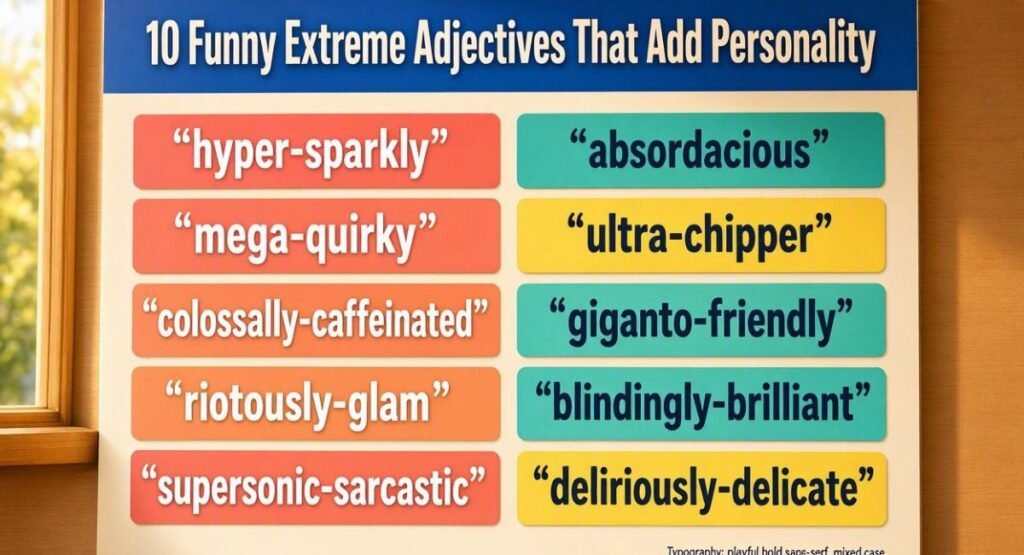
10 Funny Extreme Adjectives That Add Personality
- Humorous extreme adjectives can make informal English lively and entertaining.
- Some are conventional strong adjectives, while others are playful expressions or creative combinations.
- Use them when the situation is appropriate.
- Ridiculous: That hat looks absolutely ridiculous.
- Hilarious: Your impression of the teacher was hilarious.
- Outrageous: The price of that tiny sandwich is outrageous.
- Absurd: His excuse was completely absurd.
- Bonkers: The party became totally bonkers.
- Mind-blowing: The magician performed a mind-blowing trick.
- Crazy: That was a crazy idea, but it worked.
- Insane: The roller coaster was insane.
- Side-splitting: We watched a side-splitting comedy.
- Unbelievable: The ending of the story was unbelievable.
Common Mistakes to Avoid When Using Extreme Adjectives
- Learners sometimes assume that all strong adjectives follow identical grammar rules.
- In reality, adjective usage depends on meaning, convention, and context.
- Avoid these common mistakes to make your sentences more accurate.
Using “Very” With Every Extreme Adjective
- Incorrect or awkward in many traditional teaching examples: The weather is very freezing.
- Better: The weather is absolutely freezing.
- Natural alternative: The weather is extremely cold.
- Although some strong adjectives accept very in everyday English, learning conventional combinations is a useful starting point.
Using the Wrong Intensifier
- Awkward: She was utterly exhausted?
- Actually, utterly exhausted is an accepted and natural combination.
- More questionable combinations can occur when an adverb does not conventionally match the adjective.
- For example, deeply boiling is generally unnatural, while boiling hot is a common expression.
- Learn common collocations instead of relying on literal translation.
Creating Unnatural Comparative Forms
- Incorrect in standard usage: This water is freezing-er than that water.
- Better: This water is colder than that water.
- Another natural option: This water is even colder than the other one.
- Some strong adjectives can still be compared naturally, so consider the intended meaning.
Confusing Extreme Adjectives With Absolute Adjectives
- Extreme adjectives express a high degree of a quality, such as furious or enormous.
- Absolute adjectives describe a complete or categorical state, such as dead or impossible in their literal meanings.
- Some words overlap in usage, so it is helpful to consider whether the quality can logically vary in the situation.
Repeating Strong Adjectives Too Often
- Repetition can make writing sound exaggerated or monotonous.
- Instead of using amazing in every sentence, choose precise alternatives such as remarkable, excellent, impressive, or extraordinary.
- Use each word according to its meaning, not simply to avoid repetition.
Easy Techniques to Remember Extreme Adjectives
- Memorizing long vocabulary lists can be challenging without a practical learning method.
- Use these simple techniques to remember strong adjectives and apply them confidently.
Learn Adjective Pairs
- Study regular and extreme adjectives together.
- Examples:
- Cold → Freezing
- Tired → Exhausted
- Angry → Furious
- Hungry → Starving
- Funny → Hilarious
- This approach helps you remember both the basic meaning and the stronger alternative.
Create Your Own Sentences
- Write one sentence for each new adjective.
- Connect the sentence with an everyday experience.
- For example:
- “I was exhausted after cleaning the entire house.”
- “The restaurant served a delicious breakfast.”
- “The concert was deafening.”
- Personal examples are often easier to remember than isolated definitions.
Use Flashcards
- Write a regular adjective on one side and its stronger alternative on the other.
- Include an example sentence to reinforce the meaning.
- Review a few cards daily instead of trying to memorize everything at once.
Read and Listen to Natural English
- Notice how native and fluent English speakers use strong adjectives in conversation, podcasts, interviews, and books.
- Pay attention to the words that appear together.
- Record useful expressions, such as absolutely amazing, completely exhausted, and utterly ridiculous.
- Over time, you will become more familiar with natural adjective combinations.
Practice Through Conversation
- Choose a few new adjectives each day and use them in spoken sentences.
- Describe your day, your surroundings, a film, or a recent experience.
- Focus on accuracy first, then work on speaking more fluently.
- This practical method helps turn passive vocabulary into active vocabulary.

Practice Quiz: Test Your Knowledge of Extreme Adjectives
- Try these questions to check how well you understand strong adjectives and their common usage.
- Select the best answer for each question before checking the answer key.
1. Which adjective best replaces “very hungry”?
- A. Tiny
- B. Starving
- C. Silent
- D. Gorgeous
2. Which adjective describes something extremely cold?
- A. Boiling
- B. Delicious
- C. Freezing
- D. Hilarious
3. Choose the best intensifier for “exhausted” in traditional usage.
- A. Completely
- B. Slightly
- C. A little bit
- D. Barely
4. Which adjective means extremely frightened?
- A. Ecstatic
- B. Terrified
- C. Spotless
- D. Enormous
5. Which sentence sounds most natural?
- A. The room is very freezing.
- B. The room is absolutely freezing.
- C. The room is freezingest.
- D. The room is more freezingest.
6. Which adjective describes something extremely funny?
- A. Hilarious
- B. Ancient
- C. Vacant
- D. Feeble
7. What is the stronger alternative to “very angry”?
- A. Furious
- B. Tiny
- C. Parched
- D. Spotless
8. Which adjective describes something extremely large?
- A. Feeble
- B. Enormous
- C. Silent
- D. Filthy
9. Which word is commonly used as an intensifier with extreme adjectives?
- A. Absolutely
- B. Yesterday
- C. Slowly
- D. Outside
10. Which adjective best describes a completely clean room?
- A. Furious
- B. Spotless
- C. Deafening
- D. Starving
Answer Key:
- B — Starving
- C — Freezing
- A — Completely
- B — Terrified
- B — The room is absolutely freezing.
- A — Hilarious
- A — Furious
- B — Enormous
- A — Absolutely
- B — Spotless
Learning tip: If you make a mistake, revisit the relevant adjective pair and write your own sentence. This will help you understand the word rather than simply memorize the answer.
FAQs
What are some extreme adjectives?
Extreme adjectives include freezing, boiling, exhausted, starving, furious, terrified, gorgeous, hilarious, enormous, and delicious. They express a very high degree of a quality, condition, or feeling. For example, exhausted communicates a much stronger level of tiredness than tired.
What is an extreme adjective in English grammar?
An extreme adjective is a descriptive word that expresses a particularly high degree of a quality. It often replaces a regular adjective with very, such as freezing instead of very cold. Many extreme adjectives commonly take intensifiers such as absolutely and completely, although actual usage varies.
What are five strong adjectives?
Five common strong adjectives are fantastic, freezing, exhausted, furious, and terrified. They describe a very positive experience, intense cold, extreme tiredness, strong anger, and intense fear, respectively. Using these words can make your spoken and written English more expressive.
What are some funny extreme adjectives?
Funny or expressive adjectives include hilarious, ridiculous, outrageous, absurd, and bonkers. For example, “That was a ridiculous excuse” or “The party was completely bonkers.” Some of these words are informal, so use them according to the situation and audience.
What are 100 adjective examples?
Examples of adjectives include beautiful, ugly, cold, freezing, hot, boiling, happy, ecstatic, sad, devastated, big, enormous, small, tiny, tired, exhausted, angry, furious, funny, hilarious, good, excellent, bad, awful, interesting, fascinating, scared, terrified, clean, spotless, dirty, filthy, wet, soaked, dry, parched, hungry, starving, thirsty, delicious, tasty, gorgeous, stunning, fantastic, wonderful, brilliant, outstanding, magnificent, spectacular, incredible, astonishing, amazing, remarkable, important, crucial, difficult, impossible, easy, effortless, loud, deafening, quiet, silent, fast, rapid, slow, sluggish, strong, powerful, weak, feeble, old, ancient, new, modern, rich, wealthy, poor, impoverished, crowded, packed, full, stuffed, empty, vacant, painful, excruciating, surprising, stunning, exciting, thrilling, scary, horrifying, confusing, bewildering, ridiculous, absurd, perfect, complete, unique, rare, ordinary, and unusual.
Can we use “very” with extreme adjectives?
Traditional grammar generally recommends avoiding very with many extreme adjectives. For example, absolutely freezing is usually preferred over very freezing. However, some strong adjectives, including funny and surprising, naturally occur with very. Usage depends on the particular adjective and context.
Are extreme adjectives and absolute adjectives the same?
No. Extreme adjectives express a high degree of a quality, such as furious or enormous. Absolute adjectives traditionally describe complete or categorical states, such as dead or impossible. The categories can overlap in practical usage, and some adjectives may behave differently depending on their meaning.
How can I improve my use of extreme adjectives?
Start by learning common adjective pairs, such as cold–freezing, tired–exhausted, and angry–furious. Then create short sentences and practice using natural intensifiers. Reading, listening, and speaking regularly will help you recognize common combinations and use them confidently.
Conclusion
Understanding an extreme adjective can help you express ideas more clearly, communicate strong emotions, and improve your English vocabulary. Words such as freezing, exhausted, furious, gorgeous, and hilarious provide stronger descriptions than ordinary adjectives when the situation calls for them.
However, using powerful words correctly is just as important as learning their meanings. Pay attention to common intensifiers, understand the difference between gradable and non-gradable adjectives, and avoid unnatural comparisons. Most importantly, practice these expressions in real conversations and everyday writing.

1 thought on “50+ Powerful Extreme Adjective Examples, Rules & Uses”