


Understanding noun definition and types is an essential step toward mastering English grammar. Nouns are among the most frequently used words in everyday communication. They help us identify people, places, objects, animals, feelings, and ideas. Whether you are writing an essay, speaking English, or preparing for an examination, knowing how nouns work can improve your language skills.
A noun gives a name to something we want to discuss. For example, teacher, school, happiness, and computer are all nouns. However, not every noun serves the same purpose. Some nouns identify specific people or places, while others describe general objects, emotions, or groups.
What Is a Noun? A Simple and Powerful Definition
A noun is a word that names a person, place, thing, animal, idea, feeling, or quality. It helps us identify what we are talking about and makes our sentences noun definition and types
For example:
- Person: Doctor, student, mother, noun definition and types
- Place: Pakistan, hospital, village, noun definition and types
- Thing: Book, chair, phone, noun definition and types
- Animal: Cat, elephant, horsenoun definition and types
- Feeling: Love, anger, happiness, noun definition and types
- Idea: Freedom, justice, knowledge, noun definition and types
Consider the following sentence:
The student reads a book in the library.
In this sentence:
- Student names a pnoun definition and types
- Book names an noun definition and types
- Library names noun definition and types
All three words are nouns because they identify people, things, and places.
Nouns can also represent things we cannot touch or see. For instance, courage and kindness are nouns because they name qualities or ideas.
Therefore, a noun does not have to represent a physical object. It can also express an emotion, concept, or quality.

Noun Definition and Types: 10 Essential Categories
English nouns can be classified in several ways according to their meaning, structure, and grammatical behavior. These classifications sometimes overlap because a single noun can belong to more than one category.
For example, London is both a proper noun and a concrete noun. Similarly, team is a common noun and a collective noun.
The following categories explain the major types of nouns commonly taught in English grammar:
- Proper nouns: Names of specific people, places, or noun definition and types
- Common nouns: General names for people, places, animals, and onoun definition and types
- Concrete nouns: Names of things that can be experienced through the noun definition and types
- Abstract nouns: Names of feelings, qualities, states, andnoun definition and types
- Collective nouns: Words that refer to groups considered as anoun definition and types
- Countable nouns: Nouns that can be countednoun definition and types
- Uncountable nouns: Nouns that are not normally counted as separate unoun definition and types
- Material nouns: Names of substances or noun definition and types
- Compound nouns: Nouns formed from two or more wnoun definition and types
- Possessive nouns: Nouns that indicate ownership or noun definition and types
These categories provide a useful foundation for understanding nouns. Some grammar books group them differently, so the number of noun types can vary depending on the classification snoun definition and types
Proper Nouns: Names That Identify Something Specific
A proper noun is the particular name of a person, place, organization, brand, day, month, or other uniquely identified entity. Proper nouns usually begin with a capital letter innoun definition and types
They help distinguish one person or place from others that belong to the same general noun definition and types
Examples:
- People: Ali, Sarah, Muhammad, noun definition and types
- Countries: Pakistan, Canada, Japan, Anoun definition and types
- Cities: Islamabad, London, Tokyo, noun definition and types
- Organizations: United Nations, Microsoft,noun definition and types
- Days: Monday, Friday, Sunday
- Months: January, March, noun definition and types
How Proper Nouns Work in Sentences
- Ali is learning English grammar.
- My family lives in Islamabad.
- Pakistan is a country in South Asia.
- Monday is the first working day of the week for many people.
- Microsoft develops software and other technology products.
Each bold word identifies a specific person, place, day, or organization.
Important Rules for Proper Nouns
- Always capitalize the first letter of a proper noun definition and types
- Use the official spelling of names whenever noun definition and types
- Capitalize geographical names, including countries, rivers, and noun definition and types
- Capitalize the names of languages, nationalities, and specific historical noun definition and types
- Do not capitalize general words simply because they appear important in anoun definition and types
For example, city is a common noun, while Karachi is a proper noun. Similarly, river is a common noun, but Indus River is a proper noun definition and types
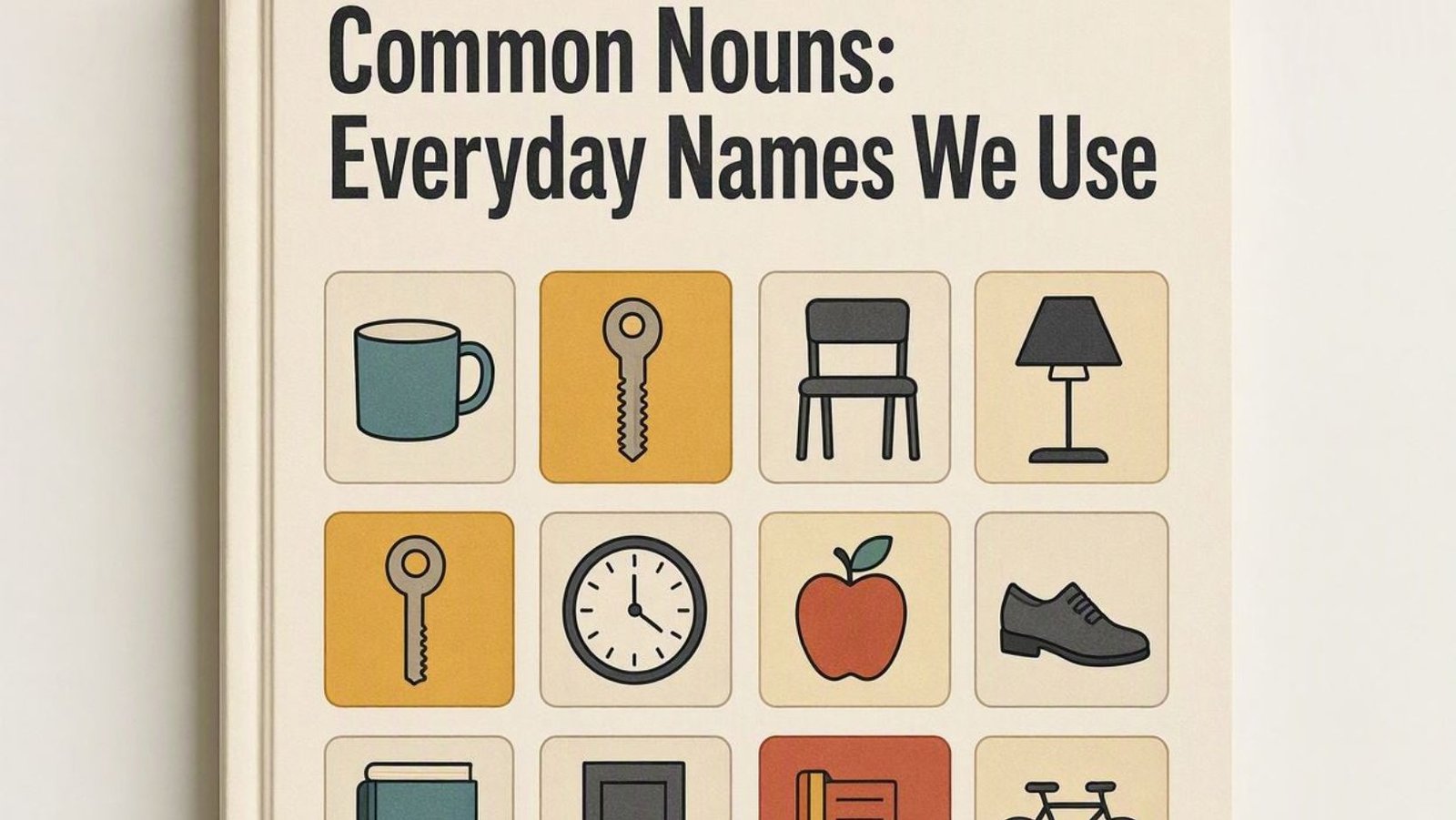
Common Nouns: Everyday Names We Use
A common noun refers to a general person, place, animal, object, or idea rather than a particular one. Unlike proper nouns, common nouns are not usually capitalized unless they begin a sentence or form part of a title.
Common nouns are widely used in everyday speaking and writing.
Examples:
- People: Teacher, doctor, farmer, noun definition and types
- Places: School, market, city, noun definition and types
- Animals: Dog, cat, lionnoun definition and types
- Objects: Table, pencil, bag,noun definition and types
- Ideas: Education, friendship, freedonoun definition and types
Common Noun Examples in Sentences
- The teacher explained the noun definition and types
- A dog is sleeping near the noun definition and types
- My brother bought a new phone.
- The market is crowded noun definition and types
- Every student should complete the assignment.
The highlighted words name general people, animals, objects, or places.
Common Nouns vs. Proper Nouns
Common nouns identify a general category, whereas proper nouns identify a particular member of that category.
| Common Noun | Proper Noun |
| Boy | Ahmed |
| Country | Pakistan |
| City | Lahore |
| River | Indus River |
| School | Beaconhouse School |
| Company | Microsoft |
| Mountain | Mount Everest |
| Book | The Hobbit |
For example, country can refer to any country. However, Pakistan identifies one specific country.
Both types are important because common nouns help us discuss general things, while proper nouns allow us to identify particular ones.
Concrete Nouns: Words for Things We Can Sense
A concrete noun names something that can be experienced through one or more of the five senses: sight, hearing, smell, taste, or touch.
Concrete nouns often represent physical objects, but they can also include sounds, scents, and other sensory experiences.
Examples:
- Sight: Rainbow, mountain, flower,noun definition and types
- Hearing: Music, thunder, bell, noun definition and types
- Smell: Perfume, smoke, fragrance, noun definition and types
- Taste: Sugar, lemon, chocolatenoun definition and types
- Touch: Stone, cotton, icenoun definition and types
Concrete Noun Examples in Sentences
- The flower smells wonderful.
- I heard the bell ringing.
- The ice feels cold.
- She ate a piece of chocolate.
- The mountain looks beautiful in winter.
Each noun represents something that can be experienced through thnoun definition and types
Why Concrete Nouns Matter
Concrete nouns make descriptions more specific and vivid. They help readers imagine the people, objects, and surroundings described in a noun definition and types
For instance, the sentence I saw something beautiful is less specific than I saw a colorful butterfly. The noun butterfly gives the reader a clearer noun definition and types
Concrete nouns can be countable or uncountable. For example, apple is countable, while water is generally uncountable.
Abstract Nouns: Understanding Feelings, Ideas, and Qualities
An abstract noun names an idea, emotion, condition, quality, or state that cannot normally be experienced through the five physical noun definition and types
Unlike concrete nouns, abstract nouns describe concepts rather than physicanoun definition and types
Examples:
- Emotions: Love, happiness, sadness, fear
- Qualities: Honesty, kindness, bravery, patience
- Ideas: Freedom, justice, equality, wisdom
- States: Childhood, poverty, peace, adulthood
- Experiences: Success, failure, growth, progress
Abstract Noun Examples in Sentences
- Honesty is an important quality.
- Her kindness made everyone feel welcome.
- Freedom is valuable to every society.
- The children expressed their happiness.
- Patience helps people overcome difficulties.
These nouns name feelings, values, and conditions rather than physical objects.
How Abstract Nouns Are Formed
Many abstract nouns come from adjectives, verbs, or other nouns.
| Root Word | Abstract Noun |
| Kind | Kindness |
| Happy | Happiness |
| Honest | Honesty |
| Brave | Bravery |
| Strong | Strength |
| Decide | Decision |
| Educate | Education |
| Grow | Growth |
| Perform | Performance |
| Free | Freedom |
However, not every abstract noun follows a predictable word-building pattern.
Concrete vs. Abstract Nouns
Concrete and abstract nouns are distinguished by what they represent.
- Concrete noun: A book that you can see and touch.
- Abstract noun: Knowledge that you can gain from reading.
- Concrete noun: A flower that you can smell.
- Abstract noun: Love that you may feel for someone.
- Concrete noun: A medal that you can hold.
- Abstract noun: Success that the medal may represent.
A helpful way to identify an abstract noun is to ask whether the word names an idea, quality, emotion, or state rather than a sensory object.
Collective Nouns: Names for Groups
A collective noun is a word that refers to a group of people, animals, or things considered as one unit.
Collective nouns allow us to describe a collection without naming every individual member.
Examples:
- People: Team, family, committee, audience
- Animals: Herd, flock, swarm, pack
- Things: Bunch, collection, set, fleet
Collective Noun Examples in Sentences
- The team won the competition.
- A flock of birds flew across the sky.
- The committee discussed the proposal.
- Our family enjoys spending time together.
- A herd of cattle was grazing in the field.
Each bold word represents a group.
Common Collective Nouns for Animals
| Collective Noun | Group |
| Herd | Cattle or elephants |
| Flock | Sheep or birds |
| Pack | Wolves or dogs |
| Swarm | Bees or insects |
| Pride | Lions |
| School | Fish |
| Colony | Ants or penguins |
| Gaggle | Geese |
| Troop | Monkeys |
| Litter | Puppies or kittens |
Some group names are traditional expressions rather than strict scientific classifications.
Singular or Plural Verb With Collective Nouns
In American English, collective nouns generally take singular verbs when the group acts as a single unit.
- The team is ready for the match.
- The committee has reached a decision.
In British English, a collective noun can take either a singular or plural verb, depending on whether the group is viewed as a unit or as individual members.
- The team are discussing their individual responsibilities.
The important point is to use a consistent grammatical approach that suits the variety of English you are writing.
Countable Nouns: Things We Can Count
A countable noun refers to something that can be counted as individual units. These nouns have singular and plural forms and can be used with numbers.
Examples:
- One apple, two apples
- One chair, four chairs
- One student, twenty students
- One car, three cars
- One idea, several ideas
Countable Nouns in Sentences
- I bought three books.
- She has an umbrella.
- There are five students in the room.
- We planted ten trees.
- He shared several ideas.
Countable nouns are often used with words such as a, an, many, few, several, and a number of.
Rules for Countable Nouns
- Use a or an with singular countable nouns when appropriate.
- Add a suitable plural ending when the noun is plural.
- Use many with plural countable nouns.
- Use few or a few to refer to a small number.
- Use numbers directly with countable nouns.
Examples:
- A student
- An orange
- Many questions
- A few friends
- Seven days
Some countable nouns have irregular plural forms, such as child/children, man/men, and tooth/teeth.

Uncountable Nouns: Understanding Non-Count Nouns
An uncountable noun, also known as a non-count noun, refers to something that is not normally counted as separate individual units.
These nouns often represent substances, materials, concepts, or general quantities.
Examples:
- Liquids: Water, milk, oil, juice
- Materials: Wood, gold, silver, plastic
- Food: Rice, sugar, flour, butter
- Ideas: Information, advice, knowledge, research
- Other concepts: Equipment, furniture, traffic, weather
Uncountable Nouns in Sentences
- Please give me some water.
- She shared useful information.
- We need more furniture.
- He gave me valuable advice.
- The weather is pleasant today.
Uncountable nouns usually do not take a plural -s ending when they are used in their general non-count meaning.
Rules for Uncountable Nouns
- Use much with uncountable nouns.
- Use little or a little to express a small amount.
- Use some or any where appropriate.
- Do not normally use a or an directly before an uncountable noun.
- Use a suitable unit or container when you need to count them.
For example:
- Some water
- Much information
- A little sugar
- A piece of advice
- Two bottles of milk
- Three bags of rice
Countable vs. Uncountable Nouns
| Countable Nouns | Uncountable Nouns |
| Apple | Water |
| Book | Information |
| Chair | Furniture |
| Coin | Money |
| Idea | Knowledge |
| Bottle | Milk |
| Question | Advice |
| Suitcase | Luggage |
Some nouns can be countable or uncountable depending on their meaning.
For example:
- I drank some coffee. (Uncountable)
- I ordered two coffees. (Two servings)
- She has a lot of experience. (General knowledge gained over time)
- She had several interesting experiences. (Individual events)
This distinction is important because the same word may behave differently in different contexts.
Material Nouns: Names of Substances and Raw Materials
A material noun names a substance or material from which things are made. In traditional English grammar, material nouns are often treated as a separate category.
Examples:
- Gold
- Silver
- Iron
- Copper
- Cotton
- Wool
- Plastic
- Wood
- Steel
- Marble
Material Noun Examples in Sentences
- The ring is made of gold.
- The gate is made of iron.
- This shirt is made of cotton.
- The table is made of wood.
- The sculpture was carved from marble.
Material nouns commonly behave as uncountable nouns when referring to the substance itself.
However, they may become countable when referring to types, objects, or servings.
For example:
- Glass is used to make windows.
- The shop sells several decorative glasses.
The first sentence refers to a material. The second refers to individual drinking vessels.
Compound Nouns: Words That Work Together
A compound noun is a noun formed by combining two or more words to create a single concept or name.
Compound nouns may be written as one word, as separate words, or with a hyphen.
Examples:
- One word: Bedroom, football, notebook, sunflower
- Two words: Bus stop, swimming pool, post office, school bus
- Hyphenated: Mother-in-law, check-in, passer-by
Compound Nouns in Sentences
- My bedroom is clean.
- We waited at the bus stop.
- She bought a new notebook.
- The swimming pool is open.
- My mother-in-law lives nearby.
Common Ways to Form Compound Nouns
- Noun + noun: Toothbrush, classroom, raincoat
- Adjective + noun: Blackbird, greenhouse, full moon
- Verb + noun: Washing machine, driving licence
- Gerund + noun: Swimming pool, dining room
- Noun + preposition + noun: Mother-in-law, editor-in-chief
Not every combination of words forms a compound noun. The combination must function as a recognized naming unit in context.
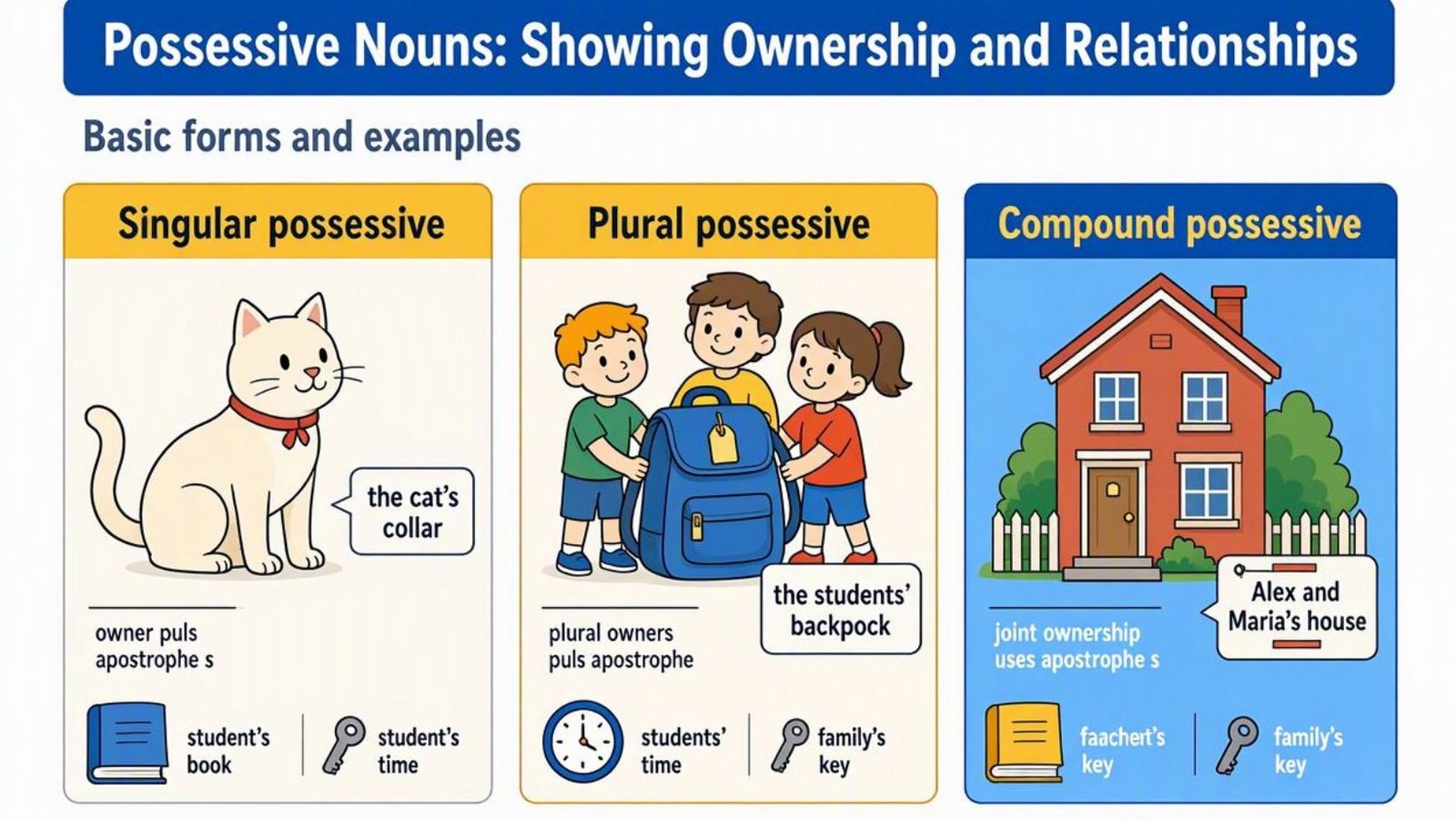
Possessive Nouns: Showing Ownership and Relationships
A possessive noun indicates ownership, association, or a relationship between people, animals, places, or things.
In English, possessive nouns commonly use an apostrophe with s or an apostrophe alone.
Examples:
- Ali’s book
- The teacher’s desk
- The dog’s tail
- The students’ classroom
- The children’s toys
Rules for Forming Possessive Nouns
- Singular noun: Add ‘s.
- The girl’s bag
- The boy’s bicycle
- Regular plural ending in s: Add an apostrophe.
- The teachers’ room
- The players’ uniforms
- Irregular plural not ending in s: Add ‘s.
- The children’s books
- The men’s shoes
- Singular noun ending in s: Often add ‘s, depending on the style guide.
- James’s phone
Possessive Nouns in Sentences
- Sarah’s laptop is new.
- The children’s playground is large.
- The teachers’ meeting starts at noon.
- The cat’s food is in the kitchen.
Possessive nouns should not be confused with plural nouns. An apostrophe generally shows possession, not simply that there is more than one item.
Nouns in Sentences: 6 Important Grammatical Functions
Nouns do more than name things. They also perform different grammatical roles within a sentence. Understanding these roles makes it easier to form clear and correct sentences.
Nouns as Subjects
A subject noun tells us who or what performs an action or is being described.
Examples:
- Ahmed plays football.
- The baby is sleeping.
- Birds fly in the sky.
Nouns as Direct Objects
A direct object receives the action of a transitive verb.
Examples:
- She reads a book.
- He kicked the ball.
- They built a house.
Nouns as Indirect Objects
An indirect object identifies the person or thing that receives something or benefits from an action.
Examples:
- She gave Ali a gift.
- The teacher told the students a story.
- My father bought me a bicycle.
In these sentences, Ali and students are nouns serving as indirect objects. Me is a pronoun.
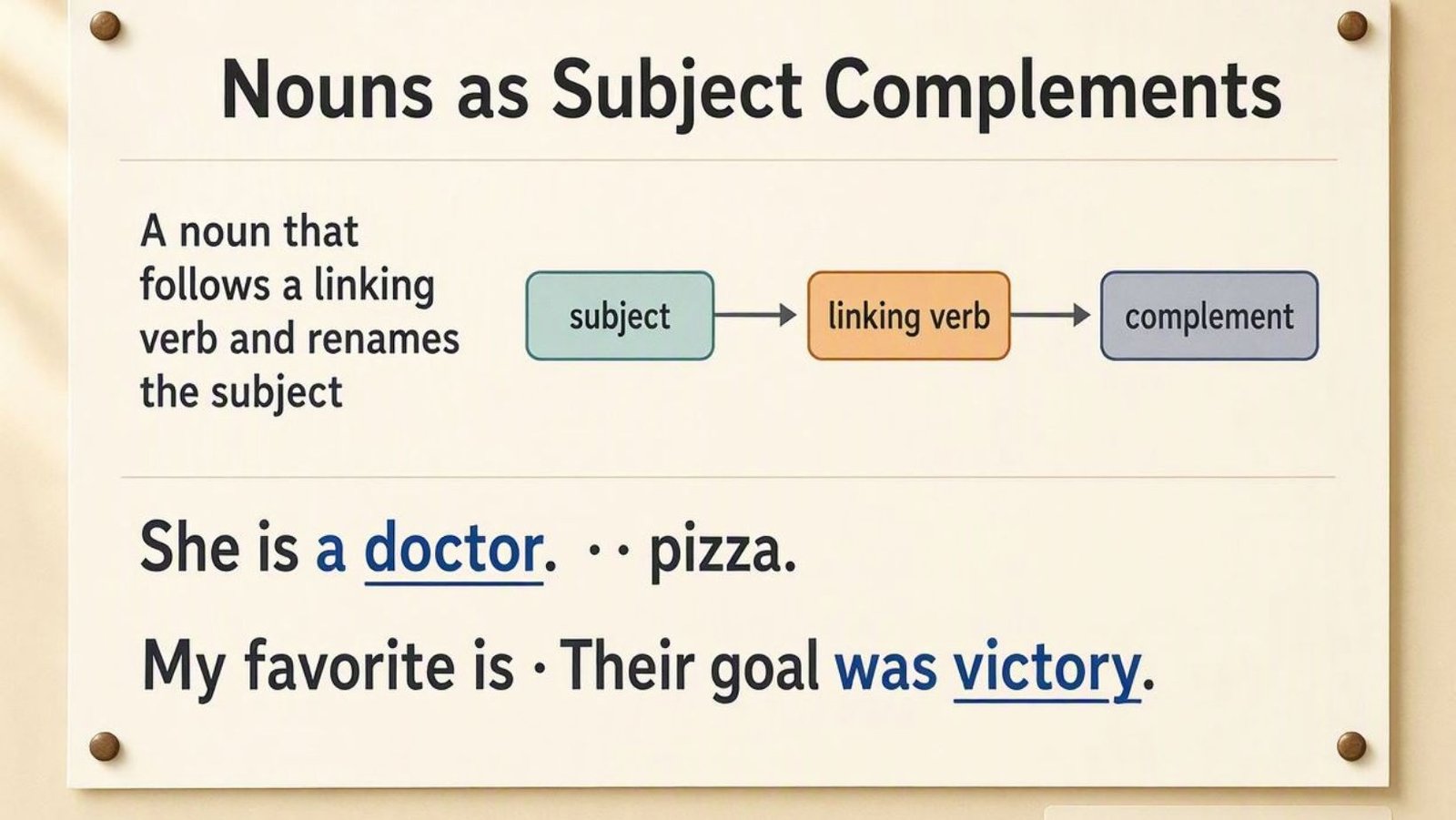
Nouns as Subject Complements
A subject complement follows a linking verb and identifies or describes the subject.
Examples:
- Ahmed is a doctor.
- My sister became a teacher.
- She is the captain.
The noun complement identifies the subject rather than receiving an action.
Nouns as Object Complements
An object complement renames or identifies the direct object.
Examples:
- They elected Ahmed president.
- We named our puppy Max.
- The committee appointed Sarah chairperson.
Nouns as Modifiers
A noun can modify another noun by describing its type, purpose, or function.
Examples:
- School bus
- Coffee cup
- Football match
- Kitchen table
In these examples, the first noun modifies the second noun.
Singular and Plural Nouns: Essential Number Rules
Nouns can express whether we are talking about one person, place, object, or animal, or more than one.
A singular noun refers to one. A plural noun usually refers to two or more.
Examples:
- Student → Students
- Book → Books
- Car → Cars
- Apple → Apples
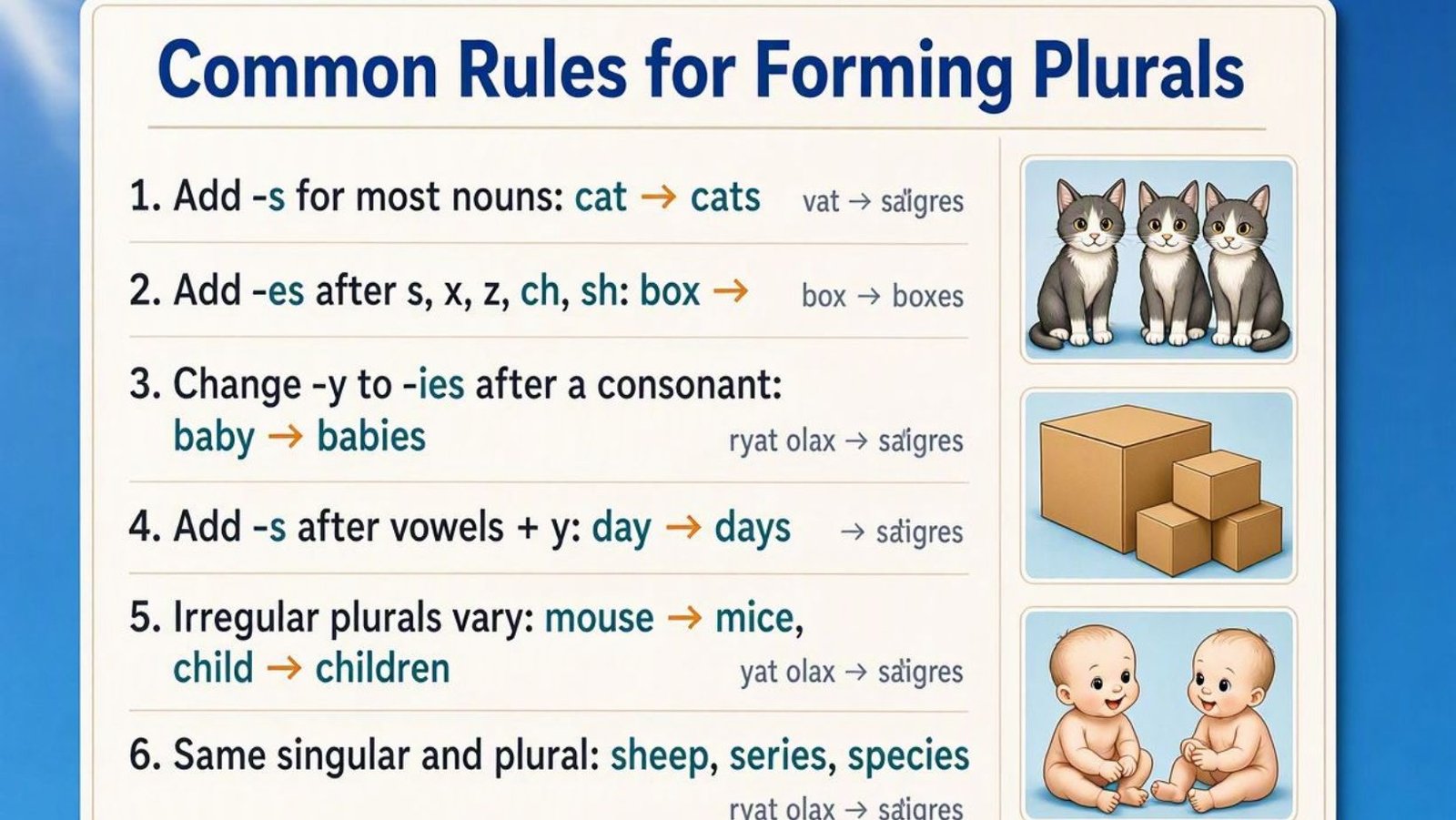
Common Rules for Forming Plurals
- Add -s to most nouns.
- Pen → Pens
- Chair → Chairs
- Add -es to many nouns ending in s, ss, sh, ch, x, or z.
- Bus → Buses
- Box → Boxes
- Change consonant + y to -ies.
- Baby → Babies
- City → Cities
- Add -s to many nouns ending in vowel + y.
- Boy → Boys
- Key → Keys
- Some nouns ending in f or fe change to -ves.
- Leaf → Leaves
- Knife → Knives
These are common patterns, but English has exceptions. For example, roof becomes roofs, not usually rooves.
Irregular Plural Nouns
Some nouns change their spelling in unusual ways.
| Singular | Plural |
| Man | Men |
| Woman | Women |
| Child | Children |
| Foot | Feet |
| Tooth | Teeth |
| Mouse | Mice |
| Person | People |
| Goose | Geese |
Some nouns have identical singular and plural forms, such as sheep, deer, and species.
Learning these forms helps avoid common grammar errors.
Gerunds: When Verbs Function as Nouns
A gerund is the -ing form of a verb that functions as a noun in a sentence.
Gerunds can name activities, habits, or experiences. Although they come from verbs, they can perform noun roles.
Examples:
- Reading improves vocabulary.
- I enjoy swimming.
- Walking is good exercise.
- She likes painting.
- Cooking requires patience.

Gerunds in Different Sentence Roles
- Subject: Dancing makes her happy.
- Direct object: He enjoys writing.
- Subject complement: My favorite activity is cycling.
- Object of a preposition: She is interested in learning.
Gerunds should not be confused with present participles, which are also formed with -ing but function differently.
For example:
- Reading is enjoyable. (Gerund functioning as a noun)
- She is reading a book. (Participle forming a verb phrase)
This distinction helps explain why the same word ending can perform different grammatical functions.
Nouns vs. Pronouns: Understanding the Difference
Nouns and pronouns are both important parts of speech, but they serve different purposes.
A noun names a person, place, thing, or idea. A pronoun takes the place of a noun or noun phrase to avoid unnecessary repetition.
| Noun | Pronoun |
| Ali | He |
| Sarah | She |
| Children | They |
| Book | It |
| Ahmed and I | We |
| The teacher | He or she |
Examples in Sentences
Without a pronoun:
- Sarah is a student. Sarah studies every day. Sarah likes science.
With a pronoun:
- Sarah is a student. She studies every day. She likes science.
The pronoun she refers to Sarah and makes the passage smoother.
Key Differences
- Nouns name specific or general people, places, objects, and ideas.
- Pronouns replace nouns or noun phrases in suitable contexts.
- Nouns can be common or proper, while pronouns have their own grammatical classifications.
- Both nouns and pronouns can function as subjects and objects.
- Pronouns must have clear references to avoid confusion.
Pronouns do not replace nouns in every situation. A noun may still be needed when introducing a new person, object, or idea.
Noun Phrases: How Nouns Work With Other Words
A noun phrase is a group of words organized around a noun or another noun-like head. It functions as a single unit in a sentence.
A noun phrase may contain determiners, adjectives, modifiers, and other elements.
Examples:
- A beautiful garden
- The old wooden house
- My younger brother
- Several interesting books
- The students in the classroom
Components of a Noun Phrase
- Determiner: A word such as a, an, the, this, or my.
- Adjective: A word that describes the noun.
- Head noun: The main noun in the phrase.
- Modifier: A word or phrase that adds further information.
For example, in the beautiful garden near our house:
- The is the determiner.
- Beautiful is an adjective.
- Garden is the head noun.
- Near our house is a modifying prepositional phrase.
Noun Phrases in Sentences
- The tall building near the station is new.
- She purchased a beautiful blue dress.
- My best friend from school visited yesterday.
The complete noun phrase functions as the subject or object, depending on its position in the sentence.
Noun Clauses: Groups of Words That Act Like Nouns
A noun clause is a dependent clause that performs a grammatical role similar to that of a noun. It often begins with words such as what, whatever, who, whoever, whether, or that.
Examples:
- What she said surprised everyone.
- I know that he is honest.
- Whoever finishes first will receive a prize.
- She explained why she was late.
Noun Clauses in Different Roles
- Subject: What you decide matters.
- Direct object: I understand what you mean.
- Subject complement: The truth is that we need more time.
- Object of a preposition: We talked about what happened.
A noun clause contains a subject and a verb, unlike a simple noun or noun phrase.
Recognizing noun clauses helps learners understand more complex sentences and improve their writing.
How to Identify a Noun in Any Sentence
Identifying nouns becomes easier when you look at the meaning and grammatical role of each word.
Use the following practical steps:
- Look for naming words. Identify words that name people, places, animals, objects, ideas, or feelings.
- Check the sentence role. See whether the word acts as a subject, object, complement, or modifier.
- Look for determiners. Words such as a, an, the, my, and those often appear before nouns or noun phrases.
- Check number. Determine whether the word has a singular or plural form, where applicable.
- Consider the context. A word can function as different parts of speech in different sentences.
Practice Examples
- The teacher explained the lesson.
- My brother bought a new bicycle.
- Honesty builds trust.
- The team celebrated its victory.
- Swimming helps improve fitness.
The highlighted words are nouns, including the gerund swimming.
However, identifying nouns by position alone can lead to errors. For example, a word ending in -ing may be a noun, an adjective, or part of a verb phrase. Always consider its function in the sentence.
Common Noun Mistakes and How to Avoid Them
Even experienced English learners sometimes misuse nouns. Understanding common mistakes can help you write more accurately.
Mistake 1: Using Plural Forms of Uncountable Nouns
Incorrect: She gave me many advices.
Correct: She gave me a lot of advice.
Advice is generally uncountable in standard English. Use a piece of advice when referring to an individual suggestion.
Mistake 2: Forgetting Capital Letters
Incorrect: I live in pakistan.
Correct: I live in Pakistan.
Proper nouns require capitalization.
Mistake 3: Confusing Possessive and Plural Forms
Incorrect: The girls bag is blue.
Correct: The girl’s bag is blue.
The apostrophe and s indicate that the bag belongs to one girl.
Mistake 4: Using Incorrect Articles
Incorrect: She bought a apple.
Correct: She bought an apple.
Use an before a vowel sound, not simply a vowel letter.
Mistake 5: Using the Wrong Subject-Verb Agreement
Incorrect: The students is ready.
Correct: The students are ready.
Plural countable nouns usually take plural verbs in the present tense.
Mistake 6: Treating Every Abstract Noun as Uncountable
Incorrect: She had many happinesses during her childhood. (In an ordinary general context.)
Correct: She experienced a lot of happiness during her childhood.
Some abstract nouns can be countable in particular meanings, so context matters. However, happiness is generally uncountable in ordinary usage.
Mistake 7: Confusing Nouns With Adjectives
Incorrect: She showed great kind.
Correct: She showed great kindness.
Kind is generally an adjective in this construction, while kindness is the noun.
Practical Examples of Different Noun Types
The following examples bring together the major noun categories and show how they work in everyday English.
| Sentence | Noun | Type |
| Ali reads every evening. | Ali | Proper |
| The teacher is helpful. | Teacher | Common |
| The baby touched the ball. | Ball | Concrete |
| Honesty matters. | Honesty | Abstract |
| The team won the match. | Team | Collective |
| She bought three apples. | Apples | Countable |
| Please add some sugar. | Sugar | Uncountable |
| The ring contains gold. | Gold | Material |
| My bedroom is spacious. | Bedroom | Compound |
| Ahmed’s car is new. | Ahmed’s | Possessive |
| Swimming is enjoyable. | Swimming | Gerund |
| The old house is beautiful. | House | Common, concrete |
Keep in mind that a noun can fit multiple categories. For example, house is both a common noun and a concrete noun. Likewise, gold is a material noun and is generally uncountable when referring to the substance.
Why Learning Nouns Is Important for English Grammar
Nouns provide the foundation for meaningful communication. They help readers and listeners understand who is involved, where something happens, and what a sentence is about.
Learning noun categories can improve several language skills:
- Sentence formation: Understand how subjects and objects work.
- Writing accuracy: Use correct singular, plural, and possessive forms.
- Vocabulary development: Recognize relationships between different word types.
- Reading comprehension: Understand how nouns identify people, concepts, and objects.
- Speaking fluency: Communicate more clearly in everyday situations.
- Examination preparation: Answer grammar questions with greater confidence.
- Academic writing: Use precise terms and construct more detailed explanations.
Furthermore, nouns work closely with verbs, adjectives, pronouns, and prepositions. Understanding their functions makes it easier to study these other parts of speech.
For students, a solid understanding of nouns also supports more advanced topics, including clauses, sentence structure, and subject-verb agreement.
Simple Tips to Master Noun Definition and Types
Learning grammar does not have to be complicated. A few regular habits can help you recognize nouns and use them correctly.
- Read every day: Identify naming words in books, articles, and short stories.
- Create word lists: Group nouns into people, places, objects, feelings, and ideas.
- Practice with sentences: Write original sentences using different noun categories.
- Learn plural forms: Memorize common irregular plurals such as children, mice, and feet.
- Study countability: Practice using many with countable nouns and much with uncountable nouns.
- Use a dictionary: Check unfamiliar words and their grammatical labels.
- Review your writing: Look for incorrect capitalization, apostrophes, and noun forms.
- Take short quizzes: Test your understanding regularly instead of memorizing definitions alone.
A simple daily exercise is to select five sentences from a book or article and identify every noun. Then classify each one by meaning and grammatical function.
Over time, this practice can make noun recognition more natural and improve your overall command of English.
Noun Definition and Types: Quick Revision Table
Use this table to review the main categories before a test or grammar exercise.
| Noun Type | Definition | Examples |
| Proper | Names a specific entity | Ali, Pakistan |
| Common | Names a general entity | Boy, city |
| Concrete | Names something sensed physically | Chair, flower |
| Abstract | Names an idea, feeling, or quality | Love, courage |
| Collective | Names a group as a unit | Team, flock |
| Countable | Can be counted individually | Pen, apple |
| Uncountable | Not normally counted as individual units | Water, advice |
| Material | Names a substance or material | Gold, cotton |
| Compound | Combines words into one naming unit | Toothbrush, bus stop |
| Possessive | Shows ownership or association | Ali’s, students’ |
These categories are not mutually exclusive. A noun may belong to multiple groups, depending on how it is used.
For example, school is a common, concrete, and countable noun. Meanwhile, Pakistan is a proper and concrete noun.
Practice Quiz: Test Your Understanding of Nouns
Try the following questions to check your knowledge of noun definition and types. Read each sentence carefully and identify the relevant noun or category.
1. Which word is a proper noun?
- A) City
- B) Teacher
- C) Islamabad
- D) Country
Answer: C) Islamabad
2. Which of the following is an abstract noun?
- A) Table
- B) Honesty
- C) Window
- D) Pencil
Answer: B) Honesty
3. Which noun refers to a group of animals?
- A) Herd
- B) Chair
- C) Happiness
- D) Water
Answer: A) Herd
4. Which of the following is uncountable in its usual meaning?
- A) Apple
- B) Book
- C) Advice
- D) Chair
Answer: C) Advice
5. Identify the compound noun.
- A) Beautiful
- B) Classroom
- C) Quickly
- D) Honest
Answer: B) Classroom
6. Which sentence contains a gerund?
- A) She is reading a book.
- B) Reading improves knowledge.
- C) She reads daily.
- D) She will read tomorrow.
Answer: B) Reading improves knowledge.
7. What type of noun is gold when referring to the substance?
- A) Proper
- B) Collective
- C) Material
- D) Possessive
Answer: C) Material
8. Which word is a possessive noun?
- A) Boys
- B) Boy’s
- C) Boy
- D) Boys’ (in a context showing possession)
Answer: B) Boy’s
9. What is the plural form of child?
- A) Childs
- B) Childes
- C) Children
- D) Childrens
Answer: C) Children
10. Which word is a common noun?
- A) Lahore
- B) Monday
- C) Doctor
- D) Pakistan
Answer: C) Doctor
Use any incorrect answers as a guide to the topics you should review. Practicing regularly will help you distinguish noun categories in real sentences.
FAQs
1. What are the five types of nouns and their definitions?
Five commonly taught types of nouns are proper, common, collective, abstract, and concrete nouns. Proper nouns name specific entities, while common nouns name general ones. Collective nouns identify groups, abstract nouns represent ideas or feelings, and concrete nouns refer to things that can be experienced through the senses. These categories explain nouns according to their meanings.
2. Is a noun a definition?
No, a noun is not a definition. A noun is a part of speech that names a person, place, thing, animal, idea, feeling, or quality. A definition is an explanation of a word or concept. For example, teacher is a noun, while the explanation “a person who teaches students” is its definition.
3. What are the 12 types of nouns?
There is no single universally accepted list of exactly 12 noun types. However, some educational grammar systems classify nouns into categories such as proper, common, concrete, abstract, collective, countable, uncountable, material, compound, possessive, singular, and plural nouns. Other classifications also include gerunds and appositive nouns. The categories may overlap, and their number depends on the grammar framework.
4. What are the 8 types of nouns?
One possible educational classification of eight noun types includes proper, common, concrete, abstract, collective, countable, uncountable, and compound nouns. These categories describe nouns according to their meaning, specificity, or grammatical behavior. Some textbooks use different classifications, so students should follow the terminology used in their course.
5. What is the easiest way to identify a noun?
The easiest way to identify a noun is to look for a word that names a person, place, thing, animal, idea, or feeling. For example, in “The child plays in the garden,” child and garden are nouns. You can also examine how a word functions in the sentence, since some words can act as different parts of speech.
6. Can one noun belong to two different types?
Yes, a noun can belong to more than one category at the same time. For example, London is a proper noun because it names a specific city, and it is also a concrete noun because it refers to a physical place. Similarly, team is both a common noun and a collective noun.
7. What is the difference between countable and uncountable nouns?
Countable nouns refer to things that can be counted individually, such as books, chairs, and apples. They have singular and plural forms. Uncountable nouns refer to substances, concepts, or quantities that are not normally counted individually, such as water, information, and furniture. Countable nouns can take many, while uncountable nouns commonly take much.
8. What is the difference between a noun and a noun phrase?
A noun is a single naming word, such as book, student, or garden. A noun phrase is a group of words centered around a noun, such as the interesting book or a talented student. Both can perform grammatical roles such as subject or object, but a noun phrase provides additional information about the main noun.
Conclusion
Understanding noun definition and types is an important part of learning English grammar. Nouns name people, places, objects, animals, emotions, and ideas. They also perform essential grammatical functions as subjects, objects, complements, and modifiers.
From proper and common nouns to abstract, collective, countable, and uncountable nouns, each category helps explain how language works. In addition, learning compound nouns, possessive forms, gerunds, and noun phrases can strengthen your writing and communication skills.

1 thought on “100 + Noun Definition and Types: Complete Guide With Examples”