

If you have ever typed grammar or grammer and stopped to wonder which spelling is correct, you are not alone. This is a common English spelling mistake, especially because the word does not sound exactly the way it looks. The good news is simple: grammar or grammer is the standard spelling when you mean the rules and structure of a language.
The spelling grammer is generally incorrect when you are referring to language rules. It often appears as a typing error or spelling mistake. However, that does not mean the word can never appear anywhere. “Grammer” may occur in proper names, such as a person’s surname, but it is not the standard spelling of the English word for language structure.
Grammar or Grammer: The Correct Answer in One Minute
- Grammar is the correct standard spelling for the rules that govern how words and sentences are formed.
- Grammer is normally a misspelling when someone intends to write the word grammar.
- The correct word has -ar at the end, not -er.
- For example, write: “I need to improve my grammar.”
- Do not write: “I need to improve my grammer.”
- The word grammar or grammer applies to sentence structure, word forms, punctuation-related conventions, and other rules of language use.
- Although spelling and grammar or grammer are related, they are not exactly the same thing.
- If a spelling checker underlines “grammer,” it is usually identifying the common misspelling of grammar.
- Therefore, when discussing English language rules, choose grammar.

Why Do People Write Grammer Instead of Grammar?
- The confusion usually comes from pronunciation. In many accents, the final part of grammar or grammer can sound close to an unstressed “er” sound.
- English spelling does not always match pronunciation perfectly. As a result, writers sometimes spell a word according to how they think it sounds.
- The repeated m also makes the word visually unusual. Some learners remember the sound but forget whether the final vowel is a or e.
- Another reason is familiarity with words ending in -er. English contains many common words with this ending, so “grammer” can look believable at first glance.
- Fast typing can also create the mistake. When people type quickly, they may produce “grammer” without noticing it.
- Autocorrect does not always solve every spelling problem. In some situations, software may overlook a mistake, especially when a word resembles a valid name or another entry.
- Search engines may also display results for common misspellings. Seeing “grammer” online does not make it the correct standard spelling.
- The simplest solution is to memorize the ending: gramm + ar = grammar.
What Does Grammar Actually Mean?
- grammar or grammer refers to the system of rules and patterns that helps speakers and writers form meaningful expressions.
- It explains how words work together within phrases, clauses, and sentences.
- Grammar includes areas such as sentence structure, verb forms, word order, agreement, and many other language patterns.
- For example, English generally places the subject before the verb in a simple statement: “The child laughed.”
- Grammar also helps us understand differences between statements, questions, commands, and other sentence types.
- Consider the difference between “She is reading” and “Is she reading?” The words are similar, but their arrangement serves different purposes.
- Good grammar or grammer can make writing clearer because readers can understand relationships between ideas more easily.
- However, grammar is not simply a collection of strict rules. Languages change over time, and actual usage influences how people communicate.
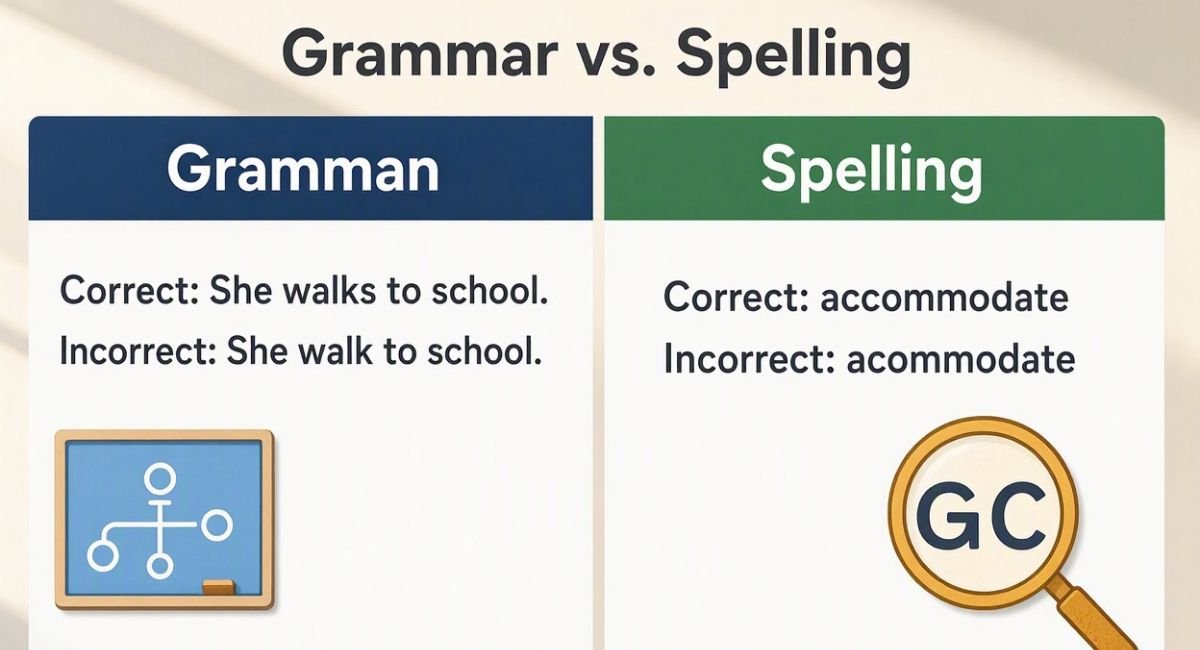
Grammar vs. Spelling: What Is the Difference?
- Grammar concerns how language is structured and used.
- Spelling concerns how individual words are written.
- For example, writing “He go to school” involves a grammatical problem because the verb does not agree with the subject in standard English.
- Writing “becaus” instead of “because” is primarily a spelling problem.
- The two areas often overlap in everyday writing. A sentence can contain both spelling and grammar or grammer errors.
- For instance, “She dont like grammar” contains an issue with subject-verb agreement or contraction usage, depending on the intended sentence, while “grammer” would be a spelling error.
- Therefore, learning grammar or grammer does not automatically mean mastering spelling.
- Strong writing usually requires attention to grammar, spelling, vocabulary, punctuation, and sentence clarity.
7 Simple Ways to Remember the Correct Spelling
- 1. Remember the ending: The standard word ends in -ar, giving you grammar, not “grammer.”
- 2. Connect it with “grammatical”: Both grammar and grammatical begin with “gramma.” This connection can help reinforce the correct spelling.
- 3. Say it slowly: Break the word into parts when learning it: gram-mar.
- 4. Write it repeatedly: Writing “grammar” several times can build visual familiarity with the correct form.
- 5. Create a sentence: Try remembering, “Good grammar or grammer makes writing clearer.”
- 6. Watch the final vowel: The most important difference is the final vowel. Choose a, not e, when you mean language rules.
- 7. Remember the shortcut: If you mean language rules, think grammar = language structure.
Common Sentences Using Grammar Correctly
- “Good grammar can make professional emails easier to understand.”
- “She is studying English grammar or grammer for her examination.”
- “The teacher explained the grammar or grammer rule with several examples.”
- “I am working on my grammar or grammer before submitting the essay.”
- “Grammar mistakes can sometimes change the meaning of a sentence.”
- “The website offers useful grammar exercises for beginners.”
- “He has strong vocabulary but needs to improve his grammar.”
- “Understanding basic grammar or grammer can make English writing more confident.”
- “The editor checked the article for grammar or grammer and spelling errors.”
- “This lesson explains an important grammar concept.”
Common Sentences Where Grammer Is Incorrect
- “I need to improve my grammer.” → Use grammar.
- “Her grammer is getting better.” → Use grammar.
- “The teacher corrected my grammer.” → Use grammar.
- “This book teaches English grammer.” → Use grammar.
- “Can you check my grammer?” → Use grammar.
- “He made several grammer mistakes.” → Use grammar.
- “I am learning basic grammer.” → Use grammar.
- “Good grammer helps clear communication.” → Use grammar.
- These examples show the same basic issue. If the intended meaning relates to language rules, the standard spelling is grammar.
A Quick Comparison Table
| Word | Standard English Word? | Meaning | Example |
| Grammar | Yes | Rules and structure of a language | “Her grammar is improving.” |
| Grammer | No, when intended as the language term | Usually a misspelling of grammar | “Check your grammer” is incorrect. |
| Grammatical | Yes | Related to grammar | “That sentence is grammatical.” |
| Grammatically | Yes | In a grammatical manner | “The sentence is grammatically correct.” |
| Grammarian | Yes | A person who studies or specializes in grammar | “The grammarian analyzed the sentence.” |
Is Grammer Ever a Correct Word?
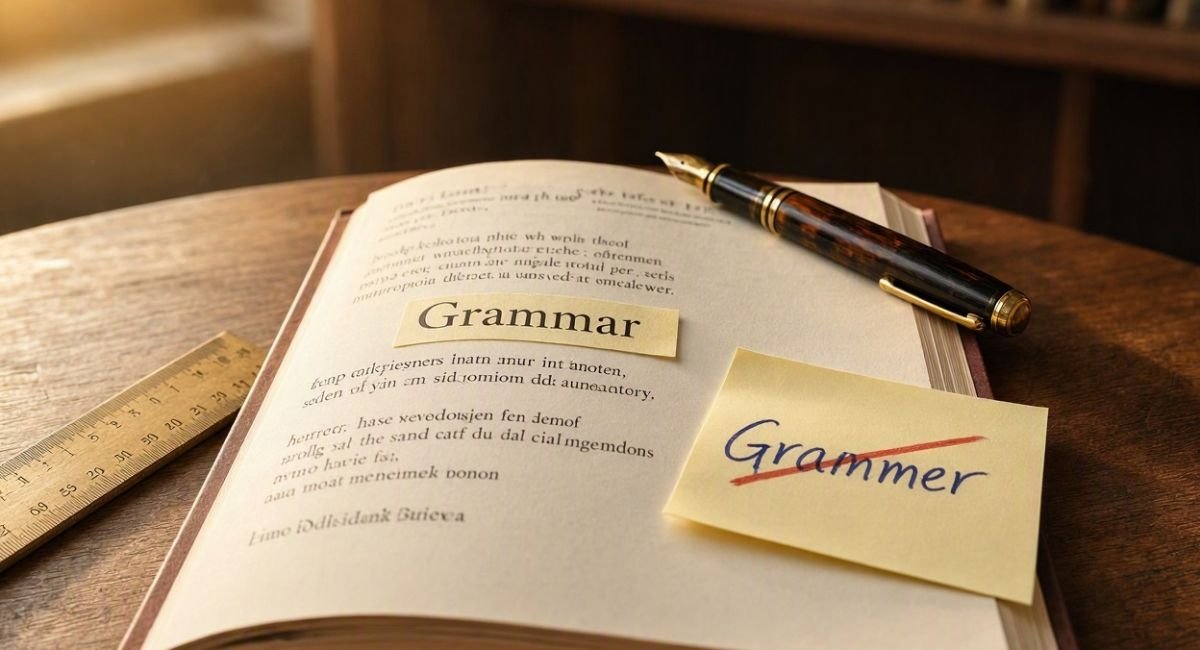
- In ordinary English writing, grammer should not replace grammar or grammer when you are discussing language rules.
- However, “Grammer” can appear as a proper name or surname. A name does not follow the same spelling logic as a common vocabulary word.
- For example, someone may legally have the surname “Grammer.” In that situation, changing it to “Grammar” would change the person’s name.
- The distinction is therefore important. A misspelling depends on the intended meaning and context.
- If you are writing about English grammar, use “grammar.”
- If you are referring to a person, organization, title, or other proper noun that genuinely uses “Grammer,” preserve its official spelling.
- This exception does not make “grammer” an alternative spelling of the language term.
Grammar in British and American English
- The spelling grammar or grammer is standard in both British English and American English.
- Unlike some words that have different regional spellings, such as “colour” and “color,” this word does not normally change from “grammar” to “grammer.”
- British English uses grammar.
- American English also uses grammar.
- Australian English uses grammar or grammer as well.
- Canadian English generally uses grammar.
- Therefore, regional English should not be used as an excuse for writing “grammer.”
- If you are writing for an international audience, grammar or grammer remains the safe standard spelling.
Does Grammar Have Different Spellings in Other English Varieties?
- No standard variety of English normally changes “grammar” into “grammer.”
- Some English words genuinely have regional spelling differences, but this is not one of them.
- For example, centre and center can reflect British and American preferences.
- Similarly, colour and color differ by regional convention.
- Grammar, however, remains “grammar” across these major varieties.
- This makes the spelling easier to learn once you know the rule.
- If you see “grammer” in an English-learning context, it is usually a mistake rather than a British or American alternative.
The Origin of the Word Grammar
- The history of grammar or grammer goes back through several languages.
- The English word ultimately traces its history to terms associated with learning, writing, and language study.
- Its deeper history is connected with the Greek word grammatike, which referred to the art of letters or writing.
- The word passed through Latin and French before becoming established in English.
- This long history helps explain why the spelling may not seem completely predictable from modern pronunciation.
- English has borrowed thousands of words from other languages. Their original spellings and sounds have often changed over centuries.
- Therefore, modern learners should focus more on the established English spelling than on trying to spell the word exactly as it sounds.
- The historical background is interesting, but remembering grammar or grammer is much more useful for everyday writing.
Why the Double M Matters
- One useful spelling clue is the double m in grammar.
- The word begins with gramm-, followed by -ar.
- Writing only one “m” creates another spelling error: “gramar.”
- Adding an “e” at the end creates the familiar mistake “grammer.”
- A useful visual pattern is GRAM-MAR.
- You can also connect the word with related forms such as grammatical and grammarian.
- These related words reinforce the “gramm” beginning.
- Once the spelling becomes visually familiar, you will probably recognize the incorrect version more quickly.
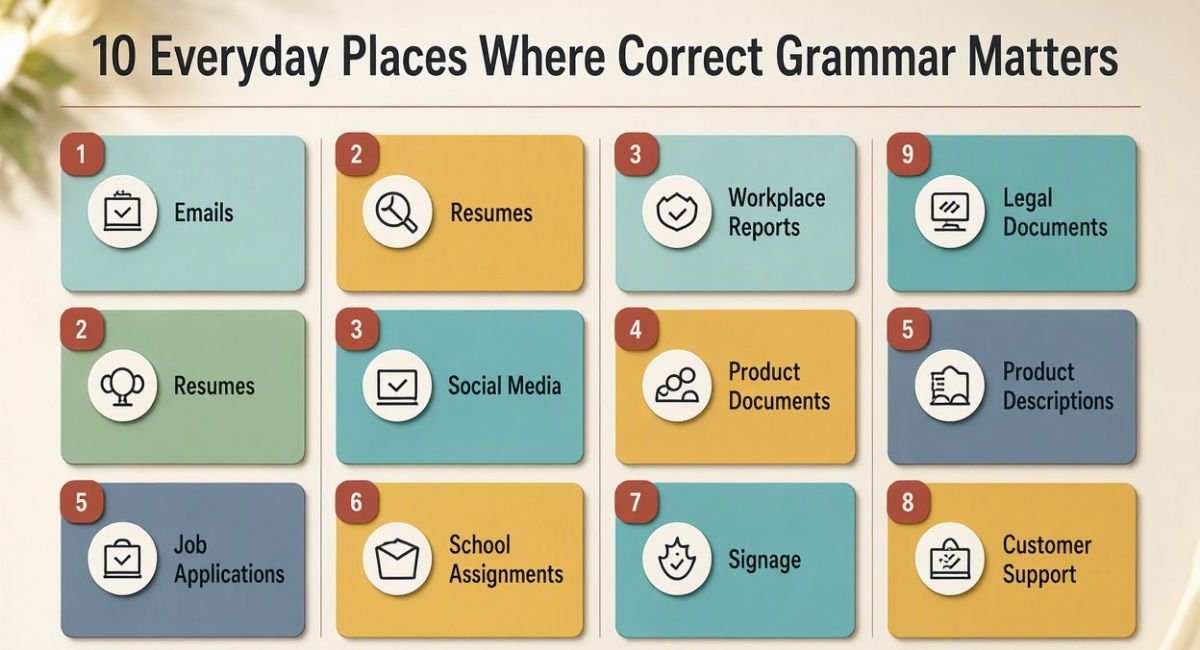
10 Everyday Places Where Correct Grammar Matters
- 1. School assignments: Teachers often evaluate grammar or grammer because clear sentences make ideas easier to understand.
- 2. College essays: Academic writing benefits from accurate sentence structure and consistent language.
- 3. Job applications: Professional documents should communicate information clearly and confidently.
- 4. Emails: Correct grammar or grammer can make workplace messages sound more polished.
- 5. Reports: Clear grammatical structures help readers follow facts, findings, and recommendations.
- 6. Websites: Poor grammar or grammer can reduce a site’s credibility, especially when the content represents a business.
- 7. Social media: Casual writing allows flexibility, but basic grammar or grammer still improves readability.
- 8. Presentations: Good sentence construction helps speakers organize written slides and supporting material.
- 9. Customer service: Clear language reduces confusion when explaining instructions or resolving problems.
- 10. Everyday messages: Even short messages become easier to understand when the sentence structure is clear.
Grammar Mistakes You Should Watch For
- Subject-verb agreement: Make sure the verb matches the subject in standard constructions.
- Verb tense: Keep the time of an action consistent unless there is a reason to change it.
- Sentence fragments: Check that a sentence contains the necessary elements to express a complete thought.
- Run-on sentences: Avoid joining multiple independent thoughts without appropriate punctuation or conjunctions.
- Pronoun agreement: Make sure pronouns clearly refer to the intended nouns.
- Word order: Place words in an order that makes the intended meaning obvious.
- Articles: Pay attention to words such as “a,” “an,” and “the.”
- Prepositions: Learn common combinations because English prepositions can be difficult for learners.
- Contractions: Use forms such as “they’re,” “their,” and “there” correctly.
- Consistency: Keep tense, person, number, and style consistent within your writing.
Grammar vs Grammer in School Writing
- Students often encounter this spelling mistake because language subjects require frequent use of the word.
- A learner might write, “I need to study grammer before the test.” The correct sentence is, “I need to study grammar or grammer before the test.”
- This small spelling issue can be easy to overlook because the incorrect form looks plausible.
- Teachers may correct it repeatedly because spelling accuracy becomes increasingly important in academic writing.
- A practical approach is to create a personal list of commonly misspelled words.
- Add grammar or grammer to that list and practice it alongside words such as “necessary,” “separate,” and “definitely.”
- Over time, repeated exposure will make the correct spelling feel natural.
Grammar vs Grammer in Professional Writing
- Professional writing creates a stronger impression when common spelling mistakes are removed.
- Imagine sending a client an email that says, “Please check the grammer in this document.” The reader may understand you, but the error can reduce the polish of the message.
- Instead, write, “Please check the grammar or grammer in this document.”
- This is especially important for editors, teachers, writers, marketers, and people whose work depends heavily on communication.
- Before sending important material, use a spelling checker and read the text yourself.
- Automated tools can identify many mistakes, but human review remains useful for context, tone, and meaning.
How to Check Grammar Without Overcomplicating It
- Read the sentence aloud: Hearing the sentence can reveal awkward structures that are difficult to notice silently.
- Check the subject and verb: Ask who or what performs the action and whether the verb agrees.
- Look at the tense: Confirm that the verb expresses the intended time.
- Check punctuation: Make sure commas, periods, question marks, and other marks serve a clear purpose.
- Review spelling: Search for familiar mistakes such as “grammer.”
- Remove unnecessary words: Concise sentences are often easier to understand.
- Read the final version once more: A second pass can catch errors missed during the first review.
8 Easy Grammar Habits for Better Writing
- 1. Read regularly: Exposure to well-written English helps you recognize natural sentence patterns.
- 2. Write every day: Even a short paragraph gives you an opportunity to practice.
- 3. Review your mistakes: Do not simply correct an error. Learn why it happened.
- 4. Keep a vocabulary notebook: Record unfamiliar words with examples.
- 5. Practice one topic at a time: Focus on verb tenses before moving to more advanced structures.
- 6. Use examples: grammar or grammer explanations become easier when you can see the rule in real sentences.
- 7. Ask for feedback: A teacher, editor, or knowledgeable reader can identify patterns you may miss.
- 8. Recheck common misspellings: Keep frequently confused words on your personal review list.
How Grammar and Vocabulary Work Together
- Grammar and vocabulary perform different jobs, but strong communication needs both.
- Vocabulary gives you the words needed to express an idea.
- Grammar helps you arrange those words so the relationship between ideas becomes clear.
- A person can know many English words but still struggle to form understandable sentences.
- Conversely, someone can use simple vocabulary while producing very clear and effective writing.
- Therefore, improving English does not require memorizing difficult words alone.
- A balanced approach includes vocabulary development, grammar or grammer practice, reading, listening, speaking, and writing.
- This approach can gradually improve both accuracy and confidence.
Why Correct Spelling Matters
- Correct spelling makes written communication easier to read.
- It also helps readers trust that the writer has reviewed the content carefully.
- A single typo is rarely a serious problem, but repeated errors can distract readers.
- In academic and professional environments, spelling accuracy can influence how polished a document appears.
- Correct spelling also helps search engines and digital tools understand content more accurately.
- For English learners, learning the standard form of common words builds a stronger foundation for future writing.
- That is why remembering grammar or grammer instead of “grammer” is a small but worthwhile improvement.
Grammar in Digital Communication
- Digital communication has made writing faster than ever.
- People send messages, comments, emails, captions, and posts within seconds.
- Because speed matters, spelling mistakes are common.
- Informal communication also encourages abbreviations, emojis, fragments, and conversational language.
- However, informal writing still benefits from basic clarity.
- In formal digital communication, such as work emails or business messages, correct spelling and grammar or grammer matter even more.
- Before posting or sending important content, take a few seconds to scan for obvious mistakes.
- That short review can prevent embarrassing errors.
A Practical Editing Checklist
- First: Read the complete text without making changes.
- Second: Identify sentences that sound unclear or awkward.
- Third: Check subject-verb agreement.
- Fourth: Review verb tenses.
- Fifth: Check spelling and commonly confused words.
- Sixth: Look for unnecessary repetition.
- Seventh: Review punctuation.
- Eighth: Make sure names, numbers, and technical terms are accurate.
- Ninth: Read the final version once more before publishing or sending it.
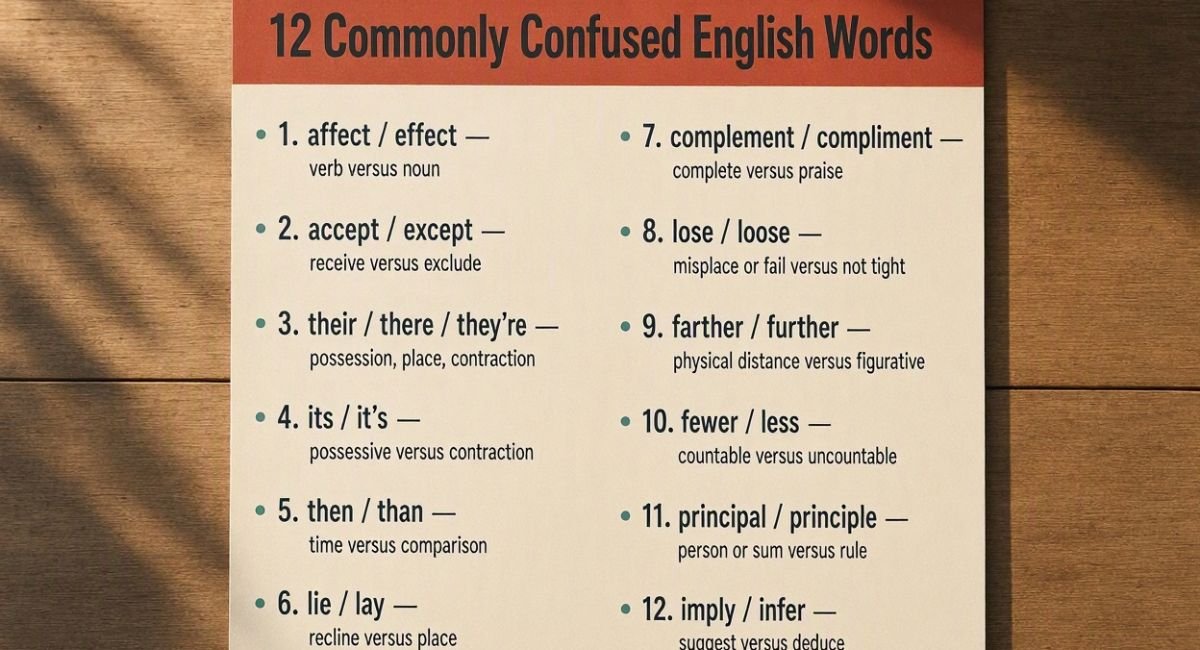
12 Commonly Confused English Words
- Their / there / they’re: These words sound similar but have different meanings and functions.
- Your / you’re: “Your” shows possession, while “you’re” means “you are.”
- Its / it’s: “Its” is possessive, while “it’s” is usually a contraction of “it is” or “it has.”
- Then / than: “Then” commonly relates to time, while “than” is used in comparisons.
- Affect / effect: These words have different grammatical roles and meanings, although usage can be complex.
- Lose / loose: “Lose” means to misplace or fail to win, while “loose” means not tight.
- Accept / except: “Accept” usually means receive or agree, while “except” commonly indicates exclusion.
- Advice / advise: “Advice” is a noun, while “advise” is a verb.
- Principal / principle: “Principal” can refer to a person or something primary, while “principle” means a rule or belief.
- Separate / seperate: The correct spelling is “separate.”
- Definitely / definately: The standard spelling is “definitely.”
- Grammar / grammer: The standard language term is grammar.
A Simple Memory Exercise
- Write the word grammar or grammer five times.
- Then cover it and try writing it from memory.
- Compare your version with the correct spelling.
- If you wrote “grammer,” focus specifically on the final a.
- Next, use the word in three sentences.
- For example: “My grammar or grammer is improving.”
- Then write: “I am studying English grammar.”
- Finally, write: “Good grammar or grammer makes writing clearer.”
- Repeating the word in meaningful sentences is usually more useful than memorizing it in isolation.
How Teachers Can Help Students Remember Grammar
- Teachers can introduce the spelling through short, repeated examples.
- A classroom word wall can display grammar alongside related terms such as grammatical and grammatically.
- Students can also create short spelling challenges.
- For example, a teacher might provide “gramm__” and ask students to complete the word.
- Another useful technique is contrast practice: “grammar” is correct, while “grammer” is incorrect when referring to language rules.
- Short exercises work particularly well because they reinforce the correct spelling without making the lesson unnecessarily difficult.
- Students should also see the word in authentic sentences.
How Writers Can Avoid Repeating the Same Mistake
- Add commonly misspelled words to a personal proofreading list.
- Use a reliable spell-checking tool before publishing.
- Read important documents slowly rather than relying entirely on automated corrections.
- Create a custom dictionary when your writing software supports one.
- Learn the correct form of words you repeatedly misspell.
- Review old documents to identify recurring mistakes.
- Keep a short checklist beside you when writing long articles.
- Most importantly, do not feel discouraged by occasional spelling errors. Recognizing a mistake is part of improving your writing.
When to Use Grammar in a Sentence
- Use grammar as a noun when referring to the rules or structure of a language.
- “English grammar can be challenging for beginners.”
- “She is studying grammar tonight.”
- “The book explains basic grammar.”
- “His grammar has improved significantly.”
- “The teacher marked several grammar errors.”
- “I want to learn grammar through practical examples.”
- The word can also appear in compounds and related expressions, such as grammar rules, grammar lesson, grammar checker, and grammar book.
Useful Grammar-Related Terms
- Grammatical: Relating to grammar or following grammatical rules.
- Grammatically: In a way that relates to grammar.
- Grammarian: A person who studies or specializes in grammar.
- Grammar checker: A digital tool designed to identify potential grammatical problems.
- Grammar rule: A description of a particular language pattern.
- Grammar lesson: Instruction focused on grammatical concepts.
- Grammar exercise: A practice activity designed to improve grammatical knowledge.
- Grammar mistake: A problem involving the grammatical structure or use of a sentence.
What a Grammar Checker Can and Cannot Do
- Grammar-checking software can identify many spelling and sentence-level problems.
- It can often flag incorrect word choices, punctuation issues, agreement problems, and possible sentence fragments.
- However, automated suggestions are not always correct.
- Context matters, especially when writing creatively, technically, or conversationally.
- A tool may suggest a change that technically follows a common pattern but does not match your intended meaning or style.
- Therefore, use digital grammar tools as assistants rather than unquestionable authorities.
- Human judgment remains important when editing professional, academic, and creative content.
Grammar for English Learners
- English learners often find grammar difficult because English contains many irregular forms and exceptions.
- However, learners do not need to master everything at once.
- Start with fundamental structures such as sentence order, common verb forms, pronouns, articles, and basic questions.
- Then gradually move toward more complex areas.
- Regular practice is more effective than studying a large amount of material once and forgetting it.
- Reading simple English texts can also expose learners to natural sentence patterns.
- Over time, those patterns become easier to recognize and reproduce.
5 Practical Steps to Improve Your English Grammar
- Step 1: Identify your weak area. Find the grammar topics that cause the most mistakes.
- Step 2: Study one rule. Avoid trying to memorize dozens of rules simultaneously.
- Step 3: Read examples. Look at several sentences that use the rule correctly.
- Step 4: Write your own examples. Personal examples make the information easier to remember.
- Step 5: Review later. Return to the topic after a few days and test yourself.
- This method creates a simple learning cycle: understand, practice, review, and apply.
Grammar Mistakes in SEO Content
- Online articles need more than keywords. They also need clear, readable language.
- Search engines increasingly focus on useful content that satisfies readers.
- Excessive keyword repetition can make an article sound unnatural.
- Strong SEO writing therefore balances search intent, useful information, natural language, and accurate spelling.
- A writer should not repeatedly insert a keyword simply to increase its count.
- Instead, related terms and natural variations can help explain the topic without making the text repetitive.
- Correct grammar also improves the reading experience, which is essential for content designed for real people.
Grammar and Readability: Why Both Matter
- Readability improves when sentences are clear, paragraphs are manageable, and ideas follow a logical order.
- Grammar contributes to that clarity because grammatical relationships help readers understand what each sentence means.
- However, complicated grammar is not automatically better grammar.
- Good writing chooses structures that suit the audience and purpose.
- For general readers, shorter sentences and familiar words often work well.
- For academic readers, more complex structures may be appropriate when they communicate precise ideas.
- The goal is not to make every sentence simple. The goal is to make every sentence understandable.
Internal Link Suggestions for This Article
- Link to an article explaining common English spelling mistakes.
- Link to a guide about grammar vs spelling.
- Link to a resource covering parts of speech.
- Link to an article about subject-verb agreement.
- Link to a guide on English verb tenses.
- Link to a page explaining punctuation rules.
- Link to a beginner-friendly English grammar guide.
- Link to an article about commonly confused English words.
- Use descriptive anchor text rather than repeatedly using the same exact keyword.
External Authority Source Suggestions
- Consider linking to the Merriam-Webster Dictionary for dictionary definitions and usage information.
- Consider using the Cambridge Dictionary for learner-friendly definitions, pronunciation, and examples.
- The Oxford English Dictionary can provide deeper historical information about the word and its development.
- Encyclopaedia Britannica can be useful for broader linguistic background.
- University language-learning resources can also support explanations of grammar concepts.
- When adding external sources, choose authoritative pages that genuinely support the information rather than adding links simply for SEO.
15 Quick Examples for Learners
- “I am improving my English grammar.”
- “The grammar lesson starts at nine.”
- “She understands basic grammar rules.”
- “This exercise tests your grammar.”
- “His grammar has improved this year.”
- “The teacher explained the grammar clearly.”
- “I bought a grammar workbook.”
- “Good grammar improves clarity.”
- “The article contains a few grammar mistakes.”
- “We discussed English grammar in class.”
- “She wants to strengthen her grammar skills.”
- “The grammar checker found several possible errors.”
- “Reading can help learners understand grammar naturally.”
- “He studies grammar every morning.”
- “The course covers essential grammar topics.”
10 Quick Corrections to Remember
- “Check my grammer.” → “Check my grammar.”
- “English grammer is difficult.” → “English grammar is difficult.”
- “I made a grammer mistake.” → “I made a grammar mistake.”
- “This grammer book is useful.” → “This grammar book is useful.”
- “She teaches grammer.” → “She teaches grammar.”
- “My grammer needs work.” → “My grammar needs work.”
- “Learn grammer online.” → “Learn grammar online.”
- “Good grammer matters.” → “Good grammar matters.”
- “Study grammer rules.” → “Study grammar rules.”
- “Improve your grammer.” → “Improve your grammar.”
Why “Grammar” Is Easy to Misspell
- The mistake is understandable because English contains many words where the ending sound does not clearly reveal the spelling.
- Learners often rely on pronunciation when writing unfamiliar words.
- In this case, the final sound can encourage an “er” spelling.
- Visual memory is therefore particularly helpful.
- Instead of thinking about how the word sounds, remember how it looks: grammar.
- You can also associate the spelling with related words such as grammatical.
- With enough exposure, the correct version becomes automatic.
Grammar in Academic English
- Academic writing requires careful attention to sentence structure because complex ideas must remain clear.
- Students should check agreement, verb tense, sentence boundaries, and logical connections between ideas.
- They should also avoid unnecessary repetition and vague wording.
- Correct spelling supports this process by preventing small distractions.
- When editing an essay, read each paragraph for meaning first.
- Then perform a separate grammar and spelling check.
- Separating these tasks can make proofreading easier because you are not trying to identify every possible issue at once.
Grammar in Business Communication
- Business writing should be concise, clear, and appropriate for the audience.
- Emails, proposals, reports, presentations, and customer messages all benefit from careful editing.
- A grammatical error may not always change the meaning, but it can affect the impression created by the message.
- Therefore, professionals should proofread important communication before sending it.
- Pay special attention to names, numbers, dates, instructions, and technical information.
- These details often matter more than decorative language.
- Clear writing helps readers understand what action they need to take.
Grammar in Social Media
- Social media writing is generally more flexible than academic or business writing.
- People often use fragments, slang, abbreviations, and informal expressions.
- That flexibility does not mean every spelling mistake becomes acceptable.
- If a post represents a business, organization, or professional identity, careful editing is still worthwhile.
- Personal accounts can naturally use a more relaxed style.
- The key is understanding your audience and choosing a writing style intentionally.
- Knowing grammar rules gives you more control over when to follow or bend conventional structures.
Grammar and Confidence
- Learning grammar can improve confidence because you become less worried about making basic sentence errors.
- Confidence does not mean writing perfectly all the time.
- Instead, it means understanding enough about language to communicate your ideas effectively.
- Small improvements can make a noticeable difference.
- Learning the correct spelling of frequently used words is one of those improvements.
- If you often write “grammer,” correcting that one habit removes a recurring mistake from your writing.
- Small corrections can eventually create stronger overall writing habits.
Final Proofreading Checklist
- Check that you wrote grammar, not “grammer,” when referring to language rules.
- Check the subject and verb in every important sentence.
- Review verb tense for consistency.
- Look for incomplete sentences.
- Break up unnecessarily long sentences.
- Remove repeated words.
- Check spelling of names and technical terms.
- Review punctuation.
- Make sure headings accurately describe the sections beneath them.
- Read the article once as a normal reader.
- Confirm that the writing answers the reader’s actual question.
- Use external sources only when they add genuine authority or useful context.
FAQs
Are there two ways to spell grammar?
- No. Grammar is the standard spelling when you mean the rules and structure of a language.
- “Grammer” is normally a misspelling of the word. It may appear as a surname or other proper name, but it is not an alternative standard spelling for the language term.
What is the difference between grammar and grammer?
- Grammar is the correct English word for the system of rules and patterns used to form language.
- Grammer is generally an incorrect spelling when someone intends to write grammar.
- Therefore, if you are discussing English language rules, choose “grammar.”
Is it spelled grammar or G-R-A-M-M-E-R?
- The standard spelling is G-R-A-M-M-A-R.
- The important point to remember is the final A before the final R.
- A simple memory aid is to divide the word visually as gram-mar.
Is it grammar school or grammer school?
- The standard expression is grammar school.
- In this expression, “grammar” is part of the established name for a type of school or educational institution.
- “Grammer school” is normally a spelling mistake unless “Grammer” is part of an official proper name.
Why do people spell grammar as grammer?
- The most common reason is pronunciation.
- The ending of “grammar” can sound like an unstressed vowel sound, which may lead writers to choose “-er.”
- Fast typing and unfamiliarity with the written form can also contribute to the mistake.
- Regular exposure to the correct spelling helps prevent it.
Is grammar the same as spelling?
- No. Grammar and spelling are related but different.
- Grammar deals with how language is structured and how words function together.
- Spelling deals with how individual words are written.
- A sentence can have correct spelling but poor grammar, or correct grammar but spelling mistakes.
Is “grammer” ever correct?
- “Grammer” can be correct when it is a genuine proper name, such as a surname.
- However, it is not the standard spelling of the English word referring to language rules.
- Context is therefore important. Use the official spelling of a person’s or organization’s name when necessary.
How can I remember the spelling of grammar?
- Remember that the word ends in -ar, not -er.
- You can also connect “grammar” with related words such as grammatical and grammatically.
- Writing the word in several sentences can strengthen your visual memory.
Conclusion
When choosing between grammar or grammer, the answer is straightforward: grammar is the correct standard spelling when you mean the rules and structure of a language. “Grammer” is normally a spelling mistake, although it can appear legitimately as a proper name or surname.
The easiest way to remember the correct form is to focus on the ending. Write grammar with -ar. Do not change the final “a” to “e” simply because the word may sound different when spoken.
Correct spelling is only one part of strong writing.

1 thought on “9 + Grammar or Grammer Easy Ways to Get It Right ”