

Have you ever wondered whether to write principal or principle in an email, school assignment, or financial document? These two words sound exactly alike, but their meanings are different. Choosing the wrong spelling can change your sentence and make your writing less accurate.
Fortunately, you do not need to memorize complicated grammar rules to use them correctly. The easiest way is to connect each word with its main meaning. principal or principle usually refers to a person in charge, something most important, or the original amount of money.principal or principle, on the other hand, refers to a basic rule, belief, or moral standard.
In this guide, you will discover seven practical ways to distinguish these words. You will also learn their definitions, common expressions, financial uses, and spelling tricks. By the end, you should be able to choose the correct word confidently in everyday writing.
7 Powerful Ways to Understand Principal or Principle
1. Remember That Principal Usually Means a Person in Charge
- Principal is a noun when it refers to the person who leads a school or educational institution.
- This person manages teachers, supports students, handles school policies, and oversees daily operations.
- For example, The principal or principle welcomed the new students on their first day.
- If you are talking about a school leader, principal or principle is the correct spelling.
- You can also use principal or principle as an adjective to describe something that is most important.
- For instance, Our principal or principle concern is student safety.
- This meaning extends beyond schools. It can describe the leading person, main reason, or most important element in a situation.
2. Connect Principle With Rules and Beliefs
- Principle refers to a fundamental rule, belief, value, or idea that guides decisions and behavior.
- A principle can influence how someone treats others, solves problems, or makes professional decisions.
- For example, Honesty is an important principle in every healthy relationship.
- The word also appears in science, mathematics, philosophy, and law.
- For instance, The principle of gravity helps explain why objects fall toward Earth.
- Whenever you mean a rule, moral value, or fundamental truth, choose principle.
3. Use the Memory Trick: Principal Is Your Pal
- A simple way to remember the difference is to associate the final letters of principal or principle with a person.
- The phrase “the principal or principle is your pal” connects the word with a familiar school leader.
- Although the phrase is only a memory aid, it works well for students and English learners.
- Practice these connections:
- Principal = Person: The principal or principle leads a school.
- Principal = Primary: The principal or principle reason is the main reason.
- Principle = Rule: A principle guides your actions.
- Principle = Belief: A principle reflects a fundamental value.
- Practice these associations whenever you hesitate between the two spellings.
4. Learn the Correct Word for Money
- In finance, principal means the original amount of money borrowed or invested, excluding interest.
- For example, if you borrow $5,000, the principal or principle is initially $5,000.
- As you repay the loan, the remaining principal or principle decreases, assuming no additional borrowing or other adjustments.
- The word also describes the amount invested before earnings or losses.
- Therefore, expressions such as principal balance, principal payment, and loan principal or principle use the word principal.
- Never substitute principle when referring to the original amount of a loan or investment.
5. Test the Word by Replacing It
- When you are unsure, replace the disputed word with a simpler word that has the same meaning.
- If you can use leader, main, or original amount, principal or principle is probably correct.
- If you can use rule, belief, or guiding value, principle is probably correct.
- Consider these examples:
- The school principal spoke at the meeting. Replace principal or principle with leader.
- Fairness is a guiding principle. Replace principle with rule or value.
- The principal balance is $2,000. Replace principal or principle with original loan amount.
- She follows a strict principle of honesty. Replace principle with guiding belief.
- This substitution technique is particularly helpful when proofreading essays and professional documents.
6. Learn the Words Through Everyday Situations
- School: The principal announces a new attendance policy.
- Workplace: The manager explains the principles behind the company’s decisions.
- Banking: The borrower makes a payment toward the principal.
- Ethics: A person refuses to lie because honesty is a personal principle.
- Science: Students learn the principles that explain how a process works.
- Business: The principal or principle objective is to improve customer service.
- Associating each spelling with a real situation makes the distinction easier to remember.
7. Practice With Short Sentences
- Our principal or principle organized a school event. — The word identifies a school leader.
- Respect is a principle worth following. — The word describes a guiding value.
- The principal or principle reason for leaving was the long commute. — The word means main.
- He paid part of the loan principal. — The word means the original borrowed amount.
- The principle of equal treatment applies to everyone. — The word describes a rule or belief.
- Read these examples aloud, identify the meaning, and explain why each spelling fits.
- With regular practice, the difference between principal or principle and principle becomes much easier to recognize.
Principal vs. Principle: The Essential Differences
The simplest way to distinguish these words is to look at their meanings rather than their pronunciation. Both words sound alike, so listening alone will not help you choose the correct spelling. Instead, consider what your sentence describes.
- principal or principle commonly functions as a noun or adjective.
- Principle is primarily a noun.
- principal or principle can refer to a school leader, a main feature, or an original sum of money.
- Principle refers to a fundamental rule, standard, belief, or scientific concept.
- Both words are correctly spelled English words, but they are not interchangeable.
Quick Comparison Table
| Feature | Principal | Principle |
| Main meaning | Person in charge, main, or original amount | Rule, belief, or fundamental truth |
| Part of speech | Noun or adjective | Noun |
| School example | The principal met the parents. | The school follows a principle of fairness. |
| Money example | She repaid the loan principal. | Not correct for the original loan amount |
| General example | The principal cause was a storm. | The principle of fairness matters. |
| Memory trick | Principal is your pal | Principle is a rule |
| Common phrase | Principal amount | Moral principle |
| Pronunciation | Usually identical to principle | Usually identical to principal |
What Does Principal Mean? Definition, Uses, and Examples
Principal has several related meanings. Its exact meaning depends on the sentence, but it generally refers to a person with authority, something most important, or an original sum of money.
Principal as a School Leader
- A school principal or principle manages the institution and oversees its educational environment.
- The principal or principlemay supervise teachers, communicate with parents, and enforce school policies.
- Example: The principal congratulated the students on their excellent examination results.
- Example: Our new principal introduced a reading program for younger students.
- Example: The principal or principle invited parents to discuss the school’s improvement plan.
- In these sentences, principal or principle is a noun referring to a specific person.
Principal as Something Most Important
- Principal can function as an adjective meaning main, primary, or most important.
- This use is common in business, academic writing, government, and everyday communication.
- Example: The principal objective of the project is to reduce waste.
- Example: Our principal or principle concern is the safety of the children.
- Example: The principal reason for the delay was bad weather.
- Example: Customer satisfaction remains the principal or principle priority of the company.
- In each sentence, principal or principle identifies the leading concern, purpose, or reason.
Principal in Finance and Banking
- In financial language, principal refers to the original amount borrowed or invested.
- Interest is calculated according to the terms of the loan or investment, often using the principal balance.
- Example: The borrower paid $500 toward the principal.
- Example: The principal balance fell after several monthly payments.
- Example: The investment generated interest on the original principal.
- Example: The bank explained how the monthly payment was divided between principal and interest.
- Remember that a loan’s outstanding principal or principle may differ from its original principal after repayments or adjustments.
Principal in Business and Law
- Principal can describe a person or organization represented by an agent.
- In an agency relationship, the principal or principle authorizes an agent to act on their behalf.
- Example: The agent negotiated the agreement for the principal.
- In business, the word can also refer to a leading partner or person with a senior role.
- Example: The firm’s principal reviewed the proposed contract.
- These uses are more specialized, but they follow the same spelling.
What Does Principle Mean? Meaning, Context, and Examples
A principle is a fundamental rule, belief, standard, or idea. It often explains how people should behave or how something works.
Moral Principles and Personal Values
- Moral principles guide people when they decide what is right or wrong.
- They can influence honesty, fairness, responsibility, kindness, and respect.
- Example: Honesty is a principle she refuses to compromise.
- Example: He made the decision according to his personal principles.
- Example: Fairness is an important principle in resolving disagreements.
- Example: The organization operates according to principles of equality and respect.
- These sentences use principle to describe values that influence behavior.
Scientific and Mathematical Principles
- Scientists and mathematicians use principles to describe basic rules or relationships.
- These ideas help explain patterns, predict outcomes, and solve problems.
- Example: Students studied the principles of motion.
- Example: The principle of conservation of energy is fundamental to physics.
- Example: The teacher explained the principles behind the mathematical formula.
- Example: The experiment demonstrated a basic principle of chemistry.
- In these contexts, principle means a foundational idea rather than a person or amount of money.
Principles in Business and Professional Life
- Businesses often establish principles to guide employees and leadership.
- These principles may cover transparency, customer service, accountability, and responsible decision-making.
- Example: The company follows the principle of treating customers fairly.
- Example: Our hiring process is based on principles of equal opportunity.
- Example: The team agreed on a principle of open communication.
- Example: Professional integrity is a principle that supports public trust.
- Such principles help organizations explain their values and maintain consistent standards.
Principles in Law and Education
- A principle can describe a fundamental legal or educational concept.
- Legal principles guide how laws are interpreted and applied.
- Educational principles influence teaching methods, assessment, and classroom management.
- Example: The lawyer explained the principle behind the legal argument.
- Example: The teacher used principles of active learning to improve participation.
- Example: The policy reflects the principle that everyone deserves fair treatment.
- In all these examples, principle refers to a guiding idea or standard.
Principal or Principle in 25 Everyday Examples
Examples make the distinction easier to apply because they show how each word works in context. Study the following sentences and notice the meaning each word communicates.
Examples Using Principal
- 1. School leader: The principal greeted students outside the main entrance.
- 2. School administration: Our principal scheduled a meeting with teachers.
- 3. Main reason: The principal reason for the cancellation was heavy rain.
- 4. Main objective: Improving literacy is the principal goal of the program.
- 5. Main concern: Road safety remains our principal concern.
- 6. Loan repayment: She made an extra payment toward the principal.
- 7. Investment: The investor protected the principal while reviewing potential returns.
- 8. Loan balance: The principal balance decreased after the payment.
- 9. Business role: The principal approved the final proposal.
- 10. Agency relationship: The agent acted on behalf of the principal.
- 11. Main feature: Reliability is the principal feature of this design.
- 12. Primary cause: Investigators identified equipment failure as the principal cause.
- 13. Main character: The principal character drives the story forward.
Examples Using Principle
- 14. Honesty: Honesty is a principle that builds trust.
- 15. Fairness: The committee followed the principle of fairness.
- 16. Personal values: She stood by her principles despite pressure.
- 17. Science: The principle explains why the experiment produced its result.
- 18. Education: The teacher introduced a principle of effective learning.
- 19. Business ethics: Transparency is an important business principle.
- 20. Law: The judge considered the relevant legal principle.
- 21. Leadership: Good leadership requires principles and accountability.
- 22. Friendship: Mutual respect is a principle of lasting friendship.
- 23. Research: The researchers tested a principle through observation.
- 24. Community: The organization promotes the principle of equal access.
- 25. Decision-making: He applied a simple principle when choosing between the options.
What These Examples Teach You
- When the word identifies a leader, main feature, or financial amount, use principal.
- When it describes a rule, belief, or fundamental concept, use principle.
- The surrounding words often provide a helpful clue.
- Words such as school, loan, main, and balance frequently appear with principal.
- Words such as moral, ethical, scientific, and guiding frequently appear with principle.
- However, context matters more than memorizing individual word combinations.
Principal or Principle Money? The Correct Financial Term
If you are discussing a loan, mortgage, investment, or repayment, principal is the correct word for the original amount of money borrowed or invested.
What Is Loan Principal?
- Loan principal is the amount a lender provides to a borrower before interest and applicable fees.
- For example, suppose you borrow $10,000 to purchase a vehicle.
- Your initial principal is $10,000, although the total repayment may be higher because of interest and fees.
- As you repay the loan, part of your payment may reduce the outstanding principal.
- The remaining principal is the amount on which future interest may be calculated, depending on the loan agreement.
Principal vs. Interest
- Principal: The amount borrowed or invested.
- Interest: The cost of borrowing money or the return earned on an investment.
- Principal payment: The portion of a payment applied to reducing the loan balance.
- Interest payment: The portion used to cover interest charged by the lender.
- Outstanding principal: The amount of the original borrowing that remains unpaid, subject to adjustments.
A Simple Loan Example
Suppose you borrow $5,000 and later make a payment of $300. Assume, for illustration, that $100 covers interest and $200 reduces the principal.
| Item | Amount |
| Original loan principal | $5,000 |
| Total payment | $300 |
| Interest portion | $100 |
| Principal portion | $200 |
| Remaining principal | $4,800 |
This simplified example assumes no additional fees, borrowing, or other adjustments.- The key point is that the principal decreases by the amount applied to principal, not necessarily by the entire payment.
- Therefore, the correct phrase is principal payment, not principle payment.
What About Investment Principal?
- Investment principal is the original amount committed to an investment.
- For example, if you deposit $2,000 into an account, that deposit represents your initial principal.
- Any interest or investment returns are separate from the original amount.
- However, investment values can rise or fall, and fees or withdrawals can change the amount remaining.
- The precise treatment depends on the investment product and its terms.
How to Use “In Principle” Correctly
The phrase in principle means that something is accepted, agreed upon, or considered reasonable at a basic level, even if some details remain unresolved.
- Example: The committee agreed to the proposal in principle.
- Example: We support the idea in principle, but we need to review the budget.
- Example: The two companies accepted the arrangement in principle.
- Example: In principle, the plan sounds reasonable.
- In these sentences, principle refers to an idea or general position, not a person or financial amount.
In Principle vs. Principal
- In principle means generally or at a fundamental level.
- Principal reason means the main reason.
- Principal amount refers to the original amount of a loan or investment.
- Guiding principle refers to a rule or belief that influences decisions.
- Example: We agree in principle with the proposal because it follows our guiding principles.
- Notice that principle appears twice in this sentence, while principal would not fit either position.
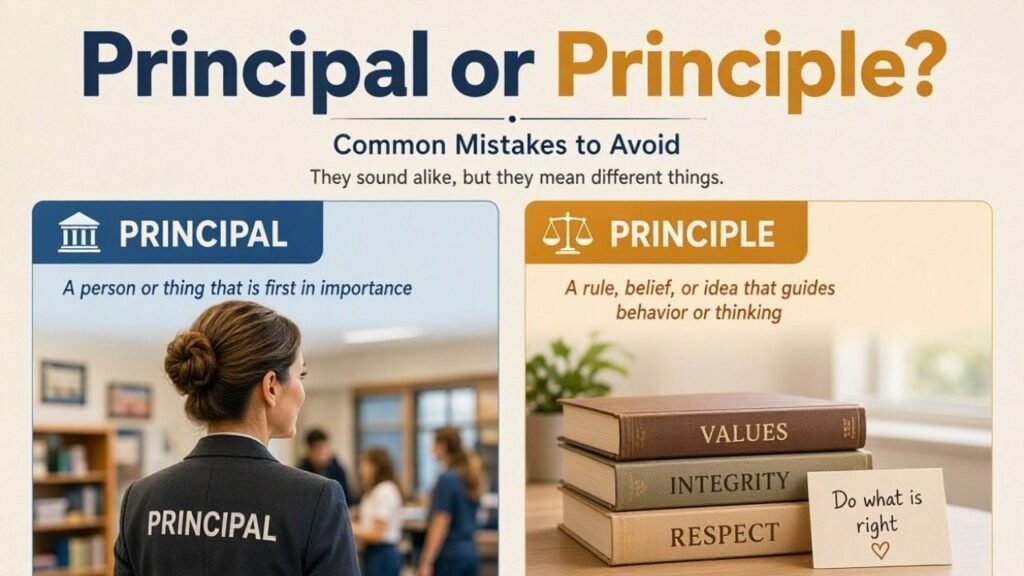
Principal or Principle: Common Mistakes to Avoid
Even confident English speakers sometimes confuse these words because their pronunciation is identical in many varieties of English. Fortunately, the errors are easy to correct once you recognize the intended meaning.
Mistake 1: Writing “Principle” for a School Leader
- Incorrect: The school principle welcomed the guests.
- Correct: The school principal welcomed the guests.
- Explanation: Principal identifies the person responsible for leading the school.
Mistake 2: Writing “Principle” for a Loan Amount
- Incorrect: I paid $200 toward the loan principle.
- Correct: I paid $200 toward the loan principal.
- Explanation: Principal refers to the amount borrowed, not a financial rule.
Mistake 3: Writing “Principal” for a Moral Belief
- Incorrect: Honesty is an important principal.
- Correct: Honesty is an important principle.
- Explanation: Honesty is a value that guides behavior.
Mistake 4: Confusing “Principal Reason” With “Guiding Principle”
- Correct: The principal reason for the change was cost.
- Correct: The guiding principle behind the change was fairness.
- Explanation: The first sentence identifies the main reason. The second describes a belief or rule.
Mistake 5: Assuming One Word Is More Correct Than the Other
- Both words are correct English words.
- Neither spelling is universally better than the other.
- Their meanings differ, so the correct choice depends on context.
- A spellchecker may not detect the error because both spellings exist.
- Always proofread the meaning, not just the spelling.
Are Principal and Principle Related?
Although principal and principle look and sound similar, their modern meanings differ. Their histories help explain why the spellings are close.
- Principal comes through French from Latin principalis, meaning first or chief.
- Principle comes through French from Latin principium, meaning beginning or foundation.
- Both are associated historically with Latin words related to beginnings or what comes first.
- Principal developed meanings connected with being chief, leading, or primary.
- Principle developed meanings connected with a foundation, basic truth, or rule.
- Their related historical roots help explain their resemblance, but they serve different purposes in modern English.
- For everyday writing, the most useful approach is still to remember their meanings and check the sentence.
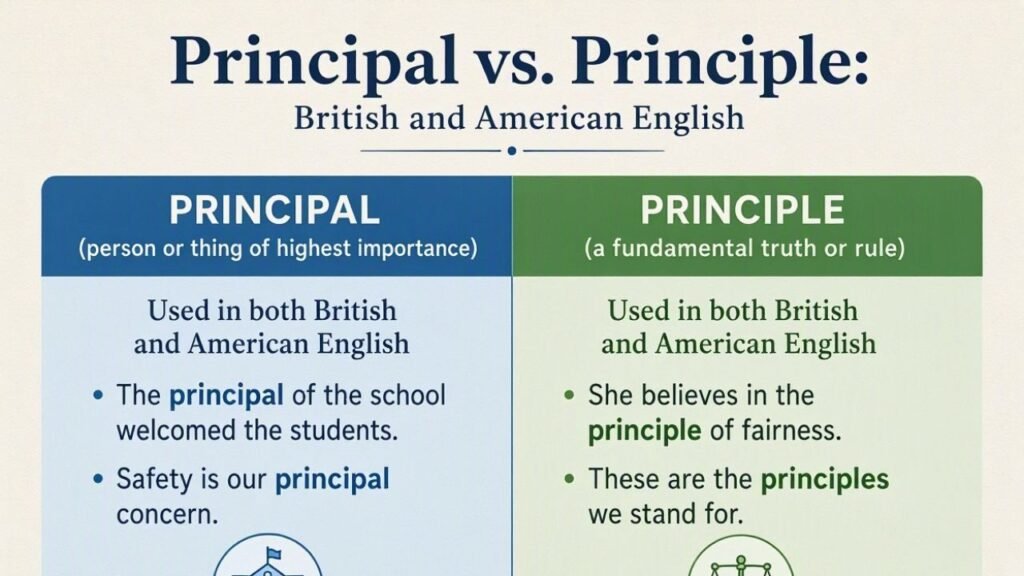
Principal vs. Principle: British and American English
The spelling distinction is essentially the same in standard British and American English.
- Principal refers to a school leader, something primary, or an original financial amount.
- Principle refers to a rule, belief, or fundamental truth.
- British writers use school principal, principal amount, and moral principle.
- American writers use the same spellings in those contexts.
- Pronunciation may vary slightly by speaker or accent, but the words are commonly homophones.
- You should not choose one spelling based on whether your audience uses British or American English.
- Instead, follow the meaning of the sentence.
Principal vs. Principle in School, Work, and Everyday Life
The easiest way to master these words is to see them in situations you encounter regularly.
In School and Education
- The principal announced the examination schedule.
- Respect is a guiding principle in our classroom.
- The principal met parents to discuss student progress.
- The school promotes the principle of equal opportunity.
- When talking about a school leader, use principal. When talking about an educational value, use principle.
In the Workplace
- The principal objective is to improve productivity.
- Integrity is a core principle of the organization.
- The principal investigator presented the research findings.
- The team follows principles of clear communication.
- Principal may describe a primary role or objective, while principle describes a standard that guides conduct.
In Personal Relationships
- She stood by her principles during the disagreement.
- Honesty is a principal reason for their strong friendship.
- He refused to compromise his principles.
- Their principal concern was the well-being of their children.
- These examples demonstrate why the meaning matters more than the sound.
In Banking and Personal Finance
- The borrower checked the remaining principal.
- The lender explained the interest rate and principal balance.
- Financial responsibility is an important principle.
- The customer made an additional principal payment.
- Remember that principal describes money, while principle describes a financial or personal rule.
Principal or Principle? A Quick Self-Test
Use the following practice questions to check whether you can select the correct word without relying on a memory trick.
- 1. The school ______ welcomed the new students.
- 2. Honesty is an important ______ in professional life.
- 3. She made an extra payment toward the loan ______.
- 4. Fairness is a guiding ______ in our organization.
- 5. The ______ reason for the delay was traffic.
- 6. The teacher explained the scientific ______.
- 7. The company follows a ______ of transparency.
- 8. The borrower checked the outstanding ______ balance.
- 9. The committee accepted the plan in ______.
- 10. The ______ investigator led the research project.
Answers and Explanations
- 1. Principal: The word refers to the school leader.
- 2. Principle: Honesty is a value that guides behavior.
- 3. Principal: The word identifies the amount of borrowed money.
- 4. Principle: Fairness is a guiding rule or standard.
- 5. Principal: The word means the main reason.
- 6. Principle: A scientific principle is a fundamental idea.
- 7. Principle: Transparency is a standard that guides the company.
- 8. Principal: The word refers to the remaining loan amount.
- 9. Principle: The expression is in principle.
- 10. Principal: The adjective describes the lead investigator.
- If you answered all ten correctly, you understand the main distinction. If you missed a few, review the meaning of each word and try again.

Practical Tips for Using These Words in SEO Content
Choosing the right spelling is important for clear writing, but it also matters when creating educational content, website copy, and search-focused articles.
- Write for meaning first: Choose the word that accurately communicates your intended message.
- Use the focus keyword naturally: Include the phrase principal or principle where it helps readers understand the topic.
- Add useful examples: Demonstrate each meaning with realistic sentences rather than repeating definitions.
- Use descriptive headings: Headings such as “Principal in Finance” and “Moral Principles” make information easier to scan.
- Avoid unnatural repetition: Do not insert both words into every paragraph simply to increase keyword frequency.
- Include related expressions: Terms such as loan principal, school principal, moral principles, and scientific principles provide relevant context.
- Answer search questions directly: Explain which spelling is correct for money, school leaders, personal beliefs, and the phrase in principle.
- Use accurate sources: Financial definitions should match reliable banking or consumer-finance guidance, while grammar explanations should agree with reputable dictionaries.
FAQs
What is the difference between principal and principle?
Principal refers to a school leader, something most important, or the original amount of a loan or investment. Principle refers to a basic rule, belief, moral value, or fundamental truth. For example, a school principal manages a school, while the principle of honesty guides someone’s behavior.
Is it principle or principal money?
Principal is the correct word when referring to money borrowed or invested. The principal is the original amount, while interest is the cost of borrowing or the return earned. For example, She made a payment toward the principal balance of her loan.
Is a person a principle or principal?
A person is a principal when the word describes a school leader or someone in a leading role. In business and law, a principal may also be a person represented by an agent. Principle refers to an idea or rule, not a person.
Do you pay principal or principle?
You pay principal when making a payment toward the amount borrowed. Depending on your loan agreement, a payment may cover both principal and interest. The word principle is incorrect when referring to the amount owed.
Which is correct: “school principal” or “school principle”?
School principal is correct when referring to the person who leads a school. For example, The school principal addressed the students. A school might teach principles such as honesty and respect, but those principles are rules or values, not the school leader.
Is principal an adjective?
Yes. principal or principle can function as an adjective meaning main, primary, or most important. For example, The principal reason for the decision was cost. Principle is a noun and does not serve the same adjectival function in standard usage.
What does “in principle” mean?
The expression in principle means generally, theoretically, or at a basic level. It often indicates agreement with an idea even when some details remain unresolved. For example, We support the proposal in principle, but we need to review its cost.
What is an easy trick to remember principal vs. principle?
Remember “the principal is your pal.” This phrase connects principal with a person, such as a school leader. For principle, think of a rule or belief. For money, remember that the loan principal is the amount borrowed.
Conclusion: Master Principal or Principle With 3 Simple Rules
Understanding principal or principle becomes much easier when you focus on meaning instead of pronunciation. Although these words sound alike, they perform different jobs in a sentence.
- Principal = person, primary, or money. Use it for a school leader, the main reason, or a loan’s original amount.
- Principle = rule, belief, or fundamental truth. Use it for moral values, scientific concepts, and guiding standards.
- Check the context. Replace the word with leader, main, amount, rule, or belief to see which meaning fits.
The next time you hesitate between principal and principle, remember the simple phrase “the principal is your pal.” Then check whether your sentence describes a person, something important, money, or a guiding idea. With these practical rules and examples, you can choose the correct spelling confidently and write clearer English.

1 thought on “7+ Powerful Principal or Principle Tips to Get It Right”