
The types of pronoun are an essential part of English grammar because they help us communicate clearly without repeating the same nouns. Pronouns replace nouns or noun phrases and make sentences shorter, smoother, and easier to understand. For example, instead of saying, “Sarah likes Sarah’s new book,” we can say, “Sarah likes her new book.”
However, English pronouns do more than replace names. They can identify people, show ownership, ask questions, connect ideas, and refer to objects. Each category has its own purpose and grammatical rules. Therefore, understanding these categories helps students, teachers, and English learners build stronger sentences.
Whether you are preparing for an examination, improving your writing, or learning basic grammar, this guide explains the different types of pronoun categories in simple language. You will discover their definitions, examples, important differences, and common mistakes. Additionally, practical tables and exercises will help you recognize them in everyday sentences.
1. What Is a Pronoun? Understanding Its Real Purpose
A types of pronoun is a word that replaces a noun or noun phrase in a sentence. It prevents unnecessary repetition and helps readers understand who or what a sentence discusses.
Consider this example:
- Without a types of pronoun: Maria is a teacher. Maria teaches English. Maria enjoys Maria’s work.
- With pronouns: Maria is a teacher. She teaches English. She enjoys her work.
The second version sounds more natural because types of pronoun replace repeated references to Maria.
Pronouns can refer to:
- People: I, you, he, she, they.
- Objects: it, this, that, these, those.
- Groups: we, they, everyone.
- Possession: mine, yours, ours, theirs.
- Questions: who, what, which.
- Relationships: who, whom, whose, which, that.
A pronoun usually refers to something already mentioned or understood from the context. The noun it refers to is called its antecedent.
12 Important Types of Pronouns in English Grammar
English grammar includes several types of pronoun categories. Different grammar books may group them differently, but the following 12 categories provide a useful overview.
| No. | Pronoun type | Main purpose | Examples |
| 1 | Personal | Refers to people or things | I, you, he |
| 2 | Possessive | Shows ownership | Mine, yours, ours |
| 3 | Reflexive | Refers back to the subject | Myself, herself |
| 4 | Intensive | Adds emphasis | Himself, ourselves |
| 5 | Demonstrative | Points to something | This, those |
| 6 | Interrogative | Asks questions | Who, what, which |
| 7 | Relative | Connects clauses | Who, whom, that |
| 8 | Indefinite | Refers generally | Someone, everyone |
| 9 | Reciprocal | Shows mutual action | Each other, one another |
| 10 | Distributive | Refers to individuals separately | Each, either, neither |
| 11 | Dummy or expletive | Fills a grammatical subject position | It, there |
| 12 | Possessive forms in extended classifications | Expresses ownership through pronoun forms | His, hers, theirs |
Important grammar note: Some classifications treat possessive types of pronoun as one category and distinguish dependent possessive determiners, such as my and your, separately. Distributive and dummy types of pronoun may also receive different treatment across grammar references. The classification depends on the grammar framework being followed.
Understanding these categories individually makes their functions easier to recognize.
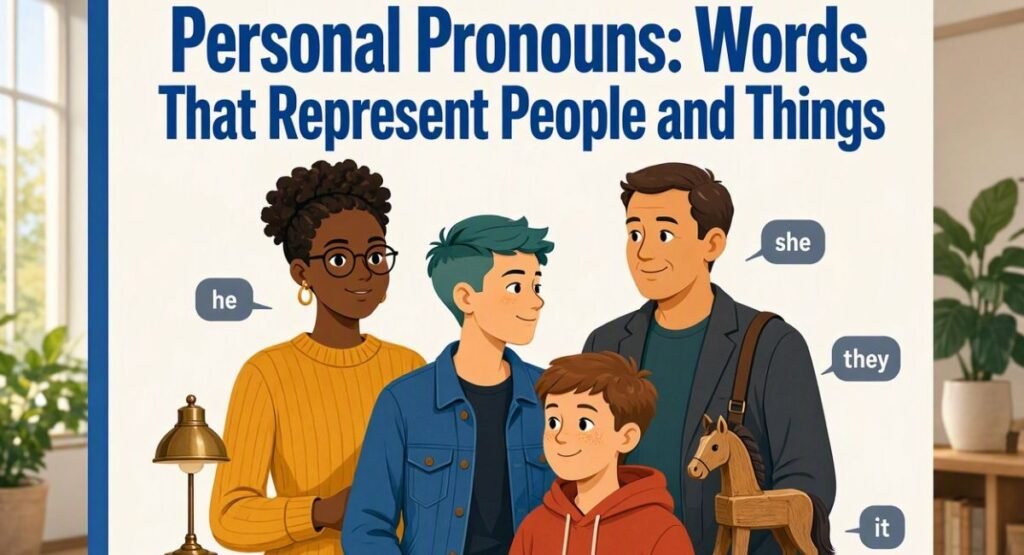
Personal Pronouns: Words That Represent People and Things
Personal types of pronoun refer to specific people, animals, objects, or groups. They are among the most frequently used words in English sentences.
Examples include:
- I
- You
- He
- She
- It
- We
- They
- Me
- Him
- Her
- Us
- Them
Personal pronouns change according to their grammatical role.
Subject Personal Pronouns
Subject types of pronoun perform the action or identify the subject of a sentence.
| Pronoun | Example |
| I | I study English. |
| You | You speak clearly. |
| He | He plays football. |
| She | She writes stories. |
| It | It looks beautiful. |
| We | We enjoy reading. |
| They | They work together. |
I refers to the speaker.- You refers to the person or people being addressed.
- He generally refers to a male person.
- She generally refers to a female person.
- It commonly refers to an object, animal, or situation.
- We includes the speaker and other people.
- They refers to multiple people or things and can also be singular.
Object Personal Pronouns
Object types of pronoun receive an action or follow a preposition.
| Pronoun | Example |
| Me | She called me. |
| You | I invited you. |
| Him | We helped him. |
| Her | They thanked her. |
| It | I found it. |
| Us | The teacher praised us. |
| Them | I spoke to them. |
Consider these differences:
- She likes him.
- He likes her.
- They invited us.
- We visited them.
Subject and object types of pronoun have different grammatical functions. Therefore, using the correct form is important for sentence accuracy.
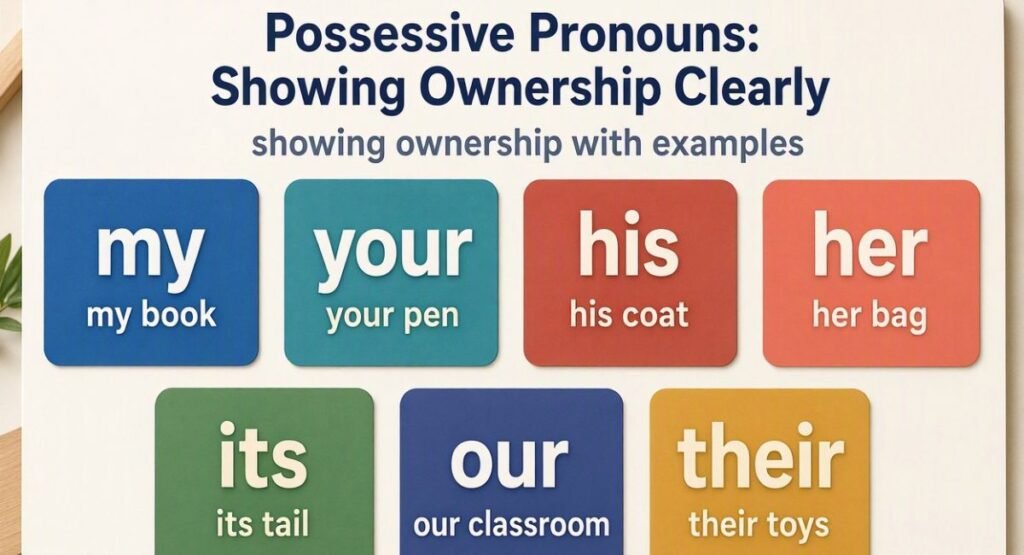
Possessive Pronouns: Showing Ownership Clearly
Possessive pronouns indicate that something belongs to someone. They help avoid repeating nouns and make sentences more concise.
The main independent possessive types of pronoun are:
- Mine
- Yours
- His
- Hers
- Ours
- Theirs
Examples:
- This notebook is mine.
- That bicycle is yours.
- The blue jacket is his.
- The red handbag is hers.
- This classroom is ours.
- Those books are theirs.
Independent and Dependent Possessive Forms
English also uses possessive determiners before nouns. These forms are often taught alongside possessive pronouns.
| Dependent possessive form | Independent possessive pronoun |
| My | Mine |
| Your | Yours |
| His | His |
| Her | Hers |
| Our | Ours |
| Their | Theirs |
Examples:
- This is my pen.
- This pen is mine.
- That is her bag.
- That bag is hers.
Remember that dependent forms appear before nouns, while independent possessive pronouns stand alone.
Reflexive Pronouns: When the Subject Receives Its Own Action
Reflexive types of pronoun refer back to the subject of a sentence. They show that the person performing an action also receives that action.
Common reflexive forms include:
| Subject | Reflexive pronoun |
| I | Myself |
| You | Yourself |
| He | Himself |
| She | Herself |
| It | Itself |
| We | Ourselves |
| You (plural) | Yourselves |
| They | Themselves |
Examples:
- I taught myself English.
- She prepared herself for the examination.
- He blamed himself for the mistake.
- We introduced ourselves.
- They enjoyed themselves at the event.
- The cat cleaned itself.
When Should You Use Reflexive Pronouns?
Use a reflexive types of pronoun when the subject and object refer to the same person or thing.
- Ali hurt himself.
- Sara looked at herself in the mirror.
- The children dressed themselves.
- I reminded myself about the meeting.
Avoid using reflexive forms when an ordinary object types of pronoun is required.
Incorrect: She invited myself.
Correct: She invited me.
Intensive Pronouns: Adding Extra Emphasis
Intensive types of pronoun emphasize a person or thing in a sentence. They have the same forms as reflexive pronouns, but their grammatical purpose is different.
Examples include:
- Myself
- Yourself
- Himself
- Herself
- Itself
- Ourselves
- Yourselves
- Themselves
Examples:
- I myself completed the assignment.
- The principal himself welcomed the visitors.
- She herself designed the invitation.
- We ourselves organized the event.
- The players themselves requested more practice.
How Are Intensive and Reflexive Pronouns Different?
The main difference is their function.
| Reflexive pronoun | Intensive pronoun |
| Acts as an essential sentence element | Adds emphasis |
| Refers back to the subject | Emphasizes the subject |
| Cannot usually be removed without changing the sentence structure | Can usually be removed without changing the basic meaning |
Compare:
- She introduced herself. (Reflexive)
- She herself introduced the guest. (Intensive)
In the first example, herself receives the action. In the second, it emphasizes who performed the action.
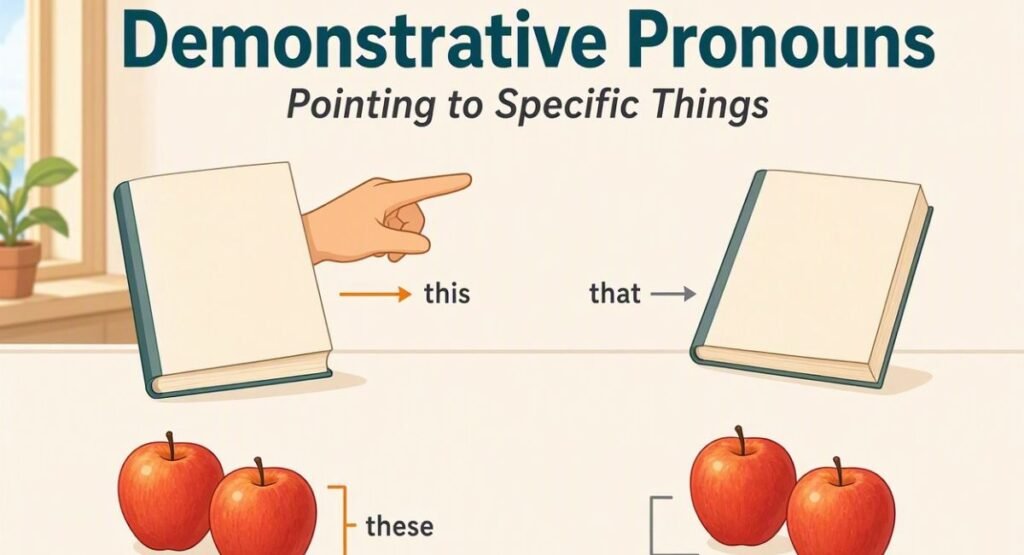
Demonstrative Pronouns: Pointing to Specific Things
Demonstrative types of pronoun identify particular people, objects, or ideas. They help speakers point out something without repeating its name.
English has four main demonstrative pronouns:
- This: Refers to one nearby person or thing.
- That: Refers to one person or thing farther away.
- These: Refers to multiple nearby people or things.
- Those: Refers to multiple people or things farther away.
Examples:
- This is my favorite book.
- That belongs to my brother.
- These are fresh flowers.
- Those look expensive.
- This is exactly what I wanted.
- Those were wonderful memories.
Singular and Plural Demonstrative Pronouns
The four forms follow simple number rules.
| Pronoun | Number | General reference |
| This | Singular | Near |
| That | Singular | Far |
| These | Plural | Near |
| Those | Plural | Far |
Use this when identifying one nearby item.- Use that when identifying one distant item.
- Use these when identifying several nearby items.
- Use those when identifying several distant items.
Demonstrative Pronouns vs. Demonstrative Adjectives
These forms can perform different grammatical functions.
A demonstrative types of pronoun stands alone. A demonstrative determiner comes before a noun.
Examples:
- This is delicious. (Pronoun)
- This cake is delicious. (Determiner)
- Those are mine. (Pronoun)
- Those shoes are mine. (Determiner)
This difference is important when identifying the grammatical role of a word.
Interrogative Pronouns: Asking Questions Naturally
Interrogative types of pronoun are words used to ask questions. They help identify people, objects, choices, and ownership.
The five commonly recognized interrogative pronouns are:
- Who
- Whom
- Whose
- Which
- What
Examples:
- Who is your English teacher?
- Whom did you invite?
- Whose is this notebook?
- Which is your favorite color?
- What happened yesterday?
Understanding the Five Interrogative Forms
| Pronoun | Purpose | Example |
| Who | Asks about a person | Who called you? |
| Whom | Asks about an object person | Whom did you meet? |
| Whose | Asks about ownership | Whose is this? |
| Which | Asks about a choice | Which do you prefer? |
| What | Asks about things or information | What is your name? |
Who vs. Whom: What Is the Difference?
Who and whom often confuse English learners. However, their grammatical functions are different.
- Who functions as a subject.
- Whom functions as an object.
Examples:
- Who opened the door?
- Whom did you call?
- Who is coming to the party?
- To whom did you send the message?
A useful trick is to replace the word with he or him.
- If he sounds correct, use who.
- If him sounds correct, use whom.
For example:
“Who called you?”
He called you. Therefore, who is correct.
“Whom did you call?”
You called him. Therefore, whom is correct.
In everyday conversation, many English speakers use who instead of whom. Nevertheless, whom remains useful in formal writing.
What vs. Which: Choosing the Correct Question Word
Both words ask questions, but their meanings differ slightly.
- Use what when the possible answers are broad or unlimited.
- Use which when choosing from a limited group.
Examples:
- What is your favorite subject?
- Which subject do you prefer, English or mathematics?
- What happened during the meeting?
- Which of these books belongs to you?
Relative Pronouns: Connecting Ideas Within Sentences
Relative types of pronoun introduce relative clauses. They connect additional information to a noun or pronoun mentioned earlier.
The main relative pronouns include:
- Who
- Whom
- Whose
- Which
- That
Examples:
- The girl who won the competition is my sister.
- The teacher whom we met was friendly.
- The student whose bag was missing found it.
- The laptop which I purchased works well.
- The movie that we watched was interesting.
How Relative Pronouns Work
Each relative types of pronoun performs a particular function.
| Relative pronoun | Common use |
| Who | Refers to people as subjects |
| Whom | Refers to people as objects |
| Whose | Shows possession |
| Which | Refers to animals or things |
| That | Refers to people, animals, or things in defining clauses |
Who vs. Which vs. That
Choosing the correct relative types of pronoun improves sentence clarity.
- The woman who teaches English is kind.
- The phone which I bought is expensive.
- The book that you recommended is helpful.
- The boy whose bicycle was stolen reported it.
In many defining clauses, that can replace which when referring to things. However, that is not normally used in non-defining relative clauses.
Defining and Non-Defining Relative Clauses
A defining relative clause provides essential information.
- The student who studies regularly usually performs well.
- The house that stands near the river is old.
A non-defining relative clause adds extra information.
- My brother, who lives in London, is visiting us.
- This laptop, which I purchased last year, still works perfectly.
Remember that non-defining relative clauses are separated by commas.
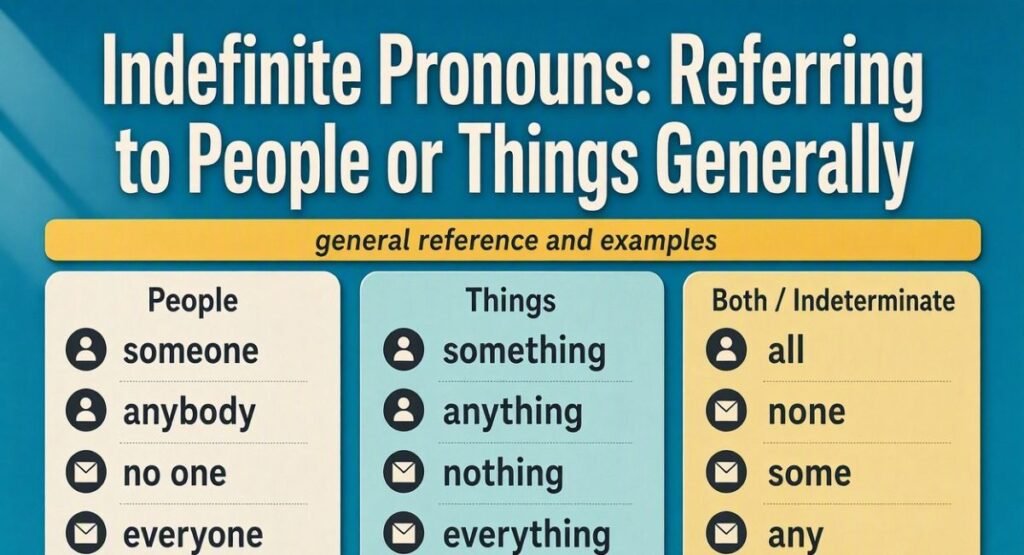
Indefinite Pronouns: Referring to People or Things Generally
Indefinite types of pronoun refer to people, objects, or quantities without identifying them specifically.
They are useful when the exact person or thing is unknown, unimportant, or not mentioned.
Common indefinite types of pronoun include:
- Someone
- Somebody
- Anyone
- Anybody
- Everyone
- Everybody
- Nobody
- No one
- Something
- Anything
- Everything
- Nothing
- Few
- Many
- Several
- All
- Some
- None
Examples:
- Someone is waiting outside.
- Everybody enjoyed the celebration.
- Nobody knows the answer.
- Everything looks beautiful.
- Several attended the meeting.
- Few understood the question.
- Nothing happened during the night.
Singular Indefinite Pronouns
Some indefinite types of pronoun generally take singular verbs.
Examples include:
- Everyone
- Everybody
- Someone
- Somebody
- Anyone
- Anybody
- Nobody
- No one
- Each
- Either
- Neither
- Something
- Everything
- Nothing
Example sentences:
- Everyone is ready.
- Somebody has called you.
- Nobody knows the truth.
- Each has received a certificate.
- Neither is available.
Plural Indefinite Pronouns
Some indefinite types of pronoun generally take plural verbs.
Examples include:
- Both
- Few
- Many
- Several
Example sentences:
- Both are talented.
- Few were present.
- Many have applied.
- Several are waiting.
Indefinite Pronouns That Can Be Singular or Plural
Certain indefinite types of pronoun change their grammatical number according to context.
These include:
- All
- Some
- Any
- None
- Most
Examples:
- Some of the water is missing.
- Some of the students are absent.
- All of the food is ready.
- All of the players are prepared.
The noun or quantity being discussed helps determine the appropriate verb.
Is Everyone Singular or Plural?
Everyone is grammatically singular, even though it refers to multiple people.
Correct: Everyone is happy.
Incorrect: Everyone are happy.
However, singular they is commonly used when referring back to an individual whose gender is unknown or irrelevant.
Example:
– Everyone should bring their notebook.
This construction is widely accepted in contemporary English.
Reciprocal Pronouns: Showing Actions Between People
Reciprocal types of pronoun express mutual actions or relationships between two or more people.
English has two main reciprocal pronouns:
- Each other
- One another
Examples:
- The friends helped each other.
- The students respected one another.
- The brothers support each other.
- The team members encouraged one another.
- The two sisters called each other.
Each Other vs. One Another
Traditional grammar sometimes distinguishes these forms by the number of people involved.
| Expression | Traditional distinction | Example |
| Each other | Two people | The twins helped each other. |
| One another | More than two people | The teammates supported one another. |
However, modern English often uses both expressions interchangeably.
When Should You Use Reciprocal Pronouns?
Use them when people perform actions mutually.
- Friends should trust each other.
- Classmates can learn from one another.
- The two companies compete with each other.
- Neighbors should respect one another.
These types of pronoun help avoid repeating the names of people involved in an action.
Distributive Pronouns: Referring to Members Separately
Distributive pronouns refer to individuals within a group separately rather than treating the group as one whole.
The most commonly discussed forms include:
- Each
- Either
- Neither
Examples:
- Each received a separate certificate.
- Either is suitable for the position.
- Neither was selected.
- Each has a different responsibility.
- Neither of the answers is correct.
Each as a Distributive Pronoun
Each refers to individual members of a group.
Examples:
- Each was given a prize.
- Each of the students received a book.
- Each has completed the assignment.
Either as a Distributive Pronoun
Either refers to one of two choices.
Examples:
- Either is acceptable.
- Either of these will work.
- Either can answer the question.
Neither as a Distributive Pronoun
Neither means not one and not the other.
Examples:
- Neither was available.
- Neither of the options is suitable.
- Neither has completed the task.
Important Agreement Rule
Each, either, and neither generally take singular verbs when functioning as pronouns.
- Each is responsible.
- Either is correct.
- Neither has arrived.
This rule helps maintain grammatical accuracy.
Dummy Pronouns: Understanding It and There
Dummy types of pronoun are words that occupy a grammatical subject position without referring to a specific person or object.
The two main examples are it and there.
Examples:
- It is raining.
- It is getting dark.
- There is a problem.
- There are three books on the table.
- It seems impossible.
- There was a loud noise outside.
The Dummy Pronoun It
The word it can act as a grammatical subject in sentences about weather, time, distance, and general situations.
Examples:
- It is cold today.
- It is seven o’clock.
- It is far from here.
- It is important to study regularly.
In these sentences, it does not refer to a particular object.
The Dummy Pronoun There
There can introduce the existence or presence of something.
Examples:
- There is a new student in class.
- There are many opportunities available.
- There was an accident yesterday.
- There have been several changes.
Is Dummy It Different From Ordinary It?
Yes. The word it can perform different functions.
- Ordinary types of pronoun: I bought a phone. It is expensive.
- Dummy pronoun: It is raining outside.
In the first example, it refers to a phone. In the second, it fills the grammatical subject position.
Grammar note: Some linguistic frameworks classify dummy it and existential there as expletives rather than ordinary types of pronoun. Their inclusion depends on the classification being used.
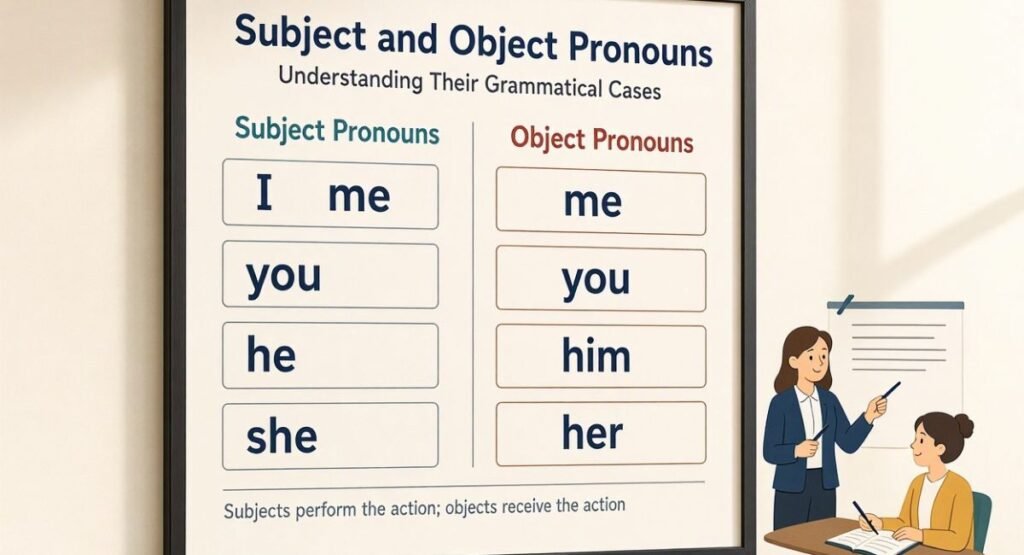
Subject and Object Pronouns: Understanding Their Grammatical Cases
Pronouns perform different functions depending on their position in a sentence.
The two major personal types of pronoun cases are subjective and objective.
Subjective Case
Subjective pronouns perform the action or act as the subject.
Examples:
- I am learning English.
- She writes excellent stories.
- He plays cricket.
- We visited the museum.
- They completed the project.
Objective Case
Objective types of pronoun receive an action or follow a preposition.
Examples:
- The teacher praised me.
- I called him.
- She invited us.
- They helped her.
- The manager spoke to them.
Subjective vs. Objective Pronouns
| Subjective form | Objective form |
| I | Me |
| You | You |
| He | Him |
| She | Her |
| It | It |
| We | Us |
| They | Them |
Common Mistake: I vs. Me
Many English learners confuse I and me, especially in compound expressions.
Incorrect: My brother and me went shopping.
Correct: My brother and I went shopping.
Incorrect: The teacher called Sarah and I.
Correct: The teacher called Sarah and me.
A useful trick is to remove the other person’s name.
- I went shopping.
- The teacher called me.
This simple test helps identify the correct pronoun.
Pronoun-Antecedent Agreement: Matching Words Correctly
An antecedent is the noun or noun phrase that a types of pronoun refers to.
Pronoun-antecedent agreement means that the types of pronoun should match its antecedent in number and, where relevant, person or gender.
Examples:
- Ahmed lost his wallet.
- Sara completed her assignment.
- The children brought their books.
- The dog wagged its tail.
Singular and Plural Agreement
A singular antecedent generally requires a singular reference, while a plural antecedent requires a plural reference.
| Antecedent | Correct reference | Example |
| The boy | He | He is reading. |
| The girl | She | She is singing. |
| The book | It | It is interesting. |
| The students | They | They are studying. |
| The children | They | They are playing. |
Avoiding Unclear Pronoun References
A types of pronoun should clearly identify the noun it replaces.
Unclear: When Ali met Ahmed, he was tired.
The reader cannot immediately tell whether Ali or Ahmed was tired.
Clear: Ali was tired when he met Ahmed.
Another example:
Unclear: Sara told Maria that her presentation was excellent.
Clear: Sara told Maria, “Your presentation was excellent.”
Clear references improve both grammar and readability.
Singular They in Modern English
English speakers commonly use singular they when a person’s gender is unknown or when someone uses they/them pronouns.
Examples:
- Someone left their umbrella.
- Every student should bring their notebook.
- Alex said they would arrive soon.
Singular they is widely accepted in contemporary English.
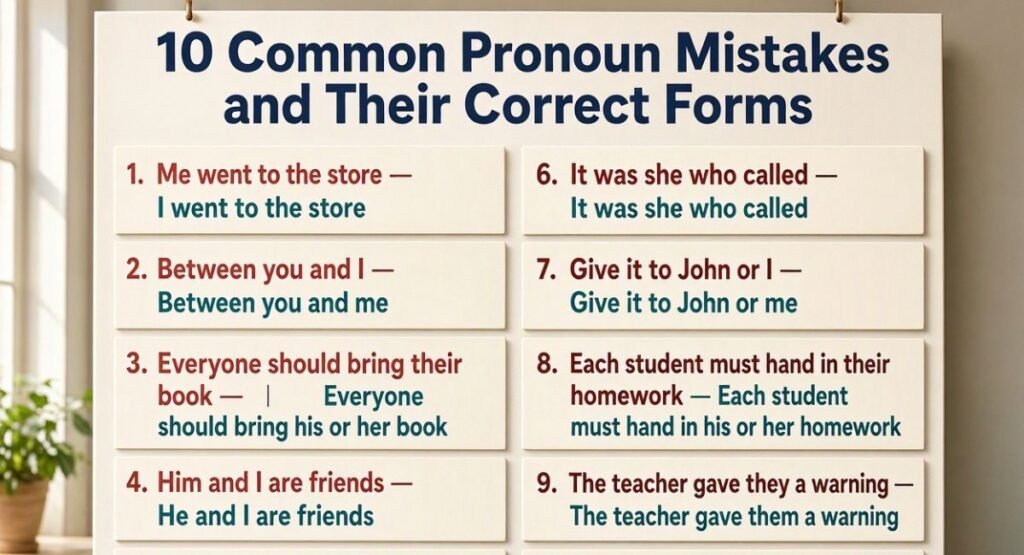
10 Common Pronoun Mistakes and Their Correct Forms
types of pronoun mistakes can make sentences confusing or grammatically incorrect. Fortunately, most errors become easier to fix once you understand the function of each form.
Here are ten common mistakes with their corrections.
1. Using Me Instead of I
- Incorrect: Me and Ali are classmates.
- Correct: Ali and I are classmates.
2. Using I Instead of Me
- Incorrect: She gave the books to Ahmed and I.
- Correct: She gave the books to Ahmed and me.
3. Confusing Your and Yours
- Incorrect: This book is your.
- Correct: This book is yours.
4. Confusing Their and There
- Incorrect: Their going to school.
- Correct: They’re going to school.
5. Using Reflexive types of pronoun Incorrectly
- Incorrect: Please contact myself.
- Correct: Please contact me.
6. Using an Incorrect Possessive Form
- Incorrect: The dog wagged it’s tail.
- Correct: The dog wagged its tail.
7. Using an Unclear types of pronoun Reference
- Incorrect: John told Peter that he had won.
- Correct: John told Peter, “You have won.”
8. Confusing Who and Whom
- Incorrect: Whom is coming today?
- Correct: Who is coming today?
9. Using an Incorrect Verb With Everyone
- Incorrect: Everyone are ready.
- Correct: Everyone is ready.
10. Confusing This and These
- Incorrect: These is my notebook.
- Correct: This is my notebook.
Learning these corrections helps improve everyday communication and formal writing.
How to Identify Different Pronouns in a Sentence
Identifying types of pronoun becomes easier when you understand what a word does in its sentence.
Instead of memorizing every word separately, examine its grammatical function.
Follow these five steps:
- Find the noun: Identify the person, place, object, or idea being discussed.
- Look for a replacement: Check whether another word refers to that noun.
- Identify its function: Determine whether it shows ownership, asks a question, or performs another role.
- Check the sentence structure: Examine whether it acts as a subject, object, or another grammatical element.
- Confirm its category: Match its function with the appropriate types of pronoun category.
Consider these examples:
| Sentence | Pronoun | Category |
| She is my sister. | She | Personal |
| This is beautiful. | This | Demonstrative |
| Who is calling? | Who | Interrogative |
| Someone is outside. | Someone | Indefinite |
| He blamed himself. | Himself | Reflexive |
| The girl who won is happy. | Who | Relative |
| This bag is mine. | Mine | Possessive |
| They helped each other. | Each other | Reciprocal |
| Each received a gift. | Each | Distributive |
| It is raining. | It | Dummy |
Can One Word Belong to Different Pronoun Categories?
Yes. A word’s grammatical category depends on its function in the sentence.
For example, consider the word that:
- That is my house. (Demonstrative pronoun)
- The house that I purchased is beautiful. (Relative pronoun)
- I know that she is honest. (Conjunction in traditional grammar)
Similarly, which can introduce a question or a relative clause.
Therefore, never identify a types of pronoun based only on its spelling. Always examine its role.
Practical Examples of Pronouns in Everyday English
Pronouns appear in conversations, emails, stories, instructions, and academic writing.
The following examples show how different categories work naturally.
Personal pronouns:
- I am learning a new language.
- She works at a hospital.
- They live near our school.
- We are preparing for examinations.
Possessive pronouns:
- This seat is mine.
- The responsibility is yours.
- That house is theirs.
- The decision was hers.
Reflexive pronouns:
- He introduced himself.
- I prepared myself for the interview.
- They completed the task themselves.
- She looked at herself in the mirror.
Intensive pronouns:
- I myself checked the document.
- The manager himself approved the request.
- We ourselves organized the event.
- She herself designed the poster.
Demonstrative pronouns:
- This is my favorite.
- Those are beautiful.
- These belong to my sister.
- That looks interesting.
Interrogative pronouns:
- Who is your best friend?
- Which is your favorite?
- What happened yesterday?
- Whose is this notebook?
Relative pronouns:
- The man who helped me was kind.
- The book that you recommended is excellent.
- The woman whose car was damaged contacted us.
- The student whom I praised received an award.
Indefinite pronouns:
- Everyone deserves respect.
- Nobody answered the question.
- Someone left a message.
- Everything is ready.
Reciprocal pronouns:
- The friends supported each other.
- The children shared their toys with one another.
Distributive pronouns:
- Each has a different opinion.
- Either is suitable.
- Neither was available.
Dummy pronouns:
- It is snowing.
- There are several options.
These examples demonstrate how pronouns make sentences shorter and more natural.
Important Pronoun Rules Every English Learner Should Know
Knowing definitions is helpful, but understanding practical grammar rules makes your writing more accurate.
Remember these essential rules:
- Rule 1: Use subject types of pronoun as sentence subjects.
- Rule 2: Use object types of pronoun after verbs and prepositions.
- Rule 3: Match pronouns with their antecedents.
- Rule 4: Use reflexive types of pronoun when the subject and object refer to the same person or thing.
- Rule 5: Use intensive pronouns only when additional emphasis is needed.
- Rule 6: Place possessive determiners before nouns.
- Rule 7: Use independent possessive pronouns without following nouns.
- Rule 8: Use demonstrative forms according to number and distance.
- Rule 9: Choose who for subjects and whom for objects in formal constructions.
- Rule 10: Make every types of pronoun reference clear.
- Rule 11: Use singular verbs with indefinite types of pronoun such as everyone and somebody.
- Rule 12: Remember that a word’s grammatical function determines its category.
Why Is Pronoun Agreement Important?
types of pronoun agreement helps readers understand who performs an action and who receives it.
Incorrect agreement can change the meaning of a sentence or make it difficult to follow.
For example:
Incorrect: The students submitted his assignments.
Correct: The students submitted their assignments.
The corrected sentence clearly matches the plural antecedent with an appropriate pronoun.
Pronouns vs. Nouns vs. Determiners: Understanding the Difference
types of pronoun, nouns, and determiners have different grammatical functions. However, learners sometimes confuse them because they appear in similar sentence positions.
| Word category | Function | Example |
| Noun | Names a person, place, thing, or idea | Sarah reads books. |
| Pronoun | Replaces or refers to a noun | She reads books. |
| Determiner | Introduces or specifies a noun | Her books are interesting. |
Noun Examples
- Ahmed plays cricket.
- The teacher explains grammar.
- Happiness is important.
- The library contains many books.
Pronoun Examples
- He plays cricket.
- She explains grammar.
- It is important.
- They contain useful information.
Determiner Examples
- My brother is studying.
- These books are interesting.
- Every student received a certificate.
- Several people attended the event.
Is My a Pronoun or a Determiner?
In traditional English grammar, my is a possessive adjective. In modern grammatical terminology, it is usually called a possessive determiner.
It does not normally stand alone before a noun.
- My phone is new. (Possessive determiner)
- The phone is mine. (Possessive pronoun)
This distinction is important for understanding possessive forms correctly.
Different Pronouns for Singular and Plural References
types of pronoun can change depending on whether they refer to one person or thing or several.
Understanding number helps prevent agreement mistakes.
| Singular | Plural |
| I | We |
| He | They |
| She | They |
| It | They |
| Me | Us |
| Him | Them |
| Her | Them |
| Myself | Ourselves |
| Yourself | Yourselves |
| Himself | Themselves |
| Herself | Themselves |
| Itself | Themselves |
Examples With Singular Pronouns
- He is a doctor.
- She enjoys reading.
- It looks expensive.
- I completed my homework.
- She introduced herself.
Examples With Plural Pronouns
- They are doctors.
- We enjoy reading.
- They look expensive.
- We completed our homework.
- They introduced themselves.
Can They Refer to One Person?
Yes. Singular they is accepted in modern English.
It can refer to an unknown person or someone who uses they/them pronouns.
Examples:
- Someone forgot their keys.
- Every applicant should submit their form.
- Jordan said they were busy.
The verb should still agree with the grammatical structure of the sentence.

What Are the Most Frequently Used Pronouns in English?
Some pronouns appear much more frequently than others in everyday communication.
Common examples include:
- I
- You
- He
- She
- It
- We
- They
- Me
- My
- Your
- This
- That
- Who
- What
- Which
- Their
- Our
These words appear frequently because speakers constantly refer to themselves, other people, objects, and ideas.
Why Are Personal Pronouns So Common?
Personal pronouns make conversations more natural.
- They prevent repeated names.
- They help identify speakers and listeners.
- They make sentences shorter.
- They improve conversational flow.
- They help connect information across sentences.
For example:
Without pronouns: Ayesha met Ayesha’s friend. Ayesha and Ayesha’s friend visited Ayesha’s school.
With pronouns: Ayesha met her friend. They visited her school.
The second version is more concise and easier to understand.
A Simple Pronoun Comparison Chart for Students
Students often need a quick reference when studying grammar. This chart brings together the main categories and their functions.
| Category | Key words | Example |
| Personal | I, you, he, she, they | She is happy. |
| Possessive | Mine, yours, hers | This is mine. |
| Reflexive | Myself, himself, themselves | He hurt himself. |
| Intensive | Myself, herself, ourselves | I myself checked it. |
| Demonstrative | This, that, these, those | Those are beautiful. |
| Interrogative | Who, whom, whose, which, what | Who called? |
| Relative | Who, whom, whose, which, that | The boy who smiled |
| Indefinite | Someone, everyone, nobody | Someone arrived. |
| Reciprocal | Each other, one another | They helped each other. |
| Distributive | Each, either, neither | Each is ready. |
| Dummy | It, there | It is raining. |
| Possessive forms | His, hers, ours, theirs | The house is theirs. |
This chart is useful for classroom revision, homework, and grammar examinations.
How to Improve Your Pronoun Skills: 7 Effective Learning Tips
Understanding grammar requires regular practice. Fortunately, you can improve your pronoun knowledge through simple daily activities.
Try these seven practical methods:
- Read English regularly: Notice how authors use pronouns in paragraphs and conversations.
- Practice sentence replacement: Replace repeated nouns with suitable pronouns.
- Learn subject and object forms: Practice the difference between I and me, and he and him.
- Write short paragraphs: Include different pronoun categories in your writing.
- Check antecedent agreement: Make sure every pronoun clearly matches its reference.
- Practice question formation: Use who, whom, whose, what, and which.
- Review your mistakes: Correct incorrect pronoun forms and understand why they were wrong.
Daily Practice Example
Start with a simple paragraph:
“Ali is a student. Ali studies English. Ali enjoys reading books.”
Now improve it:
“Ali is a student. He studies English. He enjoys reading books.”
You can also introduce additional categories:
“Ali bought a book for himself. This is his favorite subject, and he enjoys discussing it with his classmates.”
This exercise demonstrates how different pronouns work together naturally.
FAQs
1. What are the 8 types of pronouns?
The eight commonly taught pronoun categories are personal, possessive, reflexive, demonstrative, interrogative, relative, indefinite, and intensive pronouns. However, some grammar books include reciprocal, distributive, and dummy pronouns as additional categories. The exact classification depends on the grammar framework.
2. What is the rarest pronoun?
There is no officially recognized rarest pronoun in English. However, whom is less common in everyday conversation than who. Some forms, such as thou and thee, are also rare in modern everyday English because they mainly appear in historical, religious, or literary contexts.
3. What are all the different pronouns?
English has several pronoun categories, including personal, possessive, reflexive, intensive, demonstrative, interrogative, relative, indefinite, reciprocal, and distributive pronouns. Some grammar classifications also include dummy pronouns. Examples include she, mine, himself, those, who, everyone, and each other.
4. What are the most used pronouns?
Some of the most frequently used English pronouns include I, you, he, she, it, we, they, me, my, and this. Personal pronouns are especially common because people use them regularly in conversations, emails, stories, and everyday communication.
5. What is the difference between a pronoun and a noun?
A noun names a person, place, object, or idea. A pronoun replaces or refers to a noun or noun phrase. For example, Sarah is a student. She studies English. Sarah is the noun, while she is the pronoun.
6. How many types of pronouns are there in English?
There is no single universally accepted number. Many school grammar resources teach eight or nine main categories. Other classifications include reciprocal, distributive, and dummy pronouns, producing broader lists of ten, eleven, or twelve categories.
7. Can one word be used as different types of pronouns?
Yes. A word can perform different grammatical functions depending on its sentence. For example, that is a demonstrative pronoun in “That is beautiful.” It is a relative pronoun in “The book that I bought is interesting.” Therefore, context determines its grammatical role.
8. What are personal pronouns with examples?
Personal pronouns refer to specific people or things. Common examples include I, you, he, she, it, we, and they. They also have object forms, including me, him, her, us, and them. For example, “She helped me” contains two personal pronouns.
9. What is the difference between reflexive and intensive pronouns?
Both categories use the same words, such as myself, yourself, and himself. However, their functions differ. Reflexive pronouns refer back to the subject, as in “He blamed himself.” Intensive pronouns emphasize the subject, as in “He himself completed the work.”
10. Is everyone a singular or plural pronoun?
Everyone is grammatically singular and generally takes a singular verb. For example, “Everyone is welcome” is correct. However, singular they can refer to everyone in a sentence when discussing an unknown or unspecified individual.
11. What are demonstrative pronouns with examples?
Demonstrative pronouns point to specific people, objects, or ideas. The four main forms are this, that, these, and those. For example, “This is my book” and “Those are beautiful” demonstrate their use.
12. Why are pronouns important in English grammar?
Pronouns prevent unnecessary repetition and make sentences easier to understand. They also help identify people, express ownership, ask questions, and connect ideas. Learning their correct usage improves speaking, reading, writing, and overall communication.
Conclusion
Understanding the types of pronoun is essential for building accurate and meaningful English sentences. Pronouns replace nouns, prevent repetition, and make communication smoother. Each category serves a different purpose, from identifying people to expressing ownership and connecting ideas.
The main categories include personal, possessive, reflexive, intensive, demonstrative, interrogative, relative, indefinite, reciprocal, and distributive pronouns. Some grammar frameworks also recognize dummy pronouns and additional possessive distinctions.
However, memorizing definitions alone is not enough. You should also practice using pronouns in everyday sentences. Pay attention to subject and object forms, antecedent agreement, and clear references.
Start with simple examples and gradually practice more complex sentence structures. With consistent effort, you can understand pronoun rules, avoid common mistakes, and improve your English communication skills.
Meta Description: Learn the 12 types of pronouns with simple definitions, clear examples, grammar rules, and practical tips to improve your English writing.

1 thought on “12+ Types of Pronouns Complete Guide With Rules and Examples”