

Choosing between check or cheque can be confusing, especially when writing about money, banking, or payments. Both spellings are correct, but their usage depends mainly on the variety of English you follow. American English generally uses “check,” while British English and several Commonwealth countries traditionally use “cheque” for a bank payment.
However, there is an important distinction. The word “check” has several meanings beyond banking, including inspecting something, verifying information, and marking a box. Understanding these differences will help you write accurately in emails, business documents, academic assignments, and everyday conversations.
The Essential Difference Explained
The main difference between check or cheque is regional spelling when referring to a written banking instrument. Both words describe a document that instructs a bank to pay a specified amount from an account, subject to the applicable banking rules.
Here are the key facts to remember:
- Check: The standard American English spelling for a bank payment.
- Cheque: The traditional British English spelling for a bank payment.
- Check as a verb: Means to inspect, verify, examine, or confirm something.
- Check as a noun: Can mean an inspection, a verification, a mark, or a restaurant bill in American English.
- Pronunciation: Both spellings have the same standard pronunciation in their banking sense.
For example, an American customer might write, “I mailed the check or cheque yesterday.” A British writer would traditionally write, “I posted the cheque yesterday.”
Neither banking spelling is inherently more formal or more correct than the other. The appropriate choice depends on your audience and the English variety you are using.
7 Powerful Rules for Correct Usage
Use these seven practical rules to choose the appropriate spelling without second-guessing yourself.
- Rule 1: Follow American English conventions. Use “check” when writing for readers in the United States, particularly when discussing bank payments.
- Rule 2: Follow British English conventions. Use “cheque” for a bank payment when following traditional British spelling.
- Rule 3: Consider your country’s standard. Canadian, Australian, and other Commonwealth usage may follow different conventions depending on local practice and the document.
- Rule 4: Keep ordinary meanings separate. Use “check” for actions such as checking a document, checking an answer, or checking a name.
- Rule 5: Stay consistent throughout your writing. Avoid switching between American and British spellings without a clear reason.
- Rule 6: Match official terminology. Follow the spelling used by the relevant bank, institution, employer, or style guide.
- Rule 7: Remember the context. A bank payment may be a “cheque” in British English, but a restaurant bill is generally called a “bill” in British English and a “check” in American English.
These rules cover most everyday situations. When writing for an international audience, identify your intended readers first and then apply the appropriate spelling consistently.
Check vs. Cheque: A Quick Comparison Table
The following comparison highlights the differences between these spellings and their most common uses.
| Feature | Check | Cheque |
| American English bank payment | Standard spelling | Generally not standard |
| Traditional British English bank payment | Not the usual banking spelling | Standard spelling |
| Ordinary meaning of inspecting | Correct | Incorrect |
| Checking a document | Correct | Incorrect |
| Restaurant bill in American English | Common | Not used for this meaning |
| Pronunciation in banking context | Same | Same |
| Example | I deposited the check. | I deposited the cheque. |
The most important point is that “cheque” is not simply the British version of every use of “check.” British writers still use “check” when they mean to inspect, verify, or examine something.
What Does Check Mean? Discover Its 4 Main Uses
The word “check” has several meanings in modern English. Its meaning changes according to the sentence, so context matters more than spelling alone.
Check as a Bank Payment
In American English, a check or cheque is a written financial instrument that directs a bank to pay money from an account to a designated recipient, subject to the relevant requirements.
Examples include:
- I wrote a check for $250 to pay the contractor.
- The bank processed my check yesterday.
- Please deposit the check or cheque before the deadline.
- She received a refund by check.
- He signed the check or cheque before mailing it.
Although checks remain familiar in American banking, electronic transfers and digital payment methods are widely used as well.
Check as a Verb
As a verb, “check” means to examine something or make sure it is correct. This meaning applies in both American and British English.
Examples include:
- Please check the payment details before submitting the form.
- I will check or cheque the figures again this afternoon.
- She checked her email for the confirmation message.
- Always check or cheque your account balance before making a payment.
- The manager checked the report for errors.
In each sentence, “check” describes an action rather than a bank payment.
Check as a Noun
The noun “check” can describe an examination, a verification, or a mark indicating completion. In American English, it can also mean a restaurant bill.
Examples include:
- The teacher performed a quick check or cheque of the answers.
- Add a check or cheque beside every completed task.
- The restaurant server brought us the check.
- Security completed a background check.
- The technician carried out a safety check.
Consequently, replacing “check” with “cheque” in these sentences would change the meaning or create an incorrect expression.
Check as a Mark or Control
A check mark indicates that an item has been selected, reviewed, or completed. It is also commonly called a tick in British English.
Examples include:
- Place a check beside your preferred option.
- The application displays a check or cheque when a task is complete.
- Review the list and mark each finished item.
- She added a check or cheque to confirm her selection.
This meaning is unrelated to banking, so “cheque mark” is not the standard expression.
What Does Cheque Mean? Understand Its Banking Purpose
A cheque is a written payment instrument traditionally used to instruct a bank to pay a specified amount from the account holder’s funds to a named recipient or bearer, depending on the instrument and applicable law.
The spelling “cheque” is commonly associated with British English and is used in countries such as the United Kingdom. However, local banking terminology and practices can vary.
Examples of correct usage include:
- She wrote a cheque to pay her landlord.
- The company issued a cheque to its supplier.
- Please deposit the cheque into your bank account.
- The cheque was returned because of insufficient funds.
- He received a cheque as a refund.
A cheque typically includes important payment details, such as the date, payee, amount, and account holder’s signature, where required. Banks may also apply additional verification and processing requirements.
Remember that cheque-related procedures differ by country and bank. Therefore, consult your financial institution when you need information about clearing times, endorsement rules, or deposit requirements.
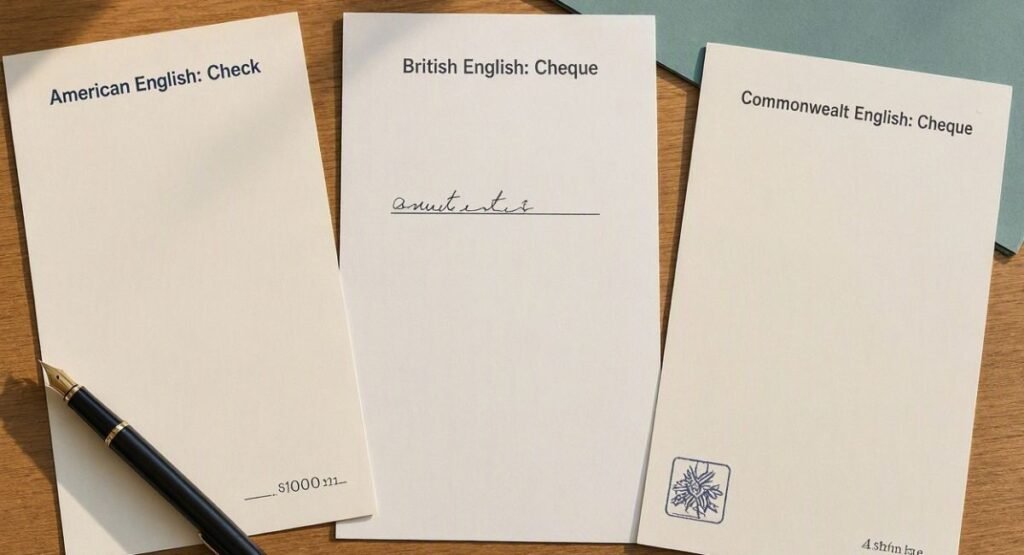
Check or Cheque in American, British, and Commonwealth English
Regional spelling conventions explain why both words exist. However, English usage is not identical across every country, and official financial terminology may differ from everyday writing.
- United States: “Check” is the standard spelling for a bank payment. Americans also use “check” for inspections and restaurant bills.
- United Kingdom: “Cheque” is traditionally used for a bank payment, while “check” remains correct for examining or verifying something.
- Canada: “Cheque” is standard in traditional Canadian English banking terminology, while “check” is used for ordinary inspection.
- Australia: “Cheque” is the traditional spelling for a bank payment, although banking practices and the popularity of paper payments have changed.
- New Zealand: “Cheque” is the traditional banking spelling, while “check” is used for verification and inspection.
- Pakistan: British English conventions are influential, so “cheque” is commonly used for bank payments. Nevertheless, follow the terminology used by your bank or organization.
- International business: Use the spelling required by the recipient, relevant institution, or organization’s style guide.
When in doubt, check the official spelling used by the financial institution or document template. This simple step can prevent inconsistencies in professional communication.
Check or Cheque Examples in Real-Life Sentences
Practical examples make the difference easier to remember. The following sentences show how each spelling works in different contexts.
Examples Using Check
- I wrote a check or cheque for the monthly rent.
- Please check whether the payment has cleared.
- The accountant checked the invoice carefully.
- She asked the waiter for the check.
- Mark each completed task with a check.
- The bank mailed the check or cheque to the customer.
- We need to check the account number before transferring money.
- He received a check from his insurance company.
- The supervisor performed a final check or cheque of the documents.
- Please check or cheque your inbox for the payment confirmation.
Examples Using Cheque
- I wrote a cheque for the monthly rent.
- The supplier received a cheque from the company.
- Please deposit the cheque before it expires under applicable rules.
- She paid the contractor by cheque.
- The bank returned the cheque for further processing.
- He signed the cheque before sending it.
- The customer requested a refund by cheque.
- The landlord accepted a cheque for the deposit.
- The company issued a cheque to its employee.
- Please confirm that the cheque details are correct.
Notice that the two spellings are interchangeable only when they refer to a bank payment and the relevant regional conventions permit the chosen form. For inspection, verification, or a restaurant bill, the word “check” has its own meaning.

Common Mistakes and How to Avoid Them
Writers often make mistakes when they confuse regional spelling with meaning. Fortunately, a few simple checks can prevent most errors.
- Mistake 1: Treating cheque as the British spelling of every check. British writers still use “check” for inspecting something. Write, “Please check or cheque the cheque details.”
- Mistake 2: Assuming one banking spelling is universally correct. Both are accepted in their respective regional contexts. Match the audience instead.
- Mistake 3: Mixing English varieties unnecessarily. Avoid using “color” in one sentence and “colour” in another unless the context calls for mixed conventions.
- Mistake 4: Using cheque to mean a restaurant bill. In British English, “bill” is the usual term for the amount owed at a restaurant.
- Mistake 5: Assuming the words sound different. Both words are normally pronounced the same way in their banking sense.
- Mistake 6: Confusing a check mark with a cheque. A mark indicating completion is a check or cheque mark in American English and commonly a tick in British English.
- Mistake 7: Ignoring institutional requirements. Banks, government departments, and businesses may specify terminology in their documents.
Before submitting important writing, read it once for meaning and again for regional consistency. This is especially helpful when preparing reports, invoices, payment instructions, and formal emails.
Checkbook or Chequebook? Learn the Correct Related Words
The spelling difference also appears in words associated with traditional banking. Choosing the correct form helps maintain consistency in American and British English.
| American English | British English | Meaning |
| Check | Cheque | A written bank payment |
| Checkbook | Chequebook | A book of checks or cheques |
| Check number | Cheque number | The identifying number of a payment instrument |
| Check payment | Cheque payment | Payment made using a check or cheque |
| Check register | Cheque record or cheque register | A record of cheque transactions; exact terminology varies |
| Check account details | Check account details | Verify or inspect account information |
The last example is particularly important. “Check account details” describes an action, so the spelling remains “check” in both American and British English.
Similarly, “checklist,” “checkpoint,” “check-in,” and “double-check” use “check” regardless of whether the writer follows American or British spelling.
Is a Bank Cheque Different From a Money Check?
People sometimes use expressions such as “money check” when they mean a check or cheque used to pay someone. However, “money check” is not the usual general term for this payment instrument.
- Personal check or cheque: Written by an account holder to make a payment from their account.
- Cashier’s check: A payment instrument issued by a bank, subject to its rules and applicable law.
- Certified check: A check for which a bank verifies or certifies certain payment conditions, depending on the jurisdiction.
- Traveler’s check: A prepaid payment instrument historically used by travelers.
- Bank draft: A bank-issued payment instrument with features that depend on local banking rules.
These instruments are not identical. Their availability, guarantees, and legal treatment vary by country and financial institution.
In British and Commonwealth contexts, some related instruments may also have different names. Therefore, use the precise banking term rather than assuming that every payment instrument is a standard cheque.
Why Do Check and Cheque Have Different Spellings?
The difference developed through the history of English spelling and banking terminology. The word “check” has a long history, while “cheque” became established as a spelling for the banking instrument in British English.
Over time, American English retained “check” for banking, while British English generally adopted “cheque” for that specific meaning. Both varieties continued using “check” for the broader meanings of inspection, verification, and control.
Today, these differences are examples of regional English spelling rather than differences in pronunciation. Similar variations appear in words such as “center” and “centre,” or “organize” and “organise.”
Understanding these patterns helps writers recognize that English has several accepted standards. The goal is not to declare one variety superior, but to use the form appropriate to the reader and context.
How to Choose the Right Spelling for Professional Writing
Choosing between check or cheque becomes easier when you establish a consistent writing standard. This matters particularly in business correspondence, accounting records, banking forms, and customer communications.
- For American clients: Use “check,” “checkbook,” and other standard American forms.
- For British clients: Use “cheque” for a bank payment and “check” when referring to verification.
- For Canadian or Australian clients: Follow the spelling used by the client, institution, or applicable style guide.
- For formal financial documents: Preserve the exact terminology used in the official form or banking instructions.
- For websites and blogs: Choose the English variety that matches your primary audience, then apply it consistently.
- For international communication: Avoid unnecessary regional expressions, and clarify the payment method when ambiguity could cause confusion.
For example, an American business might write, “Your refund will be sent by check.” A British business might write, “Your refund will be sent by cheque.”
Both sentences are correct for their intended audiences. Neither spelling makes the message more professional by itself; accuracy and consistency matter more.
Check or Cheque: 5 Simple Ways to Remember the Difference
Remembering the correct spelling does not require memorizing complicated grammar rules. Instead, connect each word with its meaning and the audience you are writing for.
- Memory trick 1: America uses check. Remember the familiar American spelling when writing about a bank payment in the United States.
- Memory trick 2: Britain traditionally uses cheque. The extra letters help distinguish the traditional British banking spelling.
- Memory trick 3: Checking always uses check. You check a message, check a calculation, and check a document in both varieties of English.
- Memory trick 4: A restaurant bill depends on location. Americans commonly ask for the check, while British customers usually ask for the bill.
- Memory trick 5: Consistency matters. Once you choose American or British English, apply that standard throughout your document.
These reminders are particularly useful for students, English learners, bloggers, and professionals who regularly communicate with international audiences.
Check or Cheque in Emails, Reports, and Business Documents
The right spelling makes professional communication clearer. However, the choice should reflect your audience rather than a personal preference for one spelling.
- Payment reminder: “Please confirm whether you received the check.” Use this wording for an American recipient.
- British payment reminder: “Please confirm whether you received the cheque.” Use this version when following British conventions.
- Verification request: “Please check the invoice number before making the payment.” The verb remains “check” in both varieties.
- Accounting report: “The cheque was recorded in the company’s payment register.” This follows traditional British terminology.
- Customer service email: “We will check your payment status and contact you shortly.” Here, “check” describes an action.
- Formal financial notice: Follow the exact spelling and terminology required by the issuing bank or organization.
- International invoice: Clearly state the payment method, currency, recipient, and applicable instructions to prevent misunderstandings.
For business writers, correct terminology is only one part of effective communication. Clear instructions, accurate figures, and consistent formatting also help readers understand payment information.
Check or Cheque: What Modern Banking Means for Writers
Although both spellings remain important, banking habits have changed. Many customers now use electronic transfers, mobile banking applications, debit cards, and online payment services instead of paper checks or cheques.
- Paper checks and cheques: These remain available in certain markets, although usage varies by country and institution.
- Electronic bank transfers: These move money electronically between accounts without requiring a paper cheque.
- Debit card payments: These generally allow customers to pay merchants directly through a payment network.
- Mobile banking: Banking applications let customers review transactions, manage accounts, and initiate supported payments.
- Digital payment records: Electronic statements and transaction confirmations often replace paper records for everyday purposes.
These developments do not eliminate the spelling difference. Instead, they make it even more important to distinguish the payment instrument from the action of checking information.
For example, “I checked the electronic transfer” means that someone verified its details. It does not mean that they used a paper check or cheque.
FAQs
1. Is it a bank cheque or check?
Both spellings can be correct. American English uses “bank check,” while traditional British English uses “bank cheque.” In either case, the term refers to a banking payment instrument. Choose the spelling that matches the country, institution, and document you are writing for.
2. Is it a money check or cheque?
“Check” or “cheque” is the usual term for a written banking payment. The correct spelling depends on regional English conventions. “Money check” is not the standard general name for this instrument, so use “check” in American English or “cheque” in traditional British English.
3. What is the difference between check and cheque?
When referring to a bank payment, “check” is standard in American English, while “cheque” is traditional in British English. However, “check” also means to inspect, verify, or examine something. “Cheque” does not replace these broader meanings.
4. What are four types of cheques?
Four commonly discussed types are personal cheques, cashier’s checks, certified checks, and traveller’s cheques. Their names and features vary by country. A cashier’s check is generally issued by a bank, while a personal cheque is written by an account holder. Availability and guarantees depend on local rules.
5. Is cheque British or American English?
“Cheque” is traditionally associated with British English and is also used in several Commonwealth countries. American English generally uses “check” for the same banking instrument. However, American writers also use “check” to mean inspect, verify, or examine something.
6. Is check correct in British English?
Yes. British English uses “check” as a verb meaning to inspect or verify something. For example, “Please check the account details” is correct. British English traditionally uses “cheque” only for the banking payment instrument, not for every meaning of “check.”
7. Are check and cheque pronounced differently?
No. In their banking sense, “check” and “cheque” are normally pronounced the same way. Their difference is primarily spelling, not pronunciation. Therefore, listeners generally rely on context to understand whether someone means a bank payment or another use of “check.”
8. Should I use check or cheque in formal writing?
Use “check” for a bank payment when writing in American English. Use “cheque” when following traditional British English conventions. For other meanings, such as inspecting documents or verifying information, use “check” in both varieties. Always follow any specific institutional style guide.
Conclusion: Check or Cheque Made Simple
Choosing between check or cheque becomes straightforward once you understand regional spelling conventions. American English uses “check” for bank payments, while British English traditionally uses “cheque.” Both spellings are correct in their respective contexts, so neither is universally better than the other.
Remember that “check” also means to inspect, verify, or examine something in both American and British English. Therefore, use the intended meaning and your audience’s preferred English variety to guide your decision.
For accurate writing, follow these three practical steps:
- Choose the spelling that matches your audience.
- Use “check” for actions involving inspection or verification.
- Keep spelling consistent throughout your article, email, or business document.
With these simple rules, you can use check or cheque confidently in everyday communication, professional writing, and banking-related content.
Meta Description: Learn check or cheque differences, meanings, regional spelling rules, and examples to choose the correct word for banking and everyday English

1 thought on “7+ Powerful Check or Cheque Rules to Choose the Right Spelling”