

If you want to know how to spell gopher, the correct spelling depends on what you mean. Gopher usually refers to a burrowing animal, while gofer describes someone who runs errands or performs routine tasks for another person.
Although these words sound alike, they have different meanings and uses. Therefore, choosing the right spelling helps you communicate clearly. Whether you are writing an email, completing a school assignment, or creating online content, this guide explains the differences with simple definitions and practical examples.
What Is the Correct Way to Spell Gopher?
- Gopher is the standard spelling when referring to the small, burrowing mammal known for digging underground tunnels.
- Gofer is a separate, accepted English word used for a person who runs errands or carries out simple tasks for someone else.
- Both spellings are correct, but they are not interchangeable in every sentence.
- If you are writing about an animal, use gopher. However, if you mean an office helper who fetches supplies or completes errands, gofer is usually the better choice.
- Remember this simple rule: a gopher digs tunnels, while a gofer goes to do tasks.
- The phrase spell gopher often appears in spelling searches because people hear the same pronunciation and wonder which letters to use.
- Before selecting a spelling, identify the meaning you want to communicate. This quick step prevents confusion in professional writing, schoolwork, and everyday messages.
Spell Gopher vs. Gofer: 7 Simple Rules to Remember
- Rule 1: Use gopher for the animal. If your sentence describes a rodent digging holes, eating roots, or living underground, write gopher.
- Rule 2: Use gofer for an errand runner. When someone picks up coffee, delivers documents, or completes small jobs for another person, gofer is generally appropriate.
- Rule 3: Check the surrounding words. Words such as burrow, tunnel, soil, and roots suggest the animal. Words such as office, errands, assistant, and fetch may indicate the workplace meaning.
- Rule 4: Consider your audience. Readers unfamiliar with the slang meaning may need a short explanation when you use gofer.
- Rule 5: Do not assume one spelling is always wrong. Both words are recognized in English dictionaries, although their meanings differ.
- Rule 6: Choose a precise alternative for formal writing. In professional documents, administrative assistant, office assistant, or support staff member may communicate your meaning more respectfully.
- Rule 7: Proofread for context. A spellchecker might accept both spellings, so you must check whether the selected word fits the sentence.
What Does Gopher Mean in English?
- A gopher is a small, burrowing rodent that spends much of its life underground.
- These animals are known for digging extensive tunnel systems and creating mounds of loose soil near their entrances.
- Many species belong to the pocket gopher family, known scientifically as Geomyidae.
- Gophers use their strong claws and front teeth to dig and gather plant material.
- Depending on the species and habitat, they may eat roots, bulbs, tubers, and other vegetation.
- Gardeners sometimes notice gopher activity when plants suddenly wilt or underground roots become damaged.
- The word can also appear in names, expressions, and technical contexts. Therefore, the surrounding sentence still matters.
Common Characteristics of a Gopher
- Appearance: Many gophers have compact bodies, small eyes, short ears, and strong front feet adapted for digging.
- Habitat: They commonly live in underground burrows in grasslands, agricultural areas, and other suitable environments.
- Diet: Their food often includes roots, tubers, bulbs, and other plant material.
- Behavior: Gophers spend substantial time underground and may push soil out through tunnel openings.
- Garden impact: Their digging can disturb lawns, damage plants, and expose mounds of fresh soil.
- Identification: Soil mounds can indicate activity, but other burrowing animals may produce similar signs.
Examples of Gopher Used Correctly
- The gopher dug another tunnel beneath the vegetable garden.
- We found fresh soil mounds near the fence after the rain.
- A gopher damaged the roots of several young plants.
- The wildlife guide explained how gophers live underground.
- She searched online to learn how to spell gopher correctly.
- The farmer noticed signs of gopher activity near the field.
- A gopher can move through its underground tunnel system with surprising efficiency.
What Does Gofer Mean in Everyday Language?
- A gofer is a person who performs errands or routine tasks for another person, often at work.
- The term is informal and is commonly associated with workplace slang.
- A gofer might collect documents, bring supplies, deliver messages, or handle small requests from a manager or colleague.
- The word is connected with the expression “go for,” referring to someone who goes to get something or complete a task.
- For example, a person might say, “Ask the gofer to bring the files upstairs.”
- Although the word is understandable in casual conversation, it can sound dismissive when used to describe an employee.
- In professional communication, a specific job title often sounds clearer and more respectful.
Typical Tasks Associated With a Gofer
- Collecting supplies: Picking up stationery, printing paper, or other office materials.
- Running errands: Visiting a nearby shop or delivering an item to another department.
- Delivering documents: Taking paperwork between offices or bringing files to a meeting.
- Fetching refreshments: Getting coffee, water, or snacks for a team.
- Supporting production: Helping a film crew, television team, or event staff with basic requests.
- Handling simple requests: Completing small tasks that allow other team members to focus on their main responsibilities.
- Providing general assistance: Helping with duties that do not require specialized training.
Examples of Gofer Used Correctly
- The new intern was treated like a gofer rather than a member of the project team.
- He worked as a gofer on a film set before becoming a production assistant.
- The manager asked the gofer to collect the meeting documents.
- She joked that she had become the office gofer because everyone asked her to fetch things.
- The company replaced the informal term gofer with the job title administrative assistant.
- He did not want to be known as the team’s gofer because his responsibilities were much broader.
- In casual conversation, the word gofer can describe someone who regularly handles errands.
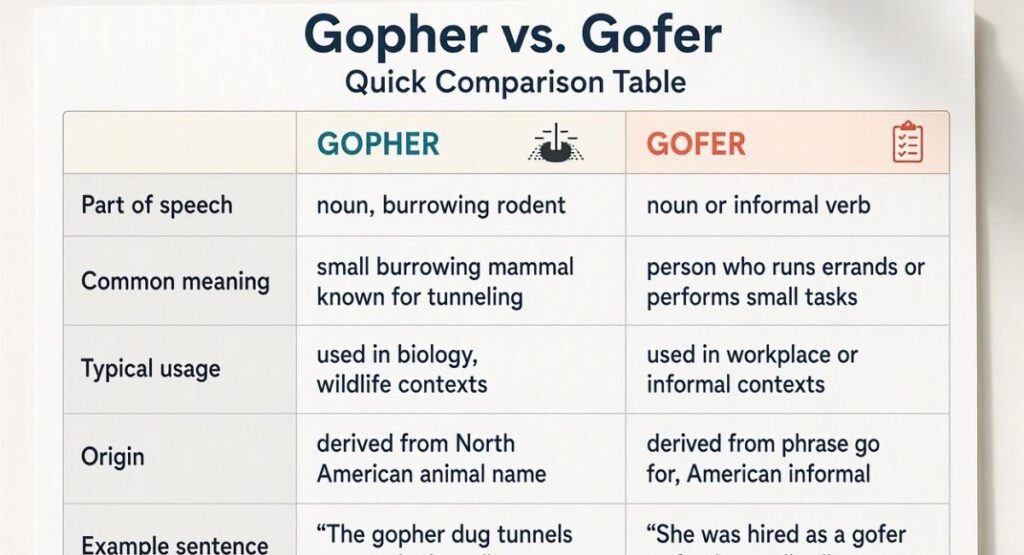
Gopher vs. Gofer: Quick Comparison Table
The easiest way to distinguish these words is to compare their meanings, contexts, and typical examples.
| Feature | Gopher | Gofer |
| Main meaning | A burrowing rodent | A person who runs errands |
| Part of speech | Noun | Noun |
| Typical context | Wildlife, gardening, nature | Workplace, entertainment, everyday slang |
| Pronunciation | Usually the same as gofer | Usually the same as gopher |
| Example | A gopher dug beneath the lawn. | The gofer brought the files. |
| Related words | Rodent, burrow, tunnel | Errand runner, helper, assistant |
| Formality | Standard word | Informal term |
| Best use | Animal descriptions | Casual descriptions of task-related work |
Both spellings are legitimate English words.- Their meanings, rather than their pronunciation, determine which spelling fits.
- In most contexts, the surrounding sentence makes the intended meaning clear.
- If you are unsure, replace the word temporarily with its definition. If the sentence still makes sense, you have probably selected the correct spelling.
Why Are Gopher and Gofer So Often Confused?
- The main reason is pronunciation. In common English usage, gopher and gofer sound alike or nearly alike.
- When people hear a word rather than see it written, they cannot always determine which spelling the speaker intended.
- Both words are nouns, so their grammatical roles do not provide an obvious clue.
- Their meanings are also unrelated enough that a reader may not immediately connect them.
- Search engines may show results for both words when someone enters a spelling question.
- In addition, people who rarely encounter the workplace slang may assume that gopher is the only valid spelling.
- Conversely, readers who often hear gofer at work may mistakenly use it when writing about the animal.
Common Reasons for Spelling Errors
- Sound-based spelling: Writing the first version that comes to mind after hearing the word.
- Limited vocabulary exposure: Not knowing that gofer has a separate meaning.
- Incorrect autocorrection: Accepting a suggested spelling without checking the sentence.
- Unclear context: Using the word in a short sentence that does not reveal whether it refers to an animal or a person.
- Rushed proofreading: Checking grammar but overlooking word choice.
- Overreliance on spellcheck: Assuming that a recognized spelling must also be the correct spelling for the intended meaning.
How to Choose the Right Spelling in Real Situations
- When discussing wildlife: Use gopher for the animal, its habitat, its behavior, and its effect on plants.
- When discussing workplace errands: Use gofer if you deliberately want an informal term for someone who performs routine tasks.
- When writing a school assignment: Use gopher for the animal and explain gofer if the assignment concerns slang or vocabulary.
- When writing a business email: Prefer a precise professional title over gofer unless you are quoting someone or discussing the slang term itself.
- When writing a news article: Select the spelling that matches the facts and provide context if readers could misunderstand it.
- When creating website content: Use the correct word naturally, and address both spellings if the page answers a spelling or vocabulary question.
- When editing someone else’s work: Check the intended meaning before correcting the spelling. A change from gofer to gopher could introduce an error rather than fix one.
Choosing a Word for Professional Communication
- Use administrative assistant for someone who coordinates office tasks and provides administrative support.
- Use office assistant for a role involving general office duties.
- Use production assistant when describing an appropriate entry-level role on a film or television production.
- Use runner when that term accurately describes the duties in a production, event, or workplace setting.
- Use personal assistant for someone who manages an individual’s schedule, correspondence, or other responsibilities.
- Use support staff member when a broad, neutral description is more appropriate.
- Use gofer only when its informal tone fits the context.
Where Did the Words Gopher and Gofer Come From?
- The two words have different histories, which helps explain why their spellings are not interchangeable.
- Gopher has been used in English for the burrowing animal for centuries. Its precise historical development is more complicated than a simple spelling rule.
- Gofer developed from the expression “go for,” describing a person who goes to obtain something or carry out a task.
- The informal workplace meaning became particularly familiar in modern English, including descriptions of people who run errands in offices and entertainment settings.
- Although their sounds overlap, the words developed around different meanings.
- Understanding this distinction is more useful than memorizing the letters alone.
The History of Gopher
- The word gopher is associated with animals known for burrowing underground.
- In North American English, it commonly refers to pocket gophers and, depending on the region, other animals called gophers.
- The term appears in wildlife guides, gardening resources, agricultural discussions, and educational materials.
- The exact animal identified by the word may vary by location and context.
- The word has also appeared in proper names and specialized expressions, so not every use refers directly to a wild animal.
- For ordinary writing about the rodent, however, gopher is the standard spelling.
The History of Gofer
- Gofer developed as an informal term based on the phrase “go for.”
- The phrase suggests a person sent to fetch something or complete an errand.
- Over time, the single-word spelling became established in informal English.
- The term is especially familiar in descriptions of office routines and behind-the-scenes work.
- It may convey humor, informality, or a sense that a person’s duties are repetitive.
- Because it can sound belittling, writers should consider whether a more specific title better represents the person’s role.
Is Gopher a Formal or Informal Word?
- Gopher is a standard noun when it refers to the animal. It is suitable for academic, educational, journalistic, and general writing.
- Gofer is also an established word, but its use to describe a person is generally informal.
- A dictionary may recognize a word without making it the best choice for every situation.
- Therefore, the right decision depends on your subject, audience, and desired tone.
- When describing wildlife, gopher is perfectly appropriate in formal writing.
- When describing an employee, choose gofer only if the casual or critical tone is intentional.
- In professional documents, an accurate job title will usually provide more information and avoid unintended disrespect.
Formal Writing Examples
- Correct: The gopher’s burrowing behavior can affect soil structure.
- Correct: Researchers observed gopher activity in the study area.
- Correct: The employee worked as a production assistant during filming.
- Less formal: The gofer collected the equipment before the meeting.
- More professional: The office assistant collected the equipment before the meeting.
- Less respectful in some contexts: The manager treated the new employee like a gofer.
- More neutral: The manager assigned the new employee several routine errands.

Spelling Gopher Correctly in Emails, Essays, and Online Content
- Emails: If you mean an animal, write gopher. If you mean an employee, consider whether assistant or runner is more suitable.
- School essays: Define unfamiliar terms the first time you use them. This is especially helpful when comparing homophones or similar-sounding words.
- Business reports: Avoid casual slang unless it is relevant to the subject. Specific job titles improve clarity.
- Blog posts: Explain the difference early when your topic concerns spelling, vocabulary, wildlife, or workplace language.
- Social media: Either word can appear in a casual post, but readers should be able to understand your intended meaning.
- News writing: Use precise language and avoid a potentially dismissive label when a person’s actual position is known.
- Educational materials: Include examples that demonstrate both spellings so learners can connect each word to its meaning.
A Simple Proofreading Checklist
- Identify whether the sentence refers to an animal or a person.
- Check whether the surrounding words support the intended meaning.
- Replace the word with burrowing rodent or person who runs errands to test the sentence.
- Review any autocorrect changes before accepting them.
- Check a reliable dictionary if the usage remains unclear.
- Read the sentence aloud and consider how a reader might interpret it.
- Make sure your wording fits the tone of the document.
Helpful Synonyms and Related Words
Choosing a synonym can make your writing more precise, especially when the original word might confuse readers.
Alternatives for Gopher
- Burrowing rodent: A broad descriptive term for an animal that digs underground.
- Pocket gopher: A more specific name for a member of the pocket gopher family.
- Rodent: A general biological category that includes gophers, mice, and many other animals.
- Burrower: A descriptive term for an animal that digs or lives in burrows.
- Underground-dwelling animal: A broad phrase suitable when the exact species is unknown.
These alternatives are not always exact substitutes. For scientific or wildlife writing, identify the correct species whenever possible.
Alternatives for Gofer
- Errand runner: A clear phrase for someone who carries out errands.
- Assistant: A broad term for someone who helps another person with tasks.
- Office assistant: A useful title for general administrative or office support.
- Runner: A role-specific term in settings such as film production and events.
- Administrative assistant: A more formal title for someone who performs administrative duties.
- Helper: A general word for someone providing assistance.
- Support worker: A broader title whose suitability depends on the actual job.
Use these alternatives according to the person’s real responsibilities. A synonym should clarify the meaning rather than exaggerate or misrepresent a role.

Practical Memory Tricks to Avoid Confusion
- Gopher has “ph.” Remember the familiar spelling of the animal, which has the letters ph in the middle.
- Gofer connects with “go for.” Imagine someone going to fetch a folder or a cup of coffee.
- Picture the situation. A gopher is underground; a gofer is going somewhere to complete an errand.
- Use a complete sentence. The sentence “The gopher dug a tunnel” clearly points to the animal.
- Learn the pair together. Studying both spellings at once helps you remember that each has a distinct meaning.
- Practice with contrasting examples. Write one sentence about wildlife and another about an office task.
- Avoid memorizing only the sound. Since pronunciation alone may not distinguish the words, focus on meaning.
Quick Practice: Choose the Correct Word
- The ___ made a mound of soil beside the garden. Answer: gopher.
- The office ___ delivered the documents. Answer: gofer, if the informal term is intended.
- A ___ can damage underground plant roots. Answer: gopher.
- The film crew asked the ___ to collect supplies. Answer: gofer, if describing an informal errand-running role.
- She searched for the correct way to spell ___ in her wildlife report. Answer: gopher.
Search Intent: Why People Look Up “Spell Gopher”
- Spelling clarification: Readers want to know which letters belong in the word.
- Meaning comparison: They want to understand the difference between gopher and gofer.
- Sentence correction: They may be editing an email, essay, report, or social media post.
- Vocabulary learning: Students and English learners may need definitions and examples.
- Animal identification: Gardeners and homeowners may search for information about gophers.
- Workplace terminology: Readers may have encountered gofer in conversation or in a film-related context.
- Dictionary confirmation: Some readers simply want to verify whether both spellings are accepted.
A helpful spelling article should answer the central question quickly, then provide definitions, examples, and practical guidance. This approach serves readers who need a fast answer as well as those who want a deeper explanation.

Reliable Resources for Checking Spelling and Meaning
- Merriam-Webster Dictionary: Check the entries for gopher and gofer to confirm their definitions and usage.
- Cambridge Dictionary: Consult its English vocabulary resources when you need a clear definition and example sentences.
- Oxford Learner’s Dictionaries: Use learner-focused definitions to understand meaning, grammar, and practical usage.
- University writing centers: Consult academic writing guides for advice about word choice, clarity, and professional tone.
- Wildlife or university extension services: Use relevant local resources when you need accurate information about gopher species and their behavior.
When writing educational or SEO content, consult authoritative references rather than relying solely on search snippets. A dictionary can verify spelling, while a wildlife authority is better suited to biological details.
FAQs
1. Is it gopher or gofer?
Both spellings are correct, but they have different meanings. Gopher usually refers to a burrowing animal, while gofer describes a person who runs errands or performs routine tasks.
2. What is another name for a gopher?
A gopher may be described as a burrowing rodent. For greater precision, pocket gopher refers to members of the pocket gopher family. The best alternative depends on the animal and the context.
3. What does “gofer” mean?
A gofer is someone who runs errands or completes simple tasks for another person. The term is informal and may describe someone who fetches supplies, delivers documents, or helps with routine requests.
4. How do you spell gopher correctly?
Spell the animal’s name g-o-p-h-e-r. If you mean an informal errand runner, use g-o-f-e-r instead.
5. Are gopher and gofer pronounced the same?
In common English usage, they are usually pronounced alike. This similarity explains why people often confuse their spelling, even though the words have different meanings.
6. Can gopher refer to a person?
Yes, gopher can occasionally be used informally for an errand runner, influenced by the similar-sounding gofer. However, gofer is the clearer and more conventional spelling for that meaning.
7. Is gofer appropriate in professional writing?
It depends on the context. The term can sound informal or belittling, so titles such as office assistant, administrative assistant, or production assistant are often more suitable.
8. What is the easiest way to remember the difference?
Remember that a gopher digs underground, while a gofer goes to complete an errand. Connecting each spelling with an action makes the distinction easier to recall.
Conclusion
Knowing how to spell gopher correctly comes down to understanding the meaning of your sentence. Use gopher when referring to the burrowing animal, and choose gofer when describing someone who runs errands. Although both words usually sound alike, their spelling and meaning are different.
For clearer writing, consider the context before choosing either word. Use examples, consult a reliable dictionary when necessary, and select a professional job title when informal language could sound disrespectful. With these simple rules, you can spell gopher confidently and avoid one of English’s easily confused word pairs.
Meta Description: Learn how to spell gopher correctly, understand gopher vs. gofer meanings, explore examples, and avoid common spelling mistakes.
